Begleiten Sie uns auf eine literarische Weltreise!
Buch zum Bücherregal hinzufügen
Grey
Einen neuen Kommentar schreiben Default profile 50px
Grey
Jetzt das ganze Buch im Abo oder die ersten Seiten gratis lesen!
All characters reduced
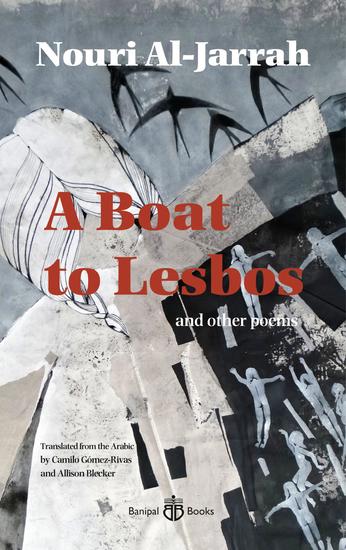
A Boat to Lesbos - and other poems - cover

A Boat to Lesbos - and other poems

Nouri al-Jarrah

Übersetzer Camilo Gomez-Rivas, Allison Blecker

Verlag: Banipal Books

  • 0
  • 0
  • 0

Beschreibung

A Boat to Lesbos is a powerful and compelling epic poem, written while thousands of Syrian refugees were enduring frightening journeys across the Mediterranean before arriving on the small island. Set out like a Greek tragedy, it is passionate and dramatic witness to the horrors and ravages suffered by Syrian families forced to flee their destroyed country, seen through the eye of history, the poetry of Sappho and the travels of Odysseus. Plus poems written while the poetry visited Lesbos during the refugee crisis.
Verfügbar seit: 15.04.2025.
Drucklänge: 112 Seiten.

Weitere Bücher, die Sie mögen werden

  • Red or Dead - cover

    Red or Dead

    David Peace

    • 0
    • 0
    • 0
    'That's all I ask from anyone. That we try to make the people happy.'
    Bill Shankly had one aim: to make Liverpool Football Club invincible.
    As its manager from 1959, he secured the team promotion, the First Division title, the FA Cup and success in Europe. For fifteen years, he defined what it was to be a Liverpool fan, and demanded total loyalty from his players and coaches. A loyalty that Bill hoped would be repaid when he retired...
    David Peace's iconic novel Red or Dead is the fictionalised story of a game, a life, and a man of two halves. This stage version was adapted and directed by Phillip Breen, and first performed at Liverpool's Royal Court in 2025, with a cast including Peter Mullan as Bill Shankly.
    The novel was shortlisted for the Goldsmiths Prize and has been widely acclaimed:
    'David Peace brings perfect pitch to this ode to Bill Shankly's Liverpool reign' Frank Cottrell-Boyce, Observer
    'A love letter to a great manager, an elegy to the beautiful game' Independent
    'So hypnotic that even the football-averse might enjoy it' Guardian
    Zum Buch
  • Past Tense Future Imperfect - cover

    Past Tense Future Imperfect

    John Miller

    • 0
    • 0
    • 0
    In these rich and witty poems, we encounter a gallery of characters, voices and situations in various stages of emotional undress and bewilderment, fretting at just the wrong distance from reality in railway stations, ferries, restaurants, war zones and watery dystopias. They are filmic pieces that announce the arrival of an unusually gifted poet, in a short collection much bigger than its size – entertaining, disturbing and despite the odds curiously life-affirming.
    Here, the poet makes the seemingly mundane scenes and interactions extraordinary, with stunning language and unforgettable images. Whether the poet talks about 'My cousin with the sensitive ears / winces as he unbuckles his memory / listens to wallpaper peeling' or a Nativity play where 'Straw lies about as if someone has detonated a scarecrow', the poet showcases remarkable skills in exploring deep, human relationships. – Romalyn Ante, co-judge of the International Book & Pamphlet Competition
    Zum Buch
  • Septet for the Luminous Ones - cover

    Septet for the Luminous Ones

    fahima ife

    • 0
    • 0
    • 0
    Continuing her search for a neotropical mythos, in this brilliant second collection poet fahima ife articulates various scenes of subduction. Spoken in quiet recognition and grounded in desire, Septet for the Luminous Ones imagines a lush soundscape textured in oblique spiritual fusion of the Taíno and Yoruba. Or, what it sounded like coming together for the first time, and what it sounds like ever after—breathless, diaspora calling. Similar to the incidents in Maroon Choreography, what resounds in these poems is an ecstatic love song of the Caribbean Americas, of the main lands and islands, shaped and reshaped as breathwork, ritual, communion, and fantasy. In essence, the collection speaks to raise the vibrational frequencies of all species on Earth through a sensual pulse of Black English.From Alchemical Sirensit flickers in balsamic appealmoist in the palms of our handsa psalm a lamp a sap in our lapsan aspplausible love song          after love poemswere last put on holdas in b l a ck a r tthe new black art is this —        find the lost soul and love it
    Zum Buch
  • The Pre-Raphaelite Poets - A poetic movement interestingly started by painters - cover

    The Pre-Raphaelite Poets - A...

    William Morris, Dante Gabriel...

    • 0
    • 0
    • 0
    The Pre-Raphaelite Brotherhood began as a group of painters, including Dante Gabriel Rossetti and William Holman Hunt, who wished to reject the stern and academic strictures of current painting and return to the simpler and more uncomplicated days before the Italian High Renaissance and the days of Raphael. 
    The movement was short lived but very influential and, as well, was taken up by a number of different arts. 
    For poetry, it was a major movement and, because of its depiction of pleasures of the flesh, was, at the time, heavily criticised.  One critic called it ‘The Fleshly School of Poetry’. However, the sensationalist aside, it unleashed works that had instant appeal.  The movement pushed back against contemporary writings which seemed full of tradition and the more mundane problems of society.  
    To exploit and gain attention for their ideas, the Brotherhood started their own periodical; The Germ, which, although it only lasted four numbers did much to bring them attention.  
    Its devotion to the Mediaeval, to symbols and a more naturalistic and detailed approach to poetry were refreshing, especially as the movement sprang up from a Victorian Society that believed morals should be strictly managed, or at least in public. 
    The Pre-Raphaelites as an organised group eventually went their own way but had behind them works which heavily influenced painting and literature for decades to come. 
    With poets of the calibre of Dante Gabriel Rossetti, his sister Christina Georgina Rossetti, William Morris, Charles Algernon Swinburne and George Meredith poetry of great beauty, tenderness and even rawness was placed on the page. 
     This volume comes to you from Portable Poetry, a specialized imprint from Deadtree Publishing.  Our range is large and growing and covers single poets, themes, and many compilations.
    Zum Buch
  • The Poetry of Khalil Gibran - Collection from the titan of world literature author of The Prophet - cover

    The Poetry of Khalil Gibran -...

    Kahlil Gibran

    • 0
    • 0
    • 0
    Gibran Khalil Gibran was born on 6th January 1883 in the village of Bsharri, Beirut Vilayet, then part of the Ottoman Empire 
    His mother took him and his siblings to the United States in 1895 where he was enrolled into a Boston school and his creative talents soon noted.  He was sent home to be schooled at the Collège de la Sagesse in Beirut but returned to Boston following the death of his youngest sister in 1902.  Within a year his mother had also died. 
    In 1904, Gibran's drawings were displayed for the first time and, a year later, his first book, in Arabic, was published in New York City.  With financial help from a benefactress he studied art in Paris from 1908 and here his path crossed with dissident Syrian exiles.  Over the years he would meet many more like-minded exiles who were exploring ways to overthrow the yoke of the Ottoman Empire.   
    By 1911 he had settled in New York working on his drawings and paintings which were now being regularly exhibited. His writing was also attracting much attention and gaining an audience.   
    His first book in English, ‘The Madman’ became an international phenomenon.  Whilst his writing has overshadowed his visual works there is no doubt that a copy of ‘The Mad Man’ is never far from any bookshelf.  This and other works have ensured his stature as an artist is world-wide and that it continues into these more modern times.  Gibran was regarded as a literary rebel and a leading figure of the Arabic literary Renaissance and made influential contributions to Western poetry, stories and thought. 
    Khalil Gibran died on 10th April 1931 in New York City from cirrhosis and incipient tuberculosis in one lung.  He was 48.   
    Gibran was one of a number of Arab intellectuals and writers who lived in the United States at the beginning of the twentieth century and who had a great influence on the development of modern Arabic literature through the exploration of Western literary movements.  The group was presided over by Gibran himself and was baptized Arrabitah, or “The League.”  Its influence is acknowledged as fundamental. 
    In this volume of poetry Gibran is able to capture and demonstrate and enlighten much of the human condition and the wonder of the world around him.
    Zum Buch
  • The Sugar Wife - cover

    The Sugar Wife

    Elizabeth Kuti

    • 0
    • 0
    • 0
    'We choose the world we live in. We make it, day by day...'
    Dublin, 1850. The delicate balance at the heart of an affluent couple's marriage and family business is challenged when two visitors – a former enslaved woman and her emancipator – come to Ireland to speak to the public about trade, money and the abolition of slavery.
    Exploring the dark side of global commodities, Elizabeth Kuti's's play The Sugar Wife offers an engrossing examination of sexual politics and political morality.
    The play won the Susan Smith Blackburn Prize in 2006. It was first produced by Rough Magic, and performed at Project Arts Centre, Dublin, in 2005, before transferring to Soho Theatre, London. It was revived, in the version published here, at the Abbey Theatre, Dublin, in 2024, directed by Annabelle Comyn.
    Zum Buch