Join us on a literary world trip!
Add this book to bookshelf
Grey
Write a new comment Default profile 50px
Grey
Subscribe to read the full book or read the first pages for free!
All characters reduced
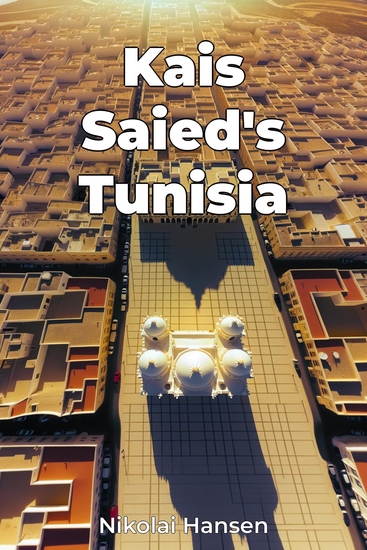
Kais Saied's Tunisia - cover

Kais Saied's Tunisia

Nikolai Hansen

Translator A AI

Publisher: Publifye

  • 0
  • 0
  • 0

Summary

'Kais Saied's Tunisia' offers a compelling examination of how a constitutional law professor's unexpected rise to power in 2019 dramatically reshaped Tunisia's political landscape. The book traces Tunisia's journey from its 2011 Arab Spring revolution through Saied's controversial presidency, analyzing how his unique vision of governance combines direct democracy with strong executive authority.

 
Through meticulous research including government documents, interviews, and public opinion surveys, the author explores three pivotal themes: the sweeping constitutional reforms of 2021-2022, Saied's implementation of direct democracy principles, and the transformation of post-Arab Spring institutions. The narrative skillfully weaves together Saied's transition from academic outsider to influential president, highlighting how his anti-corruption platform resonated with voters disillusioned by traditional politics.

 
The book progresses systematically through three main sections, beginning with Saied's political philosophy and academic background, moving to his specific policy implementations, and concluding with an evaluation of these changes' implications for Tunisia's democratic future. What sets this work apart is its comprehensive analysis of how Saied's reforms affect multiple aspects of Tunisian society, from constitutional law to economic development, providing valuable insights for political scientists, policymakers, and anyone interested in Middle Eastern democratic transitions.
Available since: 01/17/2025.
Print length: 109 pages.

Other books that might interest you

  • 50 States of Mind - A Journey to Discover American Democracy - cover

    50 States of Mind - A Journey to...

    Ryan Bernsten

    • 0
    • 0
    • 0
    Is America as divided as it seems? As a graduate student at Oxford, Ryan Bernsten undertook a 23,000-mile journey through all 50 states to look beyond the news cycles and see his home country from the ground. Following in the footsteps of Alexis de Tocqueville, Bernsten leads with the desire to listen and find common humanity in Americans he meets across the country.  Bernsten ultimately offers a hopeful vision for the future of America, as he embarks on a search for meaning and reflects on what it means to be American. This book is a companion to the podcast 50 States of Mind which showcases interviews from the journey and is available on all podcast platforms.
    Show book
  • Maitrayana Upanishad - cover

    Maitrayana Upanishad

    Unknown

    • 0
    • 0
    • 0
    The word Upanishad (upa-ni-shad) consists of, "Upa" means "near;" "ni" means "down;" "shad" means "to sit." Thus, Upanishad is to sit down near the teacher to discuss, learn, practice, and experience. There are some 200 or more Upanishads. Some are lost and are only known about because of being referenced in other Upanishads. Most of the Upanishads were kept secret for centuries, only passed on to others orally in the form of Shlokas (a category of verse line developed from the Vedic Anustubh meter).Maitra (Sanskrit: ?????) and Maitri (??????) are related words which literally mean "kindly, benevolent, good will, amity, friend of all creatures". The Maitrayaniya Upanishad is associated with the Maitrayanas school of the Yajurveda. It discusses metaphysical questions relating to Atman (Self, Soul). It is a prose style Upanishad with seven Prapathakas (or lessons). The Maitrayaniya Upanishad was probably composed in late 1st millennium BCE.The 11 principal Upanishads to which Sankara appeals in his great commentary on the Vedanta-Surtras are: Chandogya, Talavakara or Kena, Aitareya, Kaushitaki, Vajasaneyi or Isha, Katha, Mundaka, Taittirtiyaka or Taittiriya, Brihadaranyaka, Svetasvatara, and Prasna. They are also called the 11 classical Upanishads or the fundamental Upanishads of the Vedanta Philosophy. Apart from these, Maitrayana-Brahmana-Upanishad is also considered as an important Upanishad.  The Upanishadic literature is not a religious scripture and is free from dogma and doctrines. It is not a part of any religion but is a philosophy for all times and for all. German philosopher Arthur Schopenhauer, impressed by the Upanishads, called the texts "the production of the highest human wisdom".  Summary by Jothi
    Show book
  • Speak Up: Navigating Free Speech in a Turbulent World - Discover "Speak Up" audio lessons—master free speech and elevate your understanding for top performance! - cover

    Speak Up: Navigating Free Speech...

    Ethan Marlowe

    • 0
    • 0
    • 0
    Speak Up: Navigating Free Speech in a Turbulent World 
    ⭐⭐ Simplified Audio Guide ⭐⭐ 
    Are you seeking to advance in your career and strengthen your understanding of free speech in today's complex world?  
    Looking for a thorough guide that provides all the essential elements to effectively navigate contemporary conversations about free speech? 
    Your search ends here! 
    This guide is your definitive companion for deepening your knowledge, honing your skills, and engaging in practical exercises. With this, you'll be well-equipped for success. 
    Updated for the current context and challenges surrounding free speech. 
    Key features of this enriched guide: 
    - Profound insights about Empowering Your Voice in Today's Challenging Conversations 
    - Detailed explanation of Free Speech Principles 
    - Effective strategies for preparation and engagement in discussions 
    Our guide stands out with comprehensive coverage, which is crucial for your understanding and success. Concepts are not just skimmed over; they are explored in depth with precision. 
    Please note that this guide is not affiliated with any official entities and is purely an independent resource for your benefit. 
    Designed with a clear structure and easy-to-understand language, our Free Speech Guide ensures smooth transitions between topics. Say goodbye to dense jargon and welcome clear, precise, and technically accurate content. 
    So, why wait? Click the BUY NOW button, secure your guide, and begin your journey to confidently navigate the world of free speech!
    Show book
  • QAnon Unlocked: Secrets from the Source - Inside Q’s Mind- The Deeper Q’s Hidden Secrets and Theories - cover

    QAnon Unlocked: Secrets from the...

    Mr.Babylon

    • 0
    • 0
    • 0
    The Storm Is Brewing-Unlock the Secrets of QAnon 
    Who is Q? What's the Deep State hiding? What dark plans are unfolding for the next decade? 
    QAnon isn't just a conspiracy theory-it's a battle cry from the shadows, a glimpse into a war most don't even know is being fought. At its core lies the "Deep State"-a secretive cabal accused of weaving a global tapestry of corruption, manipulation, and unspeakable evil. Their goal? Some say it's a New World Order, a totalitarian reset of society. Others whisper of something even more sinister. The edges of this puzzle are jagged, the pieces don't always fit, and even Q's followers wrestle with the question: what's the real endgame? You will discover: 
    Who Is Q? The elusive figure-or figures-driving this revolution, and the allies tied to the cause. 
    Decoding the Drops: Master the art of unraveling Q's cryptic messages and see what others miss. 
    The Deep State Unveiled: Names, faces, and the shadowy power pulling the world's strings. 
    Symbolism in QAnon: The hidden codes and signs that whisper truths in plain sight. 
    The Epstein Connection: How one scandal ties into Q's warnings and shakes the elite to their core. 
    The QAnon phenomenon is a labyrinth-wild, tangled, and more bizarre with every passing day. It's a web of rumors, revelations, and red-hot debates that can swallow the unprepared whole. But you don't have to face it alone. This book is your torch in the dark-a carefully crafted guide to the terms, players, and buried secrets that define QAnon. 
    The clock is ticking. Are you ready to unlock Q's deepest secrets and stand on the front lines of the truth?
    Show book
  • Pathway to the Podium - How to Win a US Election - cover

    Pathway to the Podium - How to...

    Howie Todoit

    • 0
    • 0
    • 0
    Embark on your American political journey with "Pathway to the Podium: How to Win a U.S. Election," your essential guide from aspiration to inauguration! Understand the U.S. political system, election types, and strategic insights. Learn to build a core team, craft a compelling political platform, navigate campaign finance, and master voter outreach, leveraging the power of social media. 
     
    Discover the importance of public speaking and debating skills, with dedicated chapters on impactful speeches, media interviews, and political debates. Post-election, analyze results and plan your future endeavors. Extra tips for triumphing in U.S. elections solidify your political career. Your pathway to the podium begins now—grab your copy today!
    Show book
  • China's Church Divided - Bishop Louis Jin and the Post-Mao Catholic Revival - cover

    China's Church Divided - Bishop...

    Paul P. Mariani

    • 0
    • 0
    • 0
    During the Cultural Revolution, the Chinese state sought to eradicate religious life throughout the country. But by 1978, two years after the death of Mao Zedong, the Communist Party under Deng Xiaoping cautiously embraced the revival of religion. At the same time, the newly elected Pope John Paul II made a point of renewing outreach to China. Paul P. Mariani tracks the fate of Chinese Catholicism in the wake of these transformative leadership changes, focusing on the influential Catholic community in Shanghai. 


    Earlier policies of the 1950s had fractured the Catholic community into a state-approved "patriotic" church that answered to the government and an underground church loyal to Rome. Even after the Cultural Revolution, Mariani shows, this divide remained firmly intact. The resulting tensions were on vivid display in Shanghai, owing to the leadership of the Jesuit priest Louis Jin Luxian. Bishop Jin used his position to revitalize the local Catholic community, but his cooperation with the party put him ever at odds with underground church leaders. 


    Sensitive to the ideals, compromises, and disappointments of Catholics on both sides of the rift, China's Church Divided reveals how the community navigated the irreconcilable differences between a worldwide Church centered in Rome and a regime wary of foreign spiritual authority.
    Show book