Unisciti a noi in un viaggio nel mondo dei libri!
Aggiungi questo libro allo scaffale
Grey
Scrivi un nuovo commento Default profile 50px
Grey
Iscriviti per leggere l'intero libro o leggi le prime pagine gratuitamente!
All characters reduced
Solid-State Physics - Core Principles - cover

Solid-State Physics - Core Principles

Nikhil Lakhani

Casa editrice: Educohack Press

  • 0
  • 0
  • 0

Sinossi

"Solid-State Physics: Core Principles" delves into recent advancements, particularly in quantum materials. Edited by experts, we cover both foundational concepts and cutting-edge research.We begin with basics like crystal structures and electronic properties of solids, then explore exciting areas such as topological insulators and superconductors. A key theme is discovering new quantum materials with unique properties. We examine how these materials are created, studied, and their potential use in future technologies like quantum computing.Another important aspect is the advanced techniques used to understand these materials. We discuss complex experiments and computer modeling that allow scientists to manipulate materials at the atomic level. Additionally, we highlight how solid-state physics connects to other fields like materials science and nanotechnology, emphasizing interdisciplinary collaboration for future breakthroughs."Solid-State Physics: Core Principles" is a valuable resource for researchers and students interested in the latest developments in solid-state physics. We provide a comprehensive overview of the field while looking towards future directions and the potential of quantum materials to revolutionize technology.
Disponibile da: 20/02/2025.
Lunghezza di stampa: 275 pagine.
Altri libri che potrebbero interessarti

  • Conserving Nature in Greater Yellowstone - Controversy and Change in an Iconic Ecosystem - cover

    Conserving Nature in Greater...

    Robert B. Keiter

    • 0
    • 0
    • 0
    The story of how Yellowstone, established in 1872 as the world’s first national park, has become synonymous with nature conservation—and an examination of today’s challenges to preserve the region’s wilderness heritage. For more than 150 years, the Yellowstone region—now widely known as the twenty-three million acre Greater Yellowstone Ecosystem—has played a prominent role in the United States’ nature conservation agenda. In this book, Robert B. Keiter, an award-winning public land law and policy expert, traces the evolution and application of fundamental ecological conservation concepts tied to Yellowstone.
     
    
    Keiter’s book highlights both the conservation successes and controversies connected with this storied region, which has been enmeshed in change. 
    But in the face of explosive human population growth and related development pressures, new efforts must also account for the region’s privately owned lands along with accelerating recreational activities that present quite different problems.
    
    Exploring both notable conservation accomplishments and the ongoing challenges confronting this special place, Keiter’s book explains the many forces—scientific, political, economic, legal, cultural, climatic, and more—at work driving controversy and change across the region. But more than this, Conserving Nature in Greater Yellowstone shows us that the lessons gleaned from Yellowstone’s expansive nature conservation efforts are profoundly important for both the country and the world.
    Mostra libro
  • The Universal Timekeepers - Reconstructing History Atom by Atom - cover

    The Universal Timekeepers -...

    David J. Helfand

    • 0
    • 0
    • 0
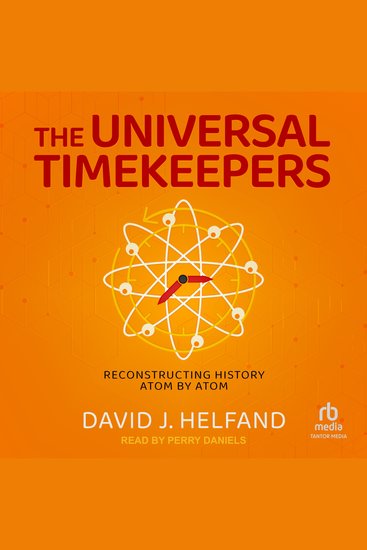
    Atoms are unfathomably tiny. It takes fifteen million trillion of them to make up a single poppy seed—give or take a few billion. And there's hardly anything to them: atoms are more than 99.9999999999 percent empty space. Yet scientists have learned to count these slivers of near nothingness with precision and to peer into their internal states. In looking so closely, we have learned that atoms, because of their inimitable signatures and imperturbable internal clocks, are little archives holding the secrets of the past. 


    David J. Helfand reconstructs the history of the universe—back to its first microsecond 13.8 billion years ago—with the help of atoms. He shows how, by using detectors and reactors, microscopes and telescopes, we can decode the tales these infinitesimal particles tell, answering questions such as: Is a medieval illustrated prayer book real or forged? How did maize cultivation spread from the highlands of central Mexico to New England? What was Earth's climate like before humans emerged? Where can we find clues to identify the culprit in the demise of the dinosaurs? When did our planet and solar system form? Can we trace the births of atoms in the cores of massive stars or even glimpse the origins of the universe itself?
    Mostra libro
  • Invisible No More - Embracing Your Road to Recovery from Long Covid and Other Complex Chronic Illnesses - cover

    Invisible No More - Embracing...

    PhD Ilene Sue Ruhoy MD

    • 0
    • 0
    • 0
    From a neurologist who diagnosed her own brain tumor, Invisible No More empowers patients with chronic and complex illnesses to take their health into their own hands.  While Covid-19 has brought increased attention to chronic and complex illnesses, these conditions have impacted millions worldwide, long before the pandemic. Covid was not the first exposure to cause long-term disease and disability, nor will it be the last.In Invisible No More, Dr. Ilene Sue Ruhoy aims to empower the long-term patients of chronic and complex diseases, delving into her own harrowing experience as a patient. She details her evolution as a neurologist, toxicologist, and integrative physician to work with people across the globe in treating their chronic symptoms and disabling disease, all while amplifying their own voices. This book serves as a practical guide with sections on nutrition, breathing, supplements and more. With a focus on healing and empowerment, Invisible No More will answer patients' most pressing questions and take their health into their own hands.A Macmillan Audio production from St. Martin’s Press Essentials.
    Mostra libro
  • The 50 Greatest Engineers - The People Whose Innovations Have Shaped Our World - cover

    The 50 Greatest Engineers - The...

    Paul Virr, William Potter

    • 0
    • 0
    • 0
    Engineering is everywhere, from the Large Hadron Collider to invisibly small circuits on silicon chips. The 50 Greatest Engineers celebrates the great achievements that have been made through the ages, containing profiles of the best-known and most innovative engineers of all time. Chosen from across the globe, they include a diverse range of talent - from the likes of Nikola Tesla, Lillian Moller Gilbreth and Gustave Eiffel to Isambard Kingdom Brunel, Fazlu Rahman Khan and the Wright Brothers.
    Mostra libro
  • The Evolution of General Ideas - cover

    The Evolution of General Ideas

    Th. Ribot

    • 0
    • 0
    • 0
    Delve into the evolution of human thought with "The Evolution of General Ideas." Explore the intellectual journey of mankind as general ideas take shape, transform, and shape societies. Witness the progression of knowledge, philosophy, and the collective understanding of the world in this illuminating exploration of human cognition.
    Mostra libro
  • The Landscapes of Science and Religion - What Are We Disagreeing About? - cover

    The Landscapes of Science and...

    Hannah Waite, Nick Spencer

    • 0
    • 0
    • 0
    The relationship between science and religion has long been a heated debate and is becoming an ever more popular topic. The scientific capacity to manipulate and change humans and their environment through genetic engineering, life extension, and AI is going to take a huge leap forward in the twenty-first century, provoking endless debates around humans "playing God." 


    But what do we mean by this? Asking this question is surprisingly hard work. Attempts to "essentialize" science, let alone religion, quickly run into trouble. Where are the boundaries? Whose definition of science is definitive? Which concept of religious is the authoritative one? 


    Ultimately, neither "science" nor "religion" can be pinned down to one single meaning or definition. Rather, they encompass a family of definitions that relate to one another in a complex web of shifting ways. Drawing on extensive research with over a hundred leading thinkers in the UK—including Martin Rees, Brian Cox, Susan Greenfield, A. C. Grayling, Ray Tallis, Linda Woodhead, Steve Bruce, Adam Rutherford, Robin Dunbar, Francesca Stavrakopoulou, and Iain McGilchrist—The Landscapes of Science and Religion takes the much-needed step of asking what science and religion actually are, before turning to the familiar question of how they relate to one another.
    Mostra libro