Unisciti a noi in un viaggio nel mondo dei libri!
Aggiungi questo libro allo scaffale
Grey
Scrivi un nuovo commento Default profile 50px
Grey
Iscriviti per leggere l'intero libro o leggi le prime pagine gratuitamente!
All characters reduced
50 Historical Events in 500 Words Each - cover

50 Historical Events in 500 Words Each

Nietsnie Trebla

Casa editrice: Shelf Indulgence

  • 0
  • 0
  • 0

Sinossi

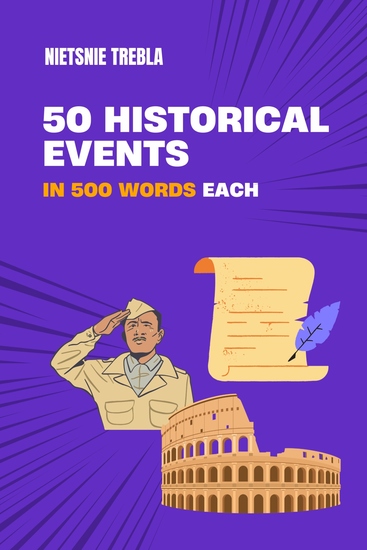
Ever wanted to uncover history’s most pivotal events—without wading through lengthy textbooks? This book takes you on a journey through 50 defining moments, distilling each into clear, concise, and engaging reads.

 
📖 What’s Inside?
 
🌍 Turning Points in History – From the rise and fall of empires to groundbreaking revolutions, explore the moments that shaped our world.
 
🛕 Humanity’s Triumphs and Challenges – Witness stories of innovation, resilience, and the events that altered the course of civilization.
 
🧠 And So Much More – A collection of powerful stories, each explained in just 500 words for quick, impactful learning.

 
🔖 Read Smarter, Not Harder
 
Forget dense history books—immerse yourself in the past with clarity and simplicity. Each chapter is a fast yet enriching read, perfect for curious minds.

 
🎯 Who’s It For?
 
History Enthusiasts – Rediscover the moments that changed the world forever.
 
Students & Lifelong Learners – Gain valuable insights into history’s most important events.
 
Busy Readers – Learn something new in just a few minutes a day.

 
👉 Start your journey now with the book series that’s been translated into multiple languages and loved by readers worldwide!
Disponibile da: 05/02/2024.
Lunghezza di stampa: 120 pagine.

Altri libri che potrebbero interessarti

  • How To Write Your Story in 30 Minutes a Day - Easy prompts for personal history and memories - cover

    How To Write Your Story in 30...

    Deb Graham

    • 0
    • 0
    • 0
    Why Write Your Own Story?It’s a scary thought--What if you die before you tell your life’s story, and your busybody sister-in-law decides to write it for you? Yes, she’s diligent, but she never really liked you, and she surely doesn’t know you as well as you know yourself. No one can tell your personal stories as clearly or as accurately as you can! Now’s the time, before it’s too late. No dry memoir here! In only thirty short minutes a day, you can begin to tell your own history, drawn from your own memories. Thousands of people have written their personal autobiography and found it compelling, even addictive. Share with your children and generations to come. How To Tell Your Story in 30 minutes or less by Deb Graham makes self-exploration easy, with dozens of questions and memory prompts, carefully designed to get you thinking, to jog memories loose in a fun and interactive way. In just a few minutes a day, you can leave a legacy that will last for generations, more important that your Last Will and Testament. It’s as easy as any essay test you’ve ever taken. Easier, because you know the subject matter intimately---it’s about YOU.
    Mostra libro
  • Learn Polish With Music - cover

    Learn Polish With Music

    Innovative Language Learning, ...

    • 0
    • 0
    • 0
    Can learning Polish be as simple as listening to music? 


    And as easy as remembering song lyrics?


    Just think. You remember song lyrics because lyrics are catchy, repeated throughout the song, and go with the music, right? Now, if you stuck in Polish, you’d easily learn Polish words and phrases the same way! 


    So, yes, learning Polish is as easy as listening to music… with the Learn Polish With Music Audiobook.


    Just press play, and you’ll hear Polish words and phrases repeated to the beat of upbeat and cheerful music. And… follow along!


    You’ll learn 180+ most common Polish words and phrases… while relaxing at home, or while driving to work.


    Learn Polish With Music is the easiest way to start learning Polish.. without getting overwhelmed by complicated explanations. Perfect for new learners with little to no language learning experience.


    What will you learn?
     
    180+ Words & Phrases Including...
     
    • Basic Greetings
     
    • Numbers
     
    • Common Questions and Answers
     
    • Parts of the Body & Talking About Your Wellbeing
     
    • Common Hobbies
     
    • And much more


    Learn Polish With Music includes...
     
    • 15 Songs/Lessons Inside (Each is about 7 minutes long)
     
    • Fast-Paced Review Section at the End of Each Lesson
     
    • 1 Hour 50 Minutes in Total
     
    • Accompanying PDF eBook with the Words, Phrases and Translations


    Download the PDF and read along
    Mostra libro
  • Neoliberalism Unveiled - Understanding the Shift Towards Free Market Policies - cover

    Neoliberalism Unveiled -...

    Arlo Holders

    • 0
    • 0
    • 0
    Neoliberalism is a term that has been widely used in academic, political, and economic discussions, yet its exact definition often varies depending on the context. Broadly, neoliberalism refers to a set of economic and political policies that emphasize the role of free markets in achieving economic prosperity, social well-being, and individual freedom. At its core, neoliberalism promotes the idea that markets should operate with minimal interference from the state, and that individuals should be free to pursue their economic interests without governmental restrictions. 
    The roots of neoliberalism can be traced back to the early 20th century, particularly to the ideas of economists such as Friedrich Hayek and Milton Friedman. These thinkers were critical of state intervention in the economy and argued that government control of markets often led to inefficiency and loss of individual freedoms. Hayek’s influential work, The Road to Serfdom (1944), warned against the dangers of central planning and collectivism, which he believed could lead to authoritarianism. Similarly, Friedman, through his advocacy for monetarism and the reduction of government spending, pushed for policies that emphasized the importance of individual choice and market forces over state control. Their ideas laid the intellectual foundation for what would later become neoliberalism. 
    Neoliberalism as a political and economic force began to take shape during the 1970s as many Western economies faced economic stagnation and rising inflation, often referred to as stagflation. Traditional Keynesian approaches, which advocated for government intervention to manage demand and stabilize economies, appeared to fail in addressing these new challenges. In response, neoliberal ideas gained traction, especially in the United States and the United Kingdom.
    Mostra libro
  • How Does Change Happen? - Scenes from the Frontlines of Activism - cover

    How Does Change Happen? - Scenes...

    Sam Gonçalves

    • 0
    • 0
    • 0
    Mass protests and direct action have been familiar tactics against the many crises of the 21st century. Though methods vary, there's a collective longing for meaningful and transformative action. Some are deemed too weak, others too disruptive: from Instagram tiles to cans of soup thrown on famous paintings.
    Through conversations with activists and organisers, Sam Gonçalves recounts stories of protest and the fight for change, from a community of landless workers in Southern Brazil, to chefs unionising their workplace in Glasgow, Scotland. These narratives reveal the opportunities and challenges that are part of the difficult work of creating change, a wrestling with the question: how does change happen?
    Having a 'positive impact' in the world is often relegated to the 'personal', an individual endeavour. Gonçalves investigates that assumption and explores ways communities have resisted collectively, and fought against the individualising forces surrounding them.
    Mostra libro
  • Soldiers - A Global History of the Fighting Man 1800–1945 - cover

    Soldiers - A Global History of...

    John A Haymond

    • 0
    • 0
    • 0
    A global study of how soldiers lived, worked, and fought, and how many died, spanning from the Napoleonic War to World War II. No matter the war, no matter the army, no matter the nationality, common threads run through the experiences of men at war. Soldiers highlights these shared experiences across 150 years of warfare, from the Napoleonic Wars through World War II and everything in between, such as the Mexican and Crimean Wars, the American Civil War, the U.S. Indian Wars and Britain’s imperial bush wars, the Boxer Rebellion, the Boer War, the First World War, and more. Haymond explores the experiences that connect soldiers across time and space and draws heavily from firsthand accounts to craft a narrative with flesh-and-blood immediacy. Soldiers is entertaining and informative: history at its best. Praise for Soldiers“What makes Soldiers an interesting read is Haymond’s writing style and technique of comparing the common experiences of fighting men regardless of uniform and time served during the period.... Highly recommended for both scholars and students alike. It is a must for readers interested in the experience and psychology of being a warrior during this period.”—Military Review: The Professional Journal of the United States Army
    Mostra libro
  • My Blue Book of Grammar for Class 7 - cover

    My Blue Book of Grammar for Class 7

    Meigha Rawat

    • 0
    • 0
    • 0
    A Grammar Series That Uses the Functional Approach 
    
    KEY FEATURES 
    - Functional approach to grammar teaching, using exemplars to illustrate the usage before defining the structure and rules 
    - Vocabulary taught through language-in-use to build the learners’ vocabulary through use rather than memorisation of rules 
    - Contemporary topics to inculcate 21-century skills amongst learners 
    - Use of literature to help learners understand how grammar is used in text 
    - A comprehension section comprising texts from different genres so that learners may relate grammar to different types of works produced in English 
    - Phonics in Grades 1 and 2 to teach the very basis of language 
    - Uniquely stylised illustrations 
    - Activities such as puzzles, crosswords, word grids and games to aid the facilitator in using the concept of ‘flipped classroom’ 
    - Periodic tests to help the learners self-assess the acquisition of concepts 
    - Digital component to cater to a technology-driven classroom 
    
    DESCRIPTION: 
    My Blue Book of Grammar is a course that has been conceptualized and designed keeping in mind the increasingly dynamic role of the English language in today’s world. Especially in our country, where English serves as the lingua franca, a grammar course has to offer not only an exposition of the pedagogy but also the exhibition of the utility of that pedagogy. The aim of a grammar series should be to encourage the development of competency amongst learners, even though their proficiency levels may vary. While the level of exposure to English of all learners may be different, a grammar series should aid in the development of a certain level of confidence amongst the learners, with the end result being that they are able to converse without hesitation in English. 
    
    WHAT WILL YOU LEARN 
    - Understand grammar concepts 
    - Learn how to use different vocabulary concepts taught through language-in-use 
    - Learn 21-century skills 
    - Develop deeper understanding of and appreciation for literature 
    - Have clearer pronunciation through a better understanding of phonics 
    
    WHO THIS BOOK IS FOR: 
    School students of Grades 7 
    
    TABLE OF CONTENTS 
    GRAMMAR 
    1. Compound–Complex Sentences 
    2. Ellipsis 
    3. Compound Subject 
    4. Reported Speech 
    5. Compound Predicate 
    6. Coordinating Adjectives 
    7. Sentences, Fragments and Run-ons 
    8. Comparative and Superlative Adverbs 
    9. Pronoun–Antecedent Agreement 
    10. Active and Passive Voice 
    11. Commas: With Introductory Phrases; When Addressing a Person; 
    in Dates; and in Addresses 
    12. Comma Splices 
    13. Singular and Plural Possessive Nouns 
    14. Linking Verbs 
    15. Transitive and Intransitive Verbs – Revision 
    Test Paper 1 
    VOCABULARY 
    16. Difference Between Who and Whom 
    17. Formal and Informal Language 
    18. Compound Subject with I and Me 
    19. Can and Could 
    20. Redundancy 
    21. Prefixes: inter–, trans–, super– 
    22. Suffixes: –ent, –ant, –ous 
    23. Latin and Greek Roots 
    24. Good vs Well 
    25. Using Clues from the Context to Find the Meaning of the Word 
    26. How versus What in Exclamations 
    27. Positive and Negative Connotations 
    28. Suggestions and Requests 
    Test Paper 2 
    WRITING 
    29. Writing a Notice 
    30. Narrative Poem 
    31. Dialogue Writing 
    32. Writing a Summary 
    33. Survey Findings 
    Test Paper 3 
    COMPREHENSION 
    34. I Have a Dream 
    35. Ain’t I a Woman? 
    36. We Are the World 
    37. Thang-Ta: The Martial Art Dance of Manipur 
    Orange Global Olympiad – English Sample Paper
    Mostra libro