¡Acompáñanos a viajar por el mundo de los libros!
Añadir este libro a la estantería
Grey
Escribe un nuevo comentario Default profile 50px
Grey
Suscríbete para leer el libro completo o lee las primeras páginas gratis.
All characters reduced
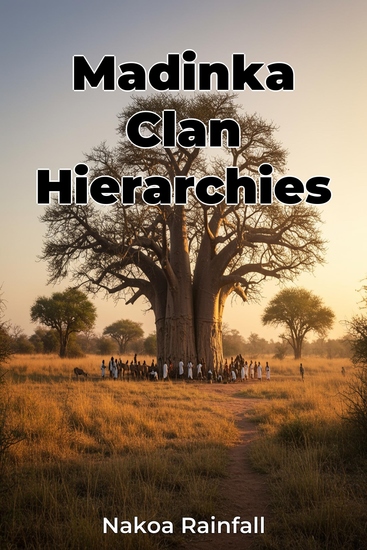
Madinka Clan Hierarchies - cover

Madinka Clan Hierarchies

Nakoa Rainfall

Traductor A AI

Editorial: Publifye

  • 0
  • 0
  • 0

Sinopsis

Madinka Clan Hierarchies explores the intricate social structures of the Madinka people in pre-colonial West Africa, focusing on how clan systems shaped power, wealth, and social standing. The book examines how these hierarchies dictated familial relationships, the distribution of authority, and the allocation of economic responsibilities, providing a framework for social order. One intriguing insight is how lineage and marriage shaped social identities and alliances, influencing everything from leadership protocols to economic strategies. The book argues that these clan hierarchies were dynamic systems, constantly adapting to changing conditions, challenging simplistic notions of tradition. This study uses a combination of documented protocols, oral record devices, and ethnographic data to understand the values and beliefs that shaped these hierarchies. It approaches oral records not as secondary sources, but as key texts. The book progresses from introducing core concepts of clan structure, kinship, and economic responsibility, to exploring variations in specific regions within the Madinka cultural sphere, and finally offering a comparative analysis of clan hierarchies. This approach provides a deeper appreciation of the complexities of social organization in West Africa.
Disponible desde: 03/05/2025.
Longitud de impresión: 58 páginas.

Otros libros que te pueden interesar

  • Spain - What Everyone Needs to Know(r)
2nd Edition - cover

    Spain - What Everyone Needs to...

    William Chislett

    • 0
    • 0
    • 0
    In Spain: What Everyone Needs to Know®, a timely addition to Oxford's What Everyone Needs to Know® series, veteran journalist William Chislett provides political and historical context for Spain's current economic and political predicament. Chislett recounts the country's fascinating and often turbulent history, beginning with the Muslim conquest in 711 and ending with the nation's deep economic crisis, sparked by the spectacular collapse of its real estate and construction sectors in 2010. He explains the country's transition from dictatorship to democracy and covers such issues as the creation of a welfare state, the influx of immigrants, internal strife from the separatist Catalan region, the effects of stringent austerity measures, the strengths and weaknesses of the economy, and how the country can create a more sustainable economic model for the future. In a concise, question-and-answer format that allows listeners to quickly access areas of particular interest, the book addresses a wide range of questions, including: What was the legacy of the Muslim presence between 711 and 1492? How did the Spanish Empire Arise? What were the causes of the 1936-39 Civil War? Why did the Socialists win a landslide victory in the 1982 election? What was the impact of European Economic Community membership? What is the violent Basque separatist group ETA? And more.
    Ver libro
  • Scripting Empire - Broadcasting the BBC and the Black Atlantic - cover

    Scripting Empire - Broadcasting...

    James Procter

    • 0
    • 0
    • 0
    Scripting Empire recovers the literary and cultural history of West Indian and West African writing at the BBC in order to rethink the critical mid-century decades of shrinking British sovereignty, late modernism, and mass migration to the metropole. Between the 1930s and the 1960s, a remarkable group of black Atlantic artists and intellectuals became producers, editors, and freelancers at the corporation. Operating at the interface of a range of literary and broadcast genres, this loose network of African Caribbean writers and thinkers prompt a reassessment of the aesthetic, formal, and political fallout of decolonization between the outbreak of World War II and the first airings of post-colonial independence. 


    Scripting Empire works comparatively across dozens of different programs spanning the General Overseas Service, Home Service, Light Program, and Third Program. Drawing upon a transnational archive of materials, including scripts, correspondence, periodicals, visual records, and sound recordings, it seeks to reposition the cultural contribution of West Indians and West Africans within a more pervasive and porous account of radio transmission, the legacy of which extends well beyond broadcasting.
    Ver libro
  • Blood and Treasure - The Economics of Conflict from the Vikings to the Modern Era - cover

    Blood and Treasure - The...

    Duncan Weldon

    • 0
    • 0
    • 0
    Wars are expensive, both in human terms and monetary ones. But while warfare might be costly it has also, at times, been an important driver of economic change and progress. Over the long span of history nothing has shaped human institutions—and thus the process of economic development—as much as war and violence. Wars made states and states made wars. As the costs of warfighting grew so did state structures, taxation systems and national markets for debt. And as warfare became ever more destructive the incentive for governments to resort to it changed too. 
     
    Blood and Treasure looks at the history and economics of warfare from the Viking Age to the war in Ukraine, examining how incentives and institutions have changed over the centuries. It surveys how warfare helped drive Europe's rise to global prominence, and it explains how the total wars of the twentieth century required a new type of strategy, one that took economics seriously. 
     
    Underpinning this riveting narrative is a focus on how and why the economics of conflict have changed over time. This is a story of how economics can help to explain the motivations of war, and how understanding the history of warfare can help explain modern economics.
    Ver libro
  • The 16 Human Desires That Make People Buy - cover

    The 16 Human Desires That Make...

    Reece Wideman

    • 0
    • 0
    • 0
    Why do people buy? 
    Beneath every purchase decision lies a deeper psychological trigger—one of sixteen core human desires that quietly influence behavior, motivation, and choice. 
    In The 16 Human Desires That Make People Buy, Reece Wideman breaks down these universal drivers with clarity and real-world insight, revealing how desire shapes everything from consumer behavior to personal ambition. This audiobook explores how power, status, belonging, curiosity, security, and meaning influence decisions—often without us realizing it. 
    Designed for creators, entrepreneurs, marketers, and anyone curious about human psychology, this audiobook offers a deeper understanding of why people act the way they do—and how recognizing these patterns can change how you communicate, create, and connect. 
    Clear, practical, and thought-provoking, this audiobook invites listeners to see human behavior through a sharper, more intentional lens.
    Ver libro
  • Voices from Home - Wisdom from Our Diasporic Roots - cover

    Voices from Home - Wisdom from...

    Ephraim Osaghae

    • 0
    • 0
    • 0
    Every human being is part of a bigger family, which is figuratively represented by the family tree. We have roots that extend beyond places and cultures of our current residences. This is particularly true for people in diaspora. Our roots still weigh a lot into our everyday living irrespective of geographical distance and time. Thus, would it not be beneficial to know and explore the advantages in our roots and avoid losing out, and losing deep? This is the main message of this book, "Voices from Home: Wisdom from our Diasporic Roots." 
    •This book will provide inspiration, some incentives, and a compass for teachable minds to explore and tap into the wealth of their roots. 
    •It provides insights on the key dynamics and interplay of cultures, underpinning motivations, and extended family structures of typical first-generation migrants. 
    •It informs global audiences about lived experiences of people of migrant backgrounds starting with the Australian context. 
    •It contributes to the value-adding conversations around the themes of identity, cross-cultural intelligence, sustainable migration, etc. 
    •It provides hints and tips for relevant policy makers, service providers, and other government officials, especially in the areas of sustainable migration. 
    •It is a resource material for intending, new, and emerging migrants as part of preparations for their migration journeys, as well as references for lessons learnt so they can position themselves for more meaningful experiences.
    Ver libro
  • White Poverty - How Exposing Myths about Race and Class Can Reconstruct American Democracy - cover

    White Poverty - How Exposing...

    Reverend Dr. William Barber II,...

    • 0
    • 0
    • 0
    A generational work with far-ranging social and political implications, White Poverty promises to be one of the most influential books in recent years. 


    One of the most pernicious and persistent myths in the United States is the association of Black skin with poverty. Though there are forty million more poor white people than Black people, most Americans, both Republicans and Democrats, continue to think of poverty—along with issues like welfare, unemployment, and food stamps—as solely a Black problem. Why is this so? What are the historical causes? And what are the political consequences that result? 


    These are among the questions that the Reverend Dr. William J. Barber II, a leading advocate for the rights of the poor and the "closest person we have to Dr. King" (Cornel West), addresses in White Poverty, a groundbreaking work that exposes a legacy of historical myths that continue to define both white and Black people, creating in the process what might seem like an insuperable divide. Analyzing what has changed since the 1930s, when the face of American poverty was white, Barber, along with Jonathan Wilson-Hartgrove, addresses white poverty as a hugely neglected subject that just might provide the key to mitigating racism and bringing together tens of millions of working class and impoverished Americans.
    Ver libro