Junte-se a nós em uma viagem ao mundo dos livros!
Adicionar este livro à prateleira
Grey
Deixe um novo comentário Default profile 50px
Grey
Assine para ler o livro completo ou leia as primeiras páginas de graça!
All characters reduced
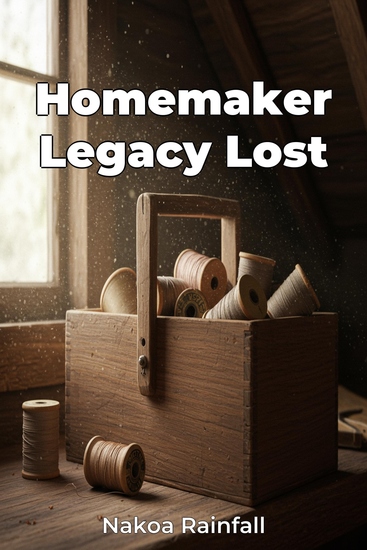
Homemaker Legacy Lost - cover
LER

Homemaker Legacy Lost

Nakoa Rainfall

Tradutor A AI

Editora: Publifye

  • 0
  • 0
  • 0

Sinopse

Homemaker Legacy Lost examines the evolving role of homemaking, a once-central aspect of societal structure, and its perceived decline in modern society. By intertwining history and social science, the book explores the multifaceted reasons behind this shift, including changing gender roles, economic pressures, and technological advancements. It highlights that the skills traditionally associated with home management, such as resourcefulness and family care, are increasingly undervalued, potentially impacting family dynamics and cultural identity.

 
The book traces the historical context of homemaking, from its essential role in pre-industrial societies to the impact of industrialization and subsequent feminist movements. It argues that the decline in traditional homemaking isn't solely about changing gender roles but also a complex interplay of factors. For instance, the rise of the two-income household and readily available services has altered the necessity and perception of domestic labor.

 
The book progresses by examining economic shifts, technological advancements, and cultural changes, culminating in a discussion of the potential consequences of this loss and the possibility of reevaluating homemaking skills for the modern era.
Disponível desde: 27/02/2025.
Comprimento de impressão: 70 páginas.

Outros livros que poderiam interessá-lo

  • Jena 1800 - The Republic of Free Spirits - cover

    Jena 1800 - The Republic of Free...

    Peter Neumann

    • 0
    • 0
    • 0
    Around the turn of the nineteenth century, a steady stream of young German poets and thinkers coursed to the town of Jena to make history. The French Revolution and the Napoleonic Wars had dealt a one-two punch to the dynastic system. Confidence in traditional social, political, and religious norms had been replaced by a profound uncertainty that was as terrifying for some as it was exhilarating for others. Nowhere was the excitement more palpable than among the extraordinary group of poets, philosophers, translators, and socialites who gathered in this Thuringian village. 


    Jena became the place for the young and intellectually curious, the site of a new departure, of philosophical disruption. Influenced by Johann Wolfgang von Goethe, then an elder statesman and artistic eminence, the leading figures among the disruptors—the translator August Wilhelm Schlegel; the philosophers Friedrich "Fritz" Schlegel and Friedrich Schelling; the dazzling, controversial intellectual Caroline Schlegel, married to August; Dorothea Schlegel, a poet and translator, married to Fritz; and the poets Ludwig Tieck and Novalis—resolved to rethink the world, to establish a republic of free spirits. They didn't just question inherited societal traditions; with their provocative views of the individual and of nature, they revolutionized our understanding of freedom and reality.
    Ver livro
  • History of the World - cover

    History of the World

    Introbooks Team

    • 0
    • 0
    • 0
    The world history defines the history of mankind as decided by the study of archaeological and inscribed archives. The recorded ancient history starts when writing was invented. Prehistory is marked by the Early Stone Age or the Palaeolithic Era which was followed by New Stone Age or Neolithic Era. The Agricultural Revolution was from 8000 and 5000 BCE; it was during this time that the humans progressed and started farming and animal husbandry and settled down to form villages and then civilizations. Expansion of these villages required one to travel and travelling from one place to the other lead to development of transport. 
    Developments of farming also lead to divisions in labours and also bought lead to division of society in upper class, middle class and lower class. More and more civilizations came up and the population grew fast spreading all over the world. 
    The history of the old world is specially the Mediterranean and Europe is divided in Antiquity or ancient history till the 476 CE, the Middle Ages or Postclassical Ages till 15 century this age also included the Islamic Golden Age and Renaissance Period, the Early Modern Period which lasted from 15th century till the 18th century and also comprised of Age of Enlightenment and Late Modern Period and finally from the Industrial Revolution till present day also counting Contemporary history. 
    Many important inventions like printing bought an end to the Middle Ages and heralded the Scientific Revolution in the middle of the century and growing knowledge and technology quickly bought about the Industrial Revolution by the 18th century. After the 18th century the world has seen quick changes like increase in population, wars, weapons, commerce, trade, technology, environmental degradation, pollution etc. All this has augmented in generating opportunities and jeopardies which now antagonise the planet's mortal communities.
    Ver livro
  • History of Marathas EP11 - Chaos after Sambhaji - cover

    History of Marathas EP11 - Chaos...

    Vikrant Pande

    • 0
    • 0
    • 0
    Sambhaji's death was a big blow to the Marathas. He was the rightful heir and a daredevil; someone who could have challenged Aurangzeb had he not been given up by his own family members.
    The Marathas were not to give up so easily. The few years after Sambhaji's death were ruinous and confusing. Sambhaji's younger brother Rajaram, who was nineteen, and his mother Tarabai stayed at the Raigad fort. Yesaji Kank, a veteran since Shivaji's time, did not waste time to declare Rajaram as the king within a week of Sambaji's capture. This was a clear message to the Mughals that the Maratha monarchy was alive and kicking and that the Marathas were too.
    Aurangzeb was not going to sit quietly. He sent Itikad Khan (later called Zulfikar Khan) to Raigad to capture Rajaram and his mother.
    Ver livro
  • Born This Way - Science Citizenship and Inequality in the American LGBTQ+ Movement - cover

    Born This Way - Science...

    Joanna Wuest

    • 0
    • 0
    • 0
    The story of how a biologically driven understanding of gender and sexuality became central to US LGBTQ+ political and legal advocacy. 
     
    Across protests and courtrooms, LGBTQ+ advocates argue that sexual and gender identities are innate. Oppositely, conservatives incite panic over “groomers” and a contagious “gender ideology” that corrupts susceptible children. Yet, as this debate rages on, the history of what first compelled the hunt for homosexuality’s biological origin story may hold answers for the queer rights movement’s future. 
    Born This Way tells the story of how a biologically based understanding of gender and sexuality became central to LGBTQ+ advocacy. Starting in the 1950s, activists sought out mental health experts to combat the pathologizing of homosexuality. As Joanna Wuest shows, these relationships were forged in subsequent decades alongside two broader, concurrent developments: the rise of an interest-group model of rights advocacy and an explosion of biogenetic and bio-based psychological research. The result is essential reading to fully understand LGBTQ+ activism today and how clashes over science remain crucial to equal rights struggles.
    Ver livro
  • The American Operations in WW2: Northern Solomons - cover

    The American Operations in WW2:...

    U.S. Army Center of Military...

    • 0
    • 0
    • 0
    World War II was the largest and most violent armed conflict in the history of mankind. Highly relevant today, World War II has much to teach us, not only about the profession of arms, but also about military preparedness, global strategy, and combined operations in the coalition war against fascism. This book follows military operations of the US Army in the Pacific from 22 February 1943 to 21 November 1944. 
    From the Allied vantage point early in the spring of 1943, progress clearly had been made in the wars against Germany and Italy in Europe and the Mediterranean and Japan in the Pacific. During the winter an entire German army had been killed or captured deep within the Soviet Union at Stalingrad. In Africa, once-invincible Axis forces were in full-scale retreat, eventually to surrender in mid-May. The specter of continued Axis expansion in Europe was no longer the threat it had been a year before.
    Halfway around the world, the Japanese offensive in the Pacific also had crested. The May 1942 Battle of the Coral Sea, followed quickly by the great American victory at Midway, had cost Japan the strategic initiative. By February 1943 American and Australian troops had thwarted a Japanese pincer movement in Papua New Guinea, defeating an overland drive on Port Moresby, evicting the Japanese from Buna, and beating back an attack against Wau. That same month, hundreds of miles to the east in the Solomon Islands, American troops had wrested Guadalcanal from the Japanese. Victory required seven months of torturous fighting, but it secured the Allied line of communications to Australia. The Allied High Command now could take advantage of its improved strategic position...
    Ver livro
  • PANDEMIC - The Great Influenza Since 1918 Tracking Contagions From Cholera To Ebola Until The Viruses Of Our Days - cover

    PANDEMIC - The Great Influenza...

    Nathan Banks

    • 0
    • 0
    • 0
    Pandemic is an educational audiobook that explores the history of infectious diseases and their impact on societies around the world. 
    From the devastating influenza pandemic of 1918 to modern outbreaks of emerging viruses, humanity has repeatedly faced global health challenges that have shaped history, science, and public health systems. 
    This audiobook traces the evolution of major epidemics and pandemics, examining how diseases spread, how societies respond, and how scientific research has helped improve the understanding of infectious illnesses. 
    Listeners will explore historical outbreaks such as cholera, influenza, Ebola, and other global health events while gaining insight into the scientific and social factors that influence the spread of disease. 
    Inside this audiobook you will discover: 
    • The historical impact of major pandemics and epidemics 
     • The story of the 1918 influenza pandemic and its global consequences 
     • How diseases such as cholera and Ebola spread across populations 
     • The development of modern public health responses 
     • The role of science and research in understanding infectious diseases 
     • How pandemics have influenced modern society and global health policies 
    Designed for listeners interested in history, science, and global health, Pandemic provides an accessible overview of how infectious diseases have shaped our world.
    Ver livro