Begleiten Sie uns auf eine literarische Weltreise!
Buch zum Bücherregal hinzufügen
Grey
Einen neuen Kommentar schreiben Default profile 50px
Grey
Jetzt das ganze Buch im Abo oder die ersten Seiten gratis lesen!
All characters reduced
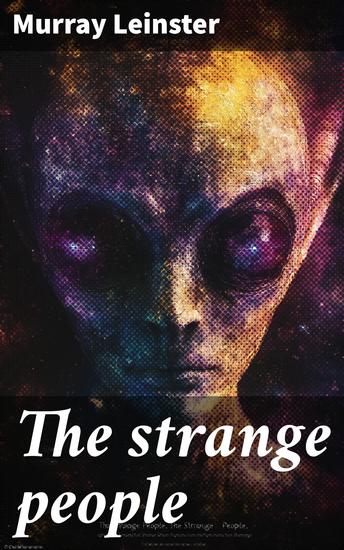
The strange people - cover

The strange people

Murray Leinster

Verlag: Good Press

  • 0
  • 0
  • 0

Beschreibung

Murray Leinster's "The Strange People" explores the intricate dynamics of human interaction with alien civilizations, weaving a narrative that intertwines themes of identity, understanding, and the unknown. Written in Leinster's characteristic clear and engaging style, this work combines elements of science fiction and social commentary, serving as a poignant reflection of mid-twentieth-century perspectives towards technology and extraterrestrial life. The novel skillfully balances speculative scenarios with rich character development, prompting readers to consider the ethical implications of contact with other intelligent beings while also revealing the quirks and complexities of human nature. Murray Leinster, a prolific and innovative writer often heralded as one of science fiction's pioneers, drew inspiration from his varied life experiences, including his service in World War II and a keen interest in technology and the sciences. His extensive background in writing for magazines and his interest in complex moral questions significantly influenced his approach to storytelling, evident in "The Strange People." Leinster's ability to construct thought-provoking narratives likely stemmed from his desire to scrutinize the human condition through an imaginative lens. "The Strange People" is a compelling read for anyone fascinated by the intersections of humanity and alien life. It not only captivates with its imaginative premise but also invites deeper reflection on our values and societal norms, making it an essential addition to the library of any science fiction enthusiast.
Verfügbar seit: 02.03.2025.
Drucklänge: 190 Seiten.


Weitere Bücher, die Sie mögen werden

  • The Perfumed Garden - cover

    The Perfumed Garden

    Sheikh Nefzaoui

    • 0
    • 0
    • 0
    The Perfumed Garden of Sensual Delight (Arabic: الروض العاطر في نزهة الخاطر Al-rawḍ al-ʿāṭir fī nuzhaẗ al-ḫāṭir) is a fifteenth-century Arabic sex manual and work of erotic literature by Muhammad ibn Muhammad al-Nefzawi, also known simply as "Nefzawi".
    The book presents opinions on what qualities men and women should have to be attractive and gives advice on sexual technique, warnings about sexual health, and recipes to remedy sexual maladies. It gives lists of names for the penis and vulva, has a section on the interpretation of dreams, and briefly describes sex among animals. Interspersed with these there are a number of stories which are intended to give context and amusement.
    Zum Buch
  • Gabriel-Ernest - From their pens to your ears genius in every story - cover

    Gabriel-Ernest - From their pens...

    Saki Saki

    • 0
    • 0
    • 0
    Hector Hugh Munro, more familiarly known by his pen-name ‘Saki’ was born in what was then Akyab in British Burma on 18th December 1870. His father was an Inspector General for the Indian Imperial Police, and his mother the daughter of a Rear Admiral. 
    When he was 2 his mother died and he and his siblings were sent back to England to be raised by their grandmother and paternal maiden aunts in a strict, puritanical household near Barnstaple, Devon. Educated by governesses Saki used many of these women as character models for his later writing. 
    At 17 his father retried and returned to England and then embarked on a series of European travels with Saki and his siblings. 
    After a short stint working in Burma with the Indian Imperial Police Saki decided to move to London to make a living as a writer. Initially he wrote as a journalist for a number of newspapers and magazines before attempting an historical study, ‘The Rise of the Russian Empire’, whose real value lay in directing him to writing short stories instead, the first of which, ‘Dogged’, he published in 1899. 
    From here it was a short stab of the pen to writing political satire before in 1902 he became the foreign correspondent for The Morning Post, first in the Balkans, then Russia, Paris and back to London in 1908, where 'the agreeable life of a man of letters with a brilliant reputation awaited him.'  
    Collections of his short stories full of witty, mischievous and often macabre stories that satirized Edwardian society and two novels now appeared in the years up to the Great War.  At its’ outbreak he was 43 but managed to join as an ordinary trooper. More than once he returned to the battlefield when officially too sick or injured.  
    On 14th November 1916 Hector Hugh Munro was sheltering in crater during the Battle of the Ancre, when he was shot and killed by a German sniper. According to several sources, his last words were "Put that bloody cigarette out!"
    Zum Buch
  • Charles Dickens 3 Classic Works - A Christmas Carol The Pickwick Papers Hard Times - cover

    Charles Dickens 3 Classic Works...

    Charles Dickens

    • 0
    • 0
    • 0
    Charles Dickens was an English writer and social critic who lived during the 19th century. He is considered one of the greatest novelists of the Victorian era and is known for his vivid portrayals of the social and economic conditions of the time. His works often addressed issues of poverty, social injustice, and class struggle, and he is credited with helping to raise public awareness of these issues. Some of his most famous works include "Oliver Twist," "A Tale of Two Cities," and "Great Expectations." 
    Dickens' writing style is characterized by his use of vivid characters, rich descriptions, and a keen understanding of human nature. His works often feature memorable characters such as Fagin, Scrooge, and Miss Havisham, and his novels are known for their intricate plots, unexpected twists, and poignant endings. Dickens' works were hugely popular in his lifetime and continue to be studied and admired for their relevance and insight into the human condition. 
     
    In addition to his contributions to literature, Dickens was also an influential social reformer. He was a vocal advocate for the rights of the poor and disadvantaged, and his works played an important role in raising public awareness of the social and economic conditions of the time. His philanthropic efforts included work with a home for "fallen women" and the establishment of a home for retired actors. Dickens' contributions to literature and society continue to be recognized and celebrated today. 
     
    Here is the ultimate Audiobook celebration of this great enduring artist narrated by Emmy-nominated actor and author Geoffrey Giuliano.
    Zum Buch
  • Æpyornis Island (Unabridged) - cover

    Æpyornis Island (Unabridged)

    H. G. Wells

    • 0
    • 0
    • 0
    "Æpyornis Island", or "Aepyornis Island", is a short story by H. G. Wells, first published in 1894 in the Pall Mall Budget.[1] It was included in The Stolen Bacillus and Other Incidents, the first collection of short stories by Wells, first published in 1895. In the story, a man looking for eggs of Aepyornis, an extinct flightless bird, passes two years alone on a small island with an Aepyornis that has hatched.
    Zum Buch
  • Frankenstein - cover

    Frankenstein

    Mary Shelley

    • 0
    • 0
    • 0
    Frankenstein tells the story of Victor Frankenstein, a young scientist who creates a sapient creature in an unorthodox scientific experiment. Shelley started writing the story when she was 18, and the first edition was published anonymously in London on 1 January 1818, when she was 20. Her name first appeared in the second edition, which was published in Paris in 1821.Shelley travelled through Europe in 1815, moving along the river Rhine in Germany, and stopping in Gernsheim, 17 kilometres (11 mi) away from Frankenstein Castle, where, two centuries before, an alchemist had engaged in experiments.[note She then journeyed to the region of Geneva, Switzerland, where much of the story takes place. Galvanism and occult ideas were topics of conversation for her companions, particularly for her lover and future husband Percy B. Shelley. In 1816 Mary, Percy and Lord Byron had a competition to see who could write the best horror story. After thinking for days, Shelley was inspired to write Frankenstein after imagining a scientist who created life and was horrified by what he had made.Though Frankenstein is infused with elements of the Gothic novel and the Romantic movement, Brian Aldiss has argued for regarding it as the first true science-fiction story. In contrast to previous stories with fantastical elements resembling those of later science fiction, Aldiss states, the central character "makes a deliberate decision" and "turns to modern experiments in the laboratory" to achieve fantastic results. The novel has had a considerable influence on literature and on popular culture; it has spawned a complete genre of horror stories, films, and plays.Since the publication of the novel, the name "Frankenstein" has often been used, erroneously, to refer to the monster, rather than to his creator/father.
    Zum Buch
  • Sheridan Le Fanu - A Short Story Collection - An anthology from the Irish master of gothic and horror fiction who's work would greatly influence prominent names such as MR James and Bram Stoker - cover

    Sheridan Le Fanu - A Short Story...

    Sheridan Le Fanu

    • 0
    • 0
    • 0
    Joseph Thomas Sheridan Le Fanu was born on August 28th, 1814, at 45 Lower Dominick Street, Dublin, into a literary family with Huguenot, Irish and English roots 
     
    The children were tutored but, according to his brother William, the tutor taught them little if anything. Le Fanu was eager to learn and used his father's library to educate himself about the world. He was a creative child and by fifteen had taken to writing poetry. 
     
    Accepted into Trinity College, Dublin to study law he also benefited from the system used in Ireland that he did not have to live in Dublin to attend lectures, but could study at home and take examinations at the university as and when necessary. 
     
    This enabled him to also write and by 1838 Le Fanu's first story The Ghost and the Bonesetter was published in the Dublin University Magazine. Many of the short stories he wrote at the time were to form the basis for his future novels.  Indeed, throughout his career Le Fanu would constantly revise, cannabilise, embellish and re-publish his earlier works to use in his later efforts. 
     
    Between 1838 and 1840 Le Fanu had written and published twelve stories which purported to be the literary remains of an 18th-century Catholic priest called Father Purcell. Set mostly in Ireland they include classic stories of gothic horror, with grim, shadowed castles, as well as supernatural visitations from beyond the grave, together with madness and suicide. One of the themes running through them is a sad nostalgia for the dispossessed Catholic aristocracy of Ireland, whose ruined castles stand in mute salute and testament to this history.  
     
    On 18 December 1844 Le Fanu married Susanna Bennett, the daughter of a leading Dublin barrister. The union would produce four children.  Le Fanu was now stretching his talents across the length of a novel and his first was The Cock and Anchor published in 1845. 
     
    A succession of works followed and his reputation grew as well as his income.  Unfortunately, a decade after his marriage it became an increasing source of difficultly. Susanna was prone to suffer from a range of neurotic symptoms including great anxiety after the deaths of several close relatives, including her father two years before.  
     
    In April 1858 she suffered an "hysterical attack" and died in circumstances that are still unclear. The anguish, profound guilt as well as overwhelming loss were channeled into Le Fanu’s work.  Working only by the light of two candles he would write through the night and burnish his reputation as a major figure of 19th Century supernaturalism. His work challenged the focus on the external source of horror and instead he wrote about it from the perspective of the inward psychological potential to strike fear in the hearts of men.  
     
    A series of books now came forth: Wylder's Hand (1864), Guy Deverell (1865), The Tenants of Malory (1867), The Green Tea (1869), The Haunted Baronet (1870), Mr. Justice Harbottle (1872), The Room in the Dragon Volant (1872) and In a Glass Darkly. (1872). 
     
    But his life was drawing to a close.  Joseph Thomas Sheridan Le Fanu died in Merrion Square in his native Dublin on February 7th, 1873, at the age of 58.  
     
    01 - Joseph Sheridan Le Fanu - A Short Story Collection - An Introduction 
    02 - The Ghost and the Bone-Setter by Sheridan Le Fanu 
    03 - Sir Dominick's Bargain by Sheridan Le Fanu 
    04 - Dickon the Devil by Sheridan Le Fanu 
    05 - Strange Event in the Life of Schalken the Painter by Sheridan Le Fanu 
    06 - An Account of Some Strange Disturbances in Aungier Street by Sheridan Le Fanu
    Zum Buch