Join us on a literary world trip!
Add this book to bookshelf
Grey
Write a new comment Default profile 50px
Grey
Subscribe to read the full book or read the first pages for free!
All characters reduced
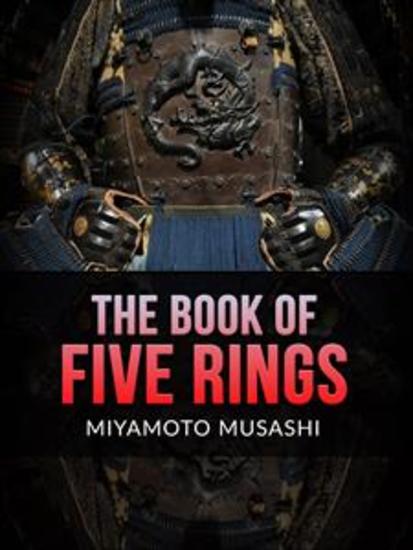
The Book of Five Rings - cover

The Book of Five Rings

Miyamoto Musashi

Publisher: David De Angelis

  • 0
  • 0
  • 0

Summary

Today it is victory over oneself. Tomorrow it is victory over lesser warriors. Miyamoto Musashi is known worldwide as the swordsman, teacher and writer who wrote The Book of Five Rings and changed the way the world thinks about strategy. Take this book literally and you will learn to become a master swordsman. Take this book as a lesson in strategy and you will have a valuable set of tools to help you hone your craft and cultivate your passion. Used by those who study the art of business, politics, warfare, and even chess, this book has much more to offer than just swordsmanship. With lessons that can be applied to almost any activity, The Book of Five Rings is a classic worth studying. This legendary book has been translated into almost every language and this version for the modern reader seeks to find a new audience for those who want to learn Musashi's lessons.
Available since: 06/16/2022.

Other books that might interest you

  • Exploits of Ben Arnold The: Wa-Si-Cu Tam-A-He-Ca - An Authentic Narrative of Sixty Years in the Old West as Indian Fighter Gold Miner Cowboy Hunter and Army Scout - cover

    Exploits of Ben Arnold The:...

    Ben Arnold, Lewis F. Crawford

    • 0
    • 0
    • 0
    The Exploits Of Ben Arnold, Wa-Si-Cu Tam-A-He-Ca is an Authentic Narrative Of Sixty Years In The Old West As Indian Fighter, Gold Miner, Cowboy, Hunter And Army Scout. He gives many first hand accounts of the treaty signings with the Indians.  He speaks of his meetings with Sitting Bull, Crazy Horse, Spotted tail and many others. The many times the government lied and cheated the Indians out of their land and what the government agreed to pay them. Also many vivid descriptions of daring feats and real life events that are told here for the first time. A must book for those interested in the history of the settlement of the wilderness along the Missouri River and West of it. There is also a harsh criticism of General Crook's failure in the the Little Bighorn Massacre.
    Show book
  • Executive functioning for teens - discover the power of self-regulation enhanced emotional intelligence and stronger problem-solving abilities - cover

    Executive functioning for teens...

    Leslie Gowans

    • 0
    • 0
    • 0
    This comprehensive guide focuses on developing executive functioning skills over a 30-day period, specifically designed for teenagers and young adults struggling with time management, focus, and self-regulation. The book offers practical strategies to overcome procrastination, manage digital distractions, and enhance emotional intelligence through actionable exercises and relatable examples. 
    Key features include innovative time management techniques, organization strategies, and methods to tackle large projects without feeling overwhelmed. It provides 8 organizational tips, 3 techniques for starting big projects, and 7 methods for establishing effective routines. The book emphasizes stress management through 5 dedicated exercises and includes specific strategies for exam preparation and deadline management. 
    The guide stands out by addressing modern challenges like digital distractions and impulsive decision-making while offering solutions for improved focus and emotional regulation. It's structured as a 30-day challenge, making it accessible and actionable for readers who may have struggled with traditional self-help approaches. 
    The book promises more than generic advice, presenting itself as a transformative tool for developing crucial life skills. It's particularly valuable for teens navigating adolescence and parents supporting their children's development. The content combines practical tools with emotional intelligence development, creating a holistic approach to executive functioning improvement.
    Show book
  • Spirit Voices - The Mysteries and Magic of North Asian Shamanism - cover

    Spirit Voices - The Mysteries...

    David J. Shi

    • 0
    • 0
    • 0
    Provides a clear and accessible guide to the many different North Asian shamanic traditions, past and present. What is shamanism? Where is it from? How does one become a shaman? What are the requirements to become one? Anthropologists tell us that the word shaman derives from the Tungus language and traditions, but few people understand the full scope of what that means. In his groundbreaking book, Spirit Voices, David Shi answers all these questions and more.   Drawing upon his own ancestral traditions, Shi explores the history and practice of shamanism. He guides readers through what may be the unfamiliar landscapes of North Asia—the place where shamanism was born—as well as the largely hidden and unfamiliar traditions of Turkic, Mongolic, and Tungus shamanism, exploring the subtle and unique aspects of each tradition. Shi provides a clear and accessible guide that explores the many different North Asian shamanic traditions.    So, what exactly is shamanism? David Shi suggests that the most accurate definition derives from shamanologist Nicholas Breeze Wood, who writes, “A shaman is someone chosen by the spirits [typically at or before birth] and who can go into a controlled and repeatable deliberate trance state, during which they A) experience ‘spirit flight,’ where they go to the spirit worlds and meet spirits, who they either fight with, negotiate with, or trick, in order to create change in this physical world, or B) are often taken over/possessed by the spirits (normally ancestral shaman spirits, or local land spirits) while in this physical world—the spirits using the shaman’s voice and body to heal, or give advice to members of the shaman’s community. Without the spirits and their blessing, a shaman cannot exist or function. Without the trance state, it is not shamanism.”   Featuring history, firsthand experiential reports, mythology, and folklore, Spirit Voices explores the spirits, spirituality, tools, and practices of true shamanism, past and present. Shi also provides practical information for those readers seeking to implement shamanic practices, including those that are appropriate to noninitiates and outsiders to the culture. As the author points out, “the purpose of shamanism can be summed up in two words: coexistence and balance—coexistence with our spirits and our communities, and the balance that must be preserved between all of us and within ourselves.”
    Show book
  • The Anchoring Effect - How Initial Information Influences Subsequent Judgments - cover

    The Anchoring Effect - How...

    William Rands

    • 0
    • 0
    • 0
    The anchoring effect is a cognitive bias that has significant implications for how people make decisions. It refers to the phenomenon where individuals rely heavily on the first piece of information they receive when making subsequent judgments. This initial information, known as the "anchor," serves as a reference point, influencing how individuals perceive and evaluate all related information. The anchoring effect has been studied extensively in the fields of psychology, economics, and decision science, revealing how it subtly but powerfully shapes human judgment, often without people being aware of its influence. 
    At its core, the anchoring effect occurs because humans have a natural tendency to rely on available information when making decisions, even if that information is arbitrary or irrelevant. Once an anchor is introduced, people tend to adjust their judgments or estimates based on that anchor, but they often do so insufficiently. This means that their final decision or judgment is still heavily influenced by the anchor, regardless of whether it is logically or contextually appropriate. 
    Research on the anchoring effect began in the early 1970s with the groundbreaking work of psychologists Amos Tversky and Daniel Kahneman. In one of their most famous experiments, participants were asked to estimate the number of countries in Africa. Before giving their estimates, they were shown a random number (the anchor), such as 10 or 100, and were then asked if the number of African countries was higher or lower than the anchor. The results revealed that participants’ estimates were skewed toward the anchor, even though the number was entirely unrelated to the actual question. This experiment demonstrated the power of anchors in influencing judgments, even when they have no logical relevance to the decision at hand.
    Show book
  • Nicholas and Alexandra Majesties and Massacre - cover

    Nicholas and Alexandra Majesties...

    Elena Sommers

    • 0
    • 0
    • 0
    This is a book about love, life and death set in Russia, during Czar Nicholas the II’s reign. It commences at the end of the 19th century with his father’s burial and his subsequent inheritance of the Crown – with absolute power. His reign is underpinned by the strong love between him and his wife Alexandra and overshadowed by the presence of Rasputin.
     
    But his unwise decisions lead to chaos, including the Khadynka Tragedy, Bloody Sunday, 1905 revolution and the Czar’s abdication. His family is imprisoned, first in Tobolsk and then in Ekaterinburg, and the story concludes with the communists obtaining power and executing the entire royal family.
     
    Become entangled in the tales of love, hate, conflict, sex, treachery, and murder between the characters. Dive into a horrifying historical moment from one hundred years ago and experience for yourself life at a crucial turning point in Russia’s bloody history.
    Show book
  • Ottoman Empire and the World Around It The: Book Summary & Analysis - cover

    Ottoman Empire and the World...

    Briefly Summaries

    • 0
    • 0
    • 0
    This is a concise summary and analysis of The Ottoman Empire and the World Around It, by Suraiya Faroqhi.
     
    It is not the original book and is not affiliated with or endorsed by Suraiya Faroqhi.
     
    Ideal those seeking a quick and insightful overview.
     
    Explore the intricate relationships between the Ottoman Empire and its neighboring regions in this comprehensive examination of political, cultural, and economic interactions from the 16th to the 18th century. This book delves into how the empire navigated diplomacy, trade, and cultural exchange while maintaining its vast and diverse territories. With an emphasis on the interconnectedness of the Ottoman world and the broader global landscape, this work provides a nuanced understanding of one of history's most influential empires.
    Show book