Begleiten Sie uns auf eine literarische Weltreise!
Buch zum Bücherregal hinzufügen
Grey
Einen neuen Kommentar schreiben Default profile 50px
Grey
Jetzt das ganze Buch im Abo oder die ersten Seiten gratis lesen!
All characters reduced
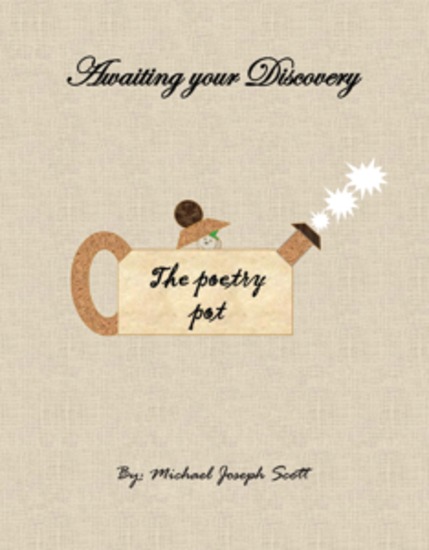
The Poetry Pot - cover

The Poetry Pot

Michael J. Scott

Verlag: Spines

  • 0
  • 0
  • 0

Beschreibung

This poetic collection takes us on a journey through life's mosaic, exploring its joys, sorrows, and the courage in between. With nostalgia for childhood wonder and the contemplation of age, it paints life’s odyssey. From inner battles to spiritual musings, these verses probe our existence, touching on love, loss, nature, and war. It's an intimate anthology that frames the human quest for meaning and celebrates the ephemeral beauty of life, urging readers to find magic in the moment and solace in the transcendental.
Verfügbar seit: 10.02.2026.
Drucklänge: 270 Seiten.

Weitere Bücher, die Sie mögen werden

  • The Queen of Sorrow - cover

    The Queen of Sorrow

    Rachel Lawson

    • 0
    • 0
    • 0
    Sorrow 
    Astra Queen of Vampires was born of the union of two monsters a mad killer for a mother and a evil sorcerer for a father he mother was under a spell until she was born so sad was her mother by her marriage to the hated enemy of her people and bearing his child she named her child Sorrow. 
    The pair were murdered by a lunatic themselves when Sorrow was a baby. 
    Her uncle raise her with his own children who didn't have powers like their mother a fate from a parallel world and their father a necromancer and enchanter Sorrow's uncle. She later became not just a vampire but their queen. It was Sorrow's uncle who named her Astra as it was a better name for a child to forget her sad start in life with a new name her old name it was like a man being called Sue nothing a man could life down. 
    She later married a friend Max Starfire the Sun's King and had a child called- Astra known as Astry. She would never give her child a bad name like herself. Astry was a vampire/ werewolf like her mother and father. 
    Not alive or dead something in between. 
    They were day walkers Max, Astra and their daughter. 
    Strange creatures neither vampire nor werewolf they were 
    Includes stories with Sorrow or Astra Queen of Vampires from my the Magicians series 
    Narrated by the author and guest narrating Addison Fell as Alexa in Bad Omens
    Zum Buch
  • Why I Was Late - cover

    Why I Was Late

    Charlie Petch

    • 0
    • 0
    • 0
    With kitchen-table candour and empathy, Charlie Petch’s debut collection of poems offers witness to a decades-long trans/personal coming of age, finding heroes in unexpected places.   
    Why I Was Late fuses text with performance, bringing a transmasculine wisdom, humour, and experience to bear upon tailgates, spaceships, and wrestling rings. Fierce, tender, convention re-inventing—Petch works hard. And whether it’s as a film union lighting technician, a hospital bed allocator, a Toronto hot dog vendor, or a performer/player of the musical saw, the work is survival. Heroes are found in unexpected places, elevated by both large and small gestures of kindness, accountability and acceptance. No subject—grief, disability, kink, sexuality, gender politics, violence—is off limits.  
    A poet so good at drag they had everyone convinced that they were a woman for the first forty years of their life, Petch has somehow brought the stage and its attendant thrills into the book. Better late than. And better.
    Zum Buch
  • Chasing Down the Dawn - Life Stories - cover

    Chasing Down the Dawn - Life...

    Anonym

    • 0
    • 0
    • 0
    Welcome to a world set to the ever-changing rhythms of an artist's life 
    In Chasing Down the Dawn, recording artist, actress, and bestselling author jewel opens her intimate journals to create a vivid montage of the people, places, and relationships that colored the life she came from and have marked this past magical, turbulent, and ultimately transformational year of her life. 
    Drawn from her remarkable chronicle of life on the road during the Spirit World Tour, this unforgettable collection of freeze-frames captures unusual images from jewel's childhood in Alaska, her beginnings as a struggling artist, and her challenges as a daughter, sister and woman. jewel paints an unblinkingly honest picture of the exceptional journey that carried her to the world's stage. 
    With acutely observed, elegantly written depictions of the musicians, lovers, strangers, celebrities and other characters that inhabit the singer/songwriter's world, Chasing Down the Dawn is more than a collection of, vignettes, observations and stories. It is a finely wrought mosaic in prose and poetry, set to the rhythm of life.
    Zum Buch
  • A Clergyman's Daughter - cover

    A Clergyman's Daughter

    George Orwell

    • 0
    • 0
    • 0
    A Clergyman's Daughter is a 1935 novel by English author George Orwell. It tells the story of Dorothy Hare, the clergyman's daughter of the title, whose life is turned upside down when she suffers an attack of amnesia. It is Orwell's most formally experimental novel, featuring a chapter written entirely in dramatic form, but he was never satisfied with it and he left instructions that after his death it was not to be reprinted. Despite these instructions, Orwell did consent to the printing of cheap editions "of any book which may bring in a few pounds for my heirs" following his death. 
      
    George Orwell, was an English novelist, essayist, journalist and critic. His work is characterized by lucid prose, biting social criticism, total opposition to totalitarianism, and outspoken support of democratic socialism. 
      
    Orwell produced literary criticism and poetry, fiction and polemical journalism. He is known for the allegorical novella Animal Farm (1945) and the dystopian novel Nineteen EightyFour (1949). His nonfiction works, including The Road to Wigan Pier (1937), documenting his experience of workingclass life in the north of England, and Homage to Catalonia (1938), an account of his experiences soldiering for the Republican faction of the Spanish Civil War (1936–1939), are as critically respected as his essays on politics and literature, language and culture. In 2008, The Times ranked George Orwell second among "The 50 greatest British writers since 1945". 
     
    Zum Buch
  • Love's Labour's Lost - cover

    Love's Labour's Lost

    William Shakespeare

    • 0
    • 0
    • 0
    King Ferdinand and his three friends, Biron, Longaville, and Dumain, plan to study philosophy for the next three years. During their academic pursuits, they must vow to sleep only three hours a night and not let any woman within a mile of court. These strict rules will prevent any distractions from their work - but their promises are soon put to the test when a princess and her three companions arrive for a state visit.
    Zum Buch
  • The Theogony - cover

    The Theogony

    Hesiod

    • 0
    • 0
    • 0
    The Theogony "the genealogy or birth of the gods" is a poem by Hesiod (8th – 7th century BC) describing the origins and genealogies of the Greek gods, composed c. 730–700 BC. It is written in the Epic dialect of Ancient Greek and contains 1022 lines. 
    Hesiod's Theogony is a large-scale synthesis of a vast variety of local Greek traditions concerning the gods, organized as a narrative that tells how they came to be and how they established permanent control over the cosmos. It is the first known Greek mythical cosmogony. The initial state of the universe is chaos, a dark indefinite void considered a divine primordial condition from which everything else appeared. Theogonies are a part of Greek mythology which embodies the desire to articulate reality as a whole; this universalizing impulse was fundamental for the first later projects of speculative theorizing.
    Hesiod appropriates to himself the authority usually reserved to sacred kingship. The poet declares that it is he, where we might have expected some king instead, upon whom the Muses have bestowed the two gifts of a scepter and an authoritative voice (Hesiod, Theogony 30–3), which are the visible signs of kingship. It is not that this gesture is meant to make Hesiod a king. Rather, the point is that the authority of kingship now belongs to the poetic voice, the voice that is declaiming the Theogony.
    Zum Buch