Join us on a literary world trip!
Add this book to bookshelf
Grey
Write a new comment Default profile 50px
Grey
Subscribe to read the full book or read the first pages for free!
All characters reduced
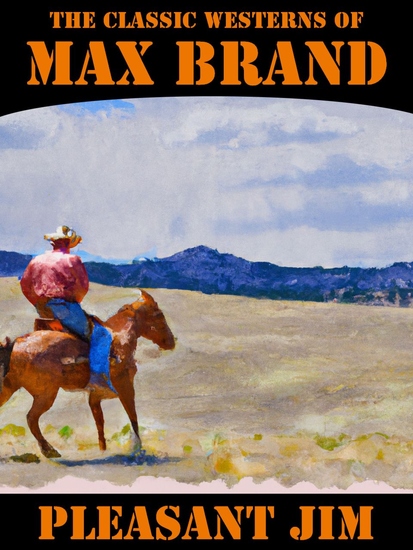
Pleasant Jim - cover

Pleasant Jim

Max Brand

Publisher: Wildside Press

  • 0
  • 0
  • 0

Summary

Gunslinger Charlie Rizdal was wanted dead or alive—eight thousand alive or five thousand dead. Jim Pleasant took him in alive and collected the eight thousand dollar bounty. But then Jim learned that Rizdal’s brother, Long Tom, has put a price on his own head. Now, Jim is fair game for every outlaw around...preferably dead!
Available since: 02/15/2023.
Print length: 176 pages.

Other books that might interest you

  • The Further Adventures of Robinson Crusoe - cover

    The Further Adventures of...

    Daniel Defoe

    • 0
    • 0
    • 0
    "The Further Adventures of Robinson Crusoe" is a novel by Daniel Defoe, first published in 1719. Just as in its significantly more popular predecessor, Robinson Crusoe (1719), the first edition credits the work's fictional protagonist Robinson Crusoe as its author. It was published under the considerably longer original title: The Farther Adventures of Robinson Crusoe; Being the Second and Last Part of His Life, And of the Strange Surprising Accounts of his Travels Round three Parts of the Globe. Although intended to be the last Crusoe tale, the novel is followed by a non-fiction book involving Crusoe by Defoe entitled Serious Reflections During the Life and Surprising Adventures of Robinson Crusoe: With his Vision of the Angelick World (1720). The story is speculated to be partially based on Moscow embassy secretary Adam Brand's journal detailing the embassy's journey from Moscow to Peking from 1693 to 1695.
    The book starts with the statement about Crusoe's marriage in England. He bought a little farm in Bedford and had three children: two sons and one daughter. Our hero suffered a distemper and a desire to see "his island." He could talk of nothing else, and one can imagine that no one took his stories seriously, except his wife. She told him, in tears, "I will go with you, but I won't leave you." But in the middle of this felicity, Providence unhinged him at once, with the loss of his wife.
    Show book
  • Top 10 Short Stories The - The Russian 19th - The top ten Short Stories of the 19th Century written by Russian authors - cover

    Top 10 Short Stories The - The...

    Alexander Puschkin, Nikolai...

    • 0
    • 0
    • 0
    Short stories have always been a sort of instant access into an author’s brain, their soul and heart.  A few pages can lift our lives into locations, people and experiences with a sweep of landscape, narration, feelings and emotions that is difficult to achieve elsewhere. 
     
    In this series we try to offer up tried and trusted ‘Top Tens’ across many different themes and authors. But any anthology will immediately throw up the questions – Why that story? Why that author?  
     
    The theme itself will form the boundaries for our stories which range from well-known classics, newly told, to stories that modern times have overlooked but perfectly exemplify the theme.  Throughout the volume our authors whether of instant recognition or new to you are all leviathans of literature. 
     
    Some you may disagree with but they will get you thinking; about our choices and about those you would have made.  If this volume takes you on a path to discover more of these miniature masterpieces then we have all gained something. 
     
    In the vast Empire of the Russians literature was a way to exchange ideas, values and cultures.  Yet each author, each story, each character is an individual example of a journey that, story by story, has transformed the glimmering arc of its literature.   
     
    1 - The Top 10 - The 19th Century - The Russians - An Introduction 
    2 - How Much Land Does A Man Need by Leo Tolstoy 
    3 - The Cloak by Nikolai Gogol also known as 'The Overcoat' 
    4 - The Crocodile. An Extraordinary Incident - Part 1 by Fyodor Dostoevsky 
    5 - The Crocodile. An Extraordinary Incident - Part 2 by Fyodor Dostoevsky 
    6 - Twenty-Six Men and a Girl by Maxim Gorky 
    7 - The Bet by Anton Chekhov 
    8 - The District Doctor by Ivan Turgenev 
    9 - The Shot by Alexander Pushkin 
    10 - Hide And Seek or Pliatki by Fyodor Sologub 
    11 - Taman by Mikhail Yurievich Lermontov 
    12 - The Signal by Vsevolod Garshin
    Show book
  • The Diary Of A Dead Officer - cover

    The Diary Of A Dead Officer

    Arthur Graeme West

    • 0
    • 0
    • 0
    Published posthumously in 1919, this collection of diary entries presents a scathing picture of army life and is said to be one of the most vivid accounts of daily life in the trenches. It chronicles West's increasing disillusion with war and his move toward pacifist and atheist beliefs. The final part consists of his powerful war poems, including God, How I Hate You, You Young Cheerful Men, and Night Patrol. West was killed by a sniper in 1917. In view of some of his poems, one wonders if death was not unwelcome. Arthur Graeme West was a British writer and war poet. West was born in Eaton, Norfolk, educated at Highgate School, then Blundell's School and Balliol College, Oxford, and killed by a sniper in 1917.
    Show book
  • Note on Realism A (Unabridged) - cover

    Note on Realism A (Unabridged)

    Robert Louis Stevenson

    • 0
    • 0
    • 0
    Robert Louis Stevenson was a Scottish novelist, essayist, poet and travel writer. Born and educated in Edinburgh, Stevenson suffered from serious bronchial trouble for much of his life, but continued to write prolifically and travel widely in defiance of his poor health. As a young man, he mixed in London literary circles, receiving encouragement from Andrew Lang, Edmund Gosse, Leslie Stephen and W. E. Henley, the last of whom may have provided the model for Long John Silver in Treasure Island.
    A NOTE ON REALISM: Style is the invariable mark of any master; and for the student who does not aspire so high as to be numbered with the giants, it is still the one quality in which he may improve himself at will. Passion, wisdom, creative force, the power of mystery or colour, are allotted in the hour of birth, and can be neither learned nor simulated.
    Show book
  • Æpyornis Island - From their pens to your ears genius in every story - cover

    Æpyornis Island - From their...

    H G Wells

    • 0
    • 0
    • 0
    Herbert George Wells was born on September 21st, 1866 at Atlas House, 46 High Street, Bromley, Kent. He was the youngest of four siblings and his family affectionately knew him as ‘Bertie’.  
    The first few years of his childhood were spent fairly quietly, and Wells didn’t display much literary interest until, in 1874, he accidentally broke his leg and was left to recover in bed, largely entertained by the library books his father regularly brought him. Through these Wells found he could escape the boredom and misery of his bed and convalescence by exploring the new worlds he encountered in these books.  
    From these humble beginnings began a career that was, after several delays, to be seen as one of the most brilliant of modern English writers.    
    Able to write comfortably in a number of genres he was especially applauded for his science fiction works such as The Time Machine and War of the Worlds but his forays into the social conditions of the times, with classics such as Kipps, were almost as commercially successful.  His short stories are miniature masterpieces many of which bring new and incredible ideas of science fiction to the edge of present day science fact.  Wells also received four nominations for the Nobel Prize in Literature 
    Despite a strong and lasting second marriage his affairs with other women also brought the complications of fathering other children.  His writings and work against fascism, as well as the promotion of socialism, brought him into increasing doubts with and opposition to religion.  His writings on what the world could be in works, such as A Modern Utopia, are thought provoking as well as being plausible, especially when viewed from the distressing times they were written in. 
    His diabetic condition pushed him to create what is now the largest Diabetes charity in the United Kingdom.  Wells even found the time to run twice for Parliament. 
    It was a long, distinguished and powerfully successful career by the time he died, aged 79, on August 13th, 1946.
    Show book
  • Anna Karenina (Part 7) - cover

    Anna Karenina (Part 7)

    Leo Tolstoy

    • 0
    • 0
    • 0
    Part 7: While visiting Moscow for Kitty's confinement, Kostya quickly gets used to the city's fast-paced, expensive and frivolous society life. He accompanies Stiva to a gentleman's club, where the two meet Vronsky. Kostya and Stiva pay a visit to Anna, who is occupying her empty days by being a patroness to an orphaned English girl. Kostya is initially uneasy about the visit, but Anna easily puts him under her spell. When he admits to Kitty that he has visited Anna, she accuses him of falling in love with her. The couple are later reconciled, realizing that Moscow society life has had a negative, corrupting effect on Kostya.
    Anna Karenina is a novel by the Russian author Leo Tolstoy, first published in book form in 1878. Many writers consider Anna Karenina the greatest work of literature ever, and Tolstoy himself called it his first true novel. It was initially released in serial installments from 1873 to 1877 in the periodical The Russian Messenger.
    Show book