Unisciti a noi in un viaggio nel mondo dei libri!
Aggiungi questo libro allo scaffale
Grey
Scrivi un nuovo commento Default profile 50px
Grey
Iscriviti per leggere l'intero libro o leggi le prime pagine gratuitamente!
All characters reduced
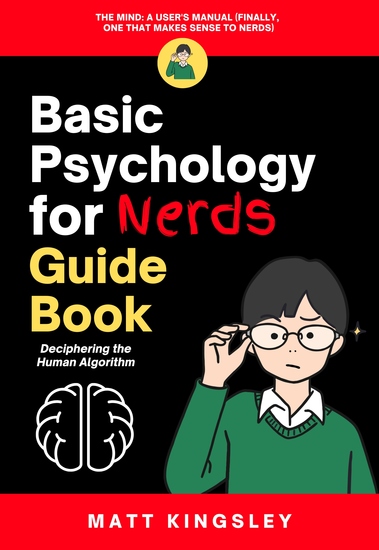
Basic Psychology for Nerds Guide Book - Psychology for BeginnersBasic Psychology GuidePsychology WorkbookHomeschool Psychology - cover

Basic Psychology for Nerds Guide Book - Psychology for BeginnersBasic Psychology GuidePsychology WorkbookHomeschool Psychology

Matt Kingsley

Casa editrice: Publishdrive

  • 0
  • 0
  • 0

Sinossi

Tired of "Feel-Good" Fluff and "Intuitive" Insights? Finally, Psychology for Those Who Demand Logic.
 
Let's be honest. Most psychology books are… well, squishy. They’re awash in touchy-feely anecdotes, vague pronouncements about “emotional intelligence,” and enough self-help jargon to make your circuits overheat. If you’re a creature of logic, a devotee of data, a nerd who prefers algorithms to affirmations, you’ve likely found yourself utterly bewildered by the prevailing discourse on the human mind.
 
But what if there was another way? What if you could approach the messy, unpredictable realm of human behavior with the same analytical rigor you apply to coding, physics, or astrophysics? What if you could finally debug the human operating system using the tools of science, not sentiment?
 
Introducing "Basic Psychology for Nerds: Deciphering the Human Algorithm (For Nerds Who Prefer Logic to Feelings)" – the guide book you’ve been waiting for, whether you knew it or not.
 
Forget the touchy-feely pronouncements and pop-psychology pabulum. This isn't your aunt Mildred's self-help manual. This is Psychological Science, dissected, analyzed, and presented in a language you, a discerning intellect, will actually understand and appreciate.
 
Inside, you’ll discover:
 
A brutally honest, no-nonsense approach to the human psyche: We ditch the sentimentalities and dive straight into the observable behaviors, the measurable outcomes, the scientific principles that actually govern why we do what we do. Think of it as psychological engineering, not psychological hand-waving.
 
Clear, concise explanations of complex concepts: From classical conditioning to cognitive biases, from anxiety disorders to the mysteries of schizophrenia – it's all here, explained with the precision and clarity you expect from a well-documented codebase. No mystical jargon, no hand-waving – just solid, scientifically grounded explanations.
 
Practical, expert tips you can actually use: Forget vague advice about “finding your inner peace.” We provide actionable, behaviorally-focused tips at the end of each chapter – think of them as debugging tools for your own life and interactions. These aren't recycled platitudes; they are strategies rooted in psychological science, designed for practical application.
 
A journey through the landscape of the mind, designed for the intellectually curious: From the fundamental principles of learning to the complexities of social behavior and mental disorders, this book takes you on a comprehensive – and yes, slightly exhaustive – exploration of the human psychological landscape. Prepare to have your assumptions challenged and your understanding deepened.
 
And yes, a healthy dose of skepticism: Because let’s face it, the human condition is inherently… messy. We don’t promise easy answers or utopian solutions. But we do promise a scientifically rigorous, intellectually stimulating, and frankly, more honest look at what makes us tick – and often, malfunction.
 
Stop relying on intuition and start understanding the science. Whether you’re a student of psychology, a seasoned programmer, a curious scientist, or simply a nerd who demands evidence-based explanations, this book is your essential guide.
 
Basic Psychology for Nerds" isn’t just a book; it’s a user’s manual for the mind, finally written in a language that makes sense to those of us who prefer logic to… well, everything else.
 
Order your copy today. Because understanding human behavior shouldn't feel like navigating a labyrinth of feelings. It should feel like… well, finally understanding the code.
Disponibile da: 06/09/2025.
Lunghezza di stampa: 20 pagine.

Altri libri che potrebbero interessarti

  • The Ethics of Technology - Moral Challengers - cover

    The Ethics of Technology - Moral...

    Craig Dames

    • 0
    • 0
    • 0
    In an age where technology permeates nearly every aspect of our lives, understanding the ethical foundations behind its development and use has never been more critical. Tech ethics, at its core, explores the moral principles that guide our decisions regarding the design, implementation, and impact of technology. As digital tools become increasingly powerful and integrated into society, they bring with them profound questions about responsibility, fairness, and the human consequences of innovation. 
    The roots of technology ethics can be traced back to classical moral philosophy. Thinkers like Aristotle, Kant, and Mill laid the groundwork for how we approach right and wrong, justice, and duty. These age-old theories—virtue ethics, deontology, and utilitarianism—are still highly relevant in today's tech-driven world. For instance, when we ask whether a self-driving car should prioritize the life of a passenger over a pedestrian, we are invoking these very moral frameworks to guide the decision-making process. In this way, ethical theory provides a lens through which we can evaluate the choices we make as developers, users, and regulators of technology. 
    Modern concerns surrounding tech ethics often revolve around issues that were unimaginable even a few decades ago. Digital privacy, algorithmic bias, and autonomous systems challenge us to reinterpret traditional moral values in new contexts. This requires a dynamic understanding of ethics—one that can evolve alongside technological change. Unlike in the past, where tools were relatively neutral and required human operation, today's technologies often act with a degree of independence, raising the stakes of their ethical implications. Machines that learn, adapt, and decide are not just tools; they become agents of action whose behavior must be morally accountable.
    Mostra libro
  • The Problems of Philosophy - cover

    The Problems of Philosophy

    Bertrand Russell

    • 0
    • 0
    • 0
    In this book, Russell tackles some of the most fundamental questions of human existence and provides a clear and concise introduction to the field of philosophy. Throughout the book, Russell's writing is clear, engaging, and accessible, making complex philosophical ideas understandable to readers with little or no background in the field. "The Problems of Philosophy" is a must-read for anyone interested in philosophy, and a great starting point for those new to the subject. Read in English, unabridged.
    Mostra libro
  • Big Mall - Shopping for Meaning - cover

    Big Mall - Shopping for Meaning

    Kate Black

    • 0
    • 0
    • 0
    A phenomenology of the mall: If the mall makes us feel bad, why do we keep going back? In a world poisoned by capitalism, is shopping what makes life worth living?
    		 
    In less than a century, the shopping mall has morphed from a blueprint for a socialist utopia to something else entirely: a home to disaffected mallrats and depressed zoo animals, a sensory overload and consumerist trap.
    		 
    Kate Black grew up in North America’s largest mall: West Edmonton Mall — a mall on steroids. It’s the site of a notoriously lethal rave for teenagers, a fatal rollercoaster accident, and more than one gun-range suicide; it’s where oil field workers reap the social mobility of a boom-and-bust economy, the impossibly large structure where teens attempt to invent themselves in dark Hollister sales racks and weird horny escapades in the indoor waterpark. It’s a place people love to hate and hate to love — a site of pleasure and pain, of death and violence, of (sub)urban legend.
    		 
    Can malls tell us something important about who we are? Blending a history of shopping with a story of coming-of-age in North America’s largest and strangest mall, Big Mall nvestigates how these structures have become the ultimate symbol of late-capitalist dread — and, surprisingly, a subversive site of hope. Ultimately, a close look at the mall reveals clues to how a good life in these times is possible.
    		 
    “Speaking as a child of PacSun and Hot Topic myself, Big Mall is like a madeleine dipped in Orange Julius. Like a mall, the book itself has a lot of everything, a sublime mix of memoir, history, and cultural criticism. Kate Black is a learned Virgil in the consumerist Inferno, always avoiding the obvious and leading us to surprising connections — oil, suicide, Reddit, squatters, dolphins. Whether malls fill you with nostalgia or horror, this book will change your relationship to the world we've constructed around us.” — Tony Tulathimutte, author of Private Citizens
    		 
    “Before there was Instagram, there was the mall. But what happens when a seasonless, tacky, fantasyland is all you knew growing up? How does one embrace a genuinely fake experience? Or to be more precise, a fake but genuine experience? Kate Black’s Big Mall is a smart, sentimental, and perspective-shifting look at the outsized role that big malls play in modern life. Love ’em or hate ’em, one thing’s for sure: after reading this book, you’ll never look at a mall in the same way again.” — Ziya Tong, Science broadcaster & author of The Reality Bubble
    Mostra libro
  • Stokely Carmichael: The Life and Legacy of the Civil Rights Activist Who Led the Black Power Movement - cover

    Stokely Carmichael: The Life and...

    Editors Charles River

    • 0
    • 0
    • 0
    “Our grandfathers had to run, run, run. My generation's out of breath. We ain't running no more.” – Stokely Carmichael 
    In the late 1960s, Stokely Carmichael would become one of the most influential and controversial figures in America, founding and leading new organizations while being meticulously shadowed by the country’s national security apparatus, particularly J. Edgar Hoover’s FBI. The attention would ultimately compel him to move to Africa, where he changed his name to Kwame Ture and became one of the world’s most famous Pan-African leaders until his death in Guinea in 1998.  
    Since then, he has remained a subject of both praise and criticism, from contemporaries and historians alike. SNCC Chairman Phil Hutchings, despite being the one who pushed Carmichael out of the organization, aptly summed up the dichotomy: "Even though we kidded and called him 'Starmichael', he could sublimate his ego to get done what was needed to be done....He would say what he thought, and you could disagree with it but you wouldn't cease being a human being and someone with whom he wanted to be in relationship." 
    Mostra libro
  • Start Ghetto - No-Nonsense Goal Setting for Self-Help Haters - cover

    Start Ghetto - No-Nonsense Goal...

    la tetra o.

    • 0
    • 0
    • 0
    A Blueprint for Those Who Can’t Afford to Wait 
    You didn’t wait to be chosen. You chose. Broke. Tired. Still moving. That’s momentum. 
    Start Ghetto is a sharp, irreverent tool for anyone who started with nothing but audacity, old shame, and seven crinkled dollars to their name. This book asks you to build with what you’ve got, from where you are… especially when the world forces you to “make it enough.” 
    Start Ghetto is a field guide for dreamers who are done pretending they don’t want more but are tired of being told to manifest better, dream harder, and pray a little longer. Through real talk, callouts, and permission-free practices, you’ll learn to:Confront the internal lies that keep you stuckRewrite how you speak to yourself when no one’s listeningUnhook from shame-based ambition and false urgencySet grounded goals backed by your truth, not their timeline 
    With the inclusion of the G.H.E.T.T.O. Method™—a radical blueprint for goal-setting that doesn’t require perfection, privilege, or permission—you’ll learn how to move like someone who belongs to themselves. 
    Narrated by the author for an unfiltered, straight-from-the-source experience. 
    The first book in the F*ck Around & Flourish series, Start Ghetto is for the ones still broke, still dreaming, and still not asking for permission.
    Mostra libro
  • The Conquest of Bread - cover

    The Conquest of Bread

    Peter Kropotkin

    • 0
    • 0
    • 0
    The Conquest of Bread  is an 1892 book by the Russian anarcho-communist Peter Kropotkin.
    Peter Kropotkin was born a Russian prince whose father owned 1,200 serfs. But he became  a Russian activist, writer, revolutionary, scientist, economist, sociologist, historian, essayist, researcher, political scientist, biologist, geographer  and philosopher.
    The Conquest of Bread has become a classic of political anarchist literature. It was heavily influential on both the Spanish Civil War and the Occupy movement.
    In the work, Kropotkin goes on to propose a more decentralized economic system based on mutual aid and voluntary cooperation, asserting that the tendencies for this kind of organization already exist, both in evolution and in human society.
    Mostra libro