Unisciti a noi in un viaggio nel mondo dei libri!
Aggiungi questo libro allo scaffale
Grey
Scrivi un nuovo commento Default profile 50px
Grey
Iscriviti per leggere l'intero libro o leggi le prime pagine gratuitamente!
All characters reduced
Self-Advocacy for Learners - cover

Self-Advocacy for Learners

Mason Ross

Traduttore A AI

Casa editrice: Publifye

  • 0
  • 0
  • 0

Sinossi

"Self-Advocacy for Learners" offers a comprehensive guide to empowering students, especially those with learning disabilities, to actively participate in their education. It emphasizes the importance of understanding one's learning profile, communicating needs effectively, and engaging in educational planning, highlighting how these skills foster independence and self-worth.

 
The book traces the evolution of special education, examining legal frameworks like IDEA that mandate student involvement in IEPs, advocating for more inclusive, student-centered approaches. This academic self-help resource argues that explicit instruction in self-advocacy is crucial for students with learning disabilities to reach their full potential.

 
Did you know that students who advocate for themselves often experience increased academic achievement and improved self-esteem?

 
The book progresses from defining self-advocacy and understanding learning disabilities to developing practical communication strategies and goal-setting techniques. Unique in its practical approach, the book provides step-by-step guidance, lesson plans, and assessment tools for educators, parents, and students. Supported by research from educational psychology and disability studies, it demonstrates the positive impact of self-advocacy interventions. The book culminates in a discussion of the long-term benefits, including success in post-secondary education.
Disponibile da: 22/02/2025.
Lunghezza di stampa: 117 pagine.

Altri libri che potrebbero interessarti

  • Martin Guerre - cover

    Martin Guerre

    Alexandre Dumas

    • 0
    • 0
    • 0
    "Martin Guerre" by Alexandre Dumas recounts the gripping true story of identity and deception in 16th-century France. Martin Guerre, a peasant, abandons his family, only for a man claiming to be him to return years later. The impostor, Arnaud du Tilh, seamlessly integrates into Martin’s life, earning the trust of his wife and community. However, cracks in his facade lead to a dramatic trial that questions truth, loyalty, and justice. Dumas explores themes of identity, love, and societal expectations, painting a vivid picture of rural life and legal drama. A tale of intrigue and human complexity, it reflects on the fragility of trust and the consequences of ambition, blending history with suspenseful storytelling.
    Mostra libro
  • Summary of Tucker - by Chadwick Moore: Key Takeaways Summary & Analysis - cover

    Summary of Tucker - by Chadwick...

    Brooks Bryant

    • 0
    • 0
    • 0
    DISCLAIMER: THIS IS NOT THE OFFICIAL BOOK. 
    This is a summary, & it does not accompany the official 
    In "Tucker" by Chadwick Moore, readers gain an intimate understanding of the influential and polarizing figure Tucker Carlson, who became a powerful counternarrative voice on cable news for tens of millions of Americans. Carlson's unique perspective challenged the establishment, Washington, and the mainstream media on crucial issues like the COVID-19 vaccine, the January 6 events, the Ukraine war, and even UFOs, earning him the highest ratings in cable news history. 
    This book delves beyond the television persona to explore the man behind the camera. Chadwick Moore, with unprecedented access, delves into Tucker Carlson's upbringing, motivations, and personal life. Drawing from extensive interviews with Carlson, his family, colleagues, acquaintances, and even his critics, "Tucker" offers a comprehensive and revealing look into the life and career of one of the most influential and controversial figures in American politics and culture.
    Mostra libro
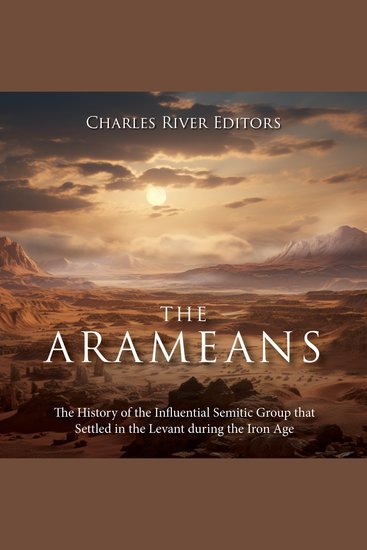
  • Arameans The: The History of the Influential Semitic Group that Settled in the Levant during the Iron Age - cover

    Arameans The: The History of the...

    Editors Charles River

    • 0
    • 0
    • 0
    When the Late Bronze Age system of the Near East collapsed around the year 1200 BCE, the empires and kingdoms that had ruled the region for hundreds of years were replaced by new dynasties and peoples. In some cases – such as in Egypt, Assyria, and Babylon – new dynasties came to power that followed the culture and styles of previous generations. However, alongside them new ethnic groups also came to power, some of whom took advantage of the general chaos following the Bronze Age collapse to migrate to the region. Some of these new waves of migrants entered the Near East from Europe via the Mediterranean Sea and Anatolia, while others came from Arabia. They all brought with them new weapons, ideas, and plenty of new people that eventually helped establish a new, early Iron Age order in the Near East. Among these new groups that came to prominence in the early Iron Age Near East, the Arameans were arguably the most important. 
    	The Arameans entered the historical record just after the collapse of the Bronze Age, and although they were once thought to be one of the factors in the Bronze Age collapse, most scholars now see them as taking advantage of the situation more than bringing it about. Once the Arameans entered the Levant and Mesopotamia, they influenced their new homes to varying degrees, ranging from having little influence in southern Mesopotamia to being a major geopolitical player in the inland Levant. An examination of Aramean history and culture reveals that the Arameans were a people who were not so easy to define, as they had no central leadership, and they often adopted the cultural attributes of their neighbors. With that said, historians, archaeologists, and philologists have identified a definite Aramean culture that at times played a major role in the wider cultural events of the Near East.
    Mostra libro
  • Penis Guide The - Everything You Need To Know From Erections Enhancements & Erectile Dysfunction to Porn Penile Enlargement & Pelvic Floor Kegels - cover

    Penis Guide The - Everything You...

    Jason Brown

    • 0
    • 0
    • 0
    Is your penis small, or are you just disillusioned? Do erections and ejaculations just happen, or do you have control over them? Can your penis fail, and will that be the end for you? 
    Imagine all the things the penis does that we all take for granted – sturdy erections, explosive orgasms, fatherhood. We rarely think twice about the role of the penis in all these, but what do we stand to gain if we took the time to study the penis? 
    Imagine having all the knowledge and understanding to prevent all those embarrassing sexual shortcomings that all men experience at some point in their lives. Imagine knowing exactly what you need to do to prevent erectile dysfunction and to last longer in bed. This book is the thing you’ve been missing – the operating manual for your penis. 
    Penis 101 helps men because in this book, we stick to the fundamentals. We don’t delve into highly technical medical procedures and convoluted explanations – we just focus on what you need to know, and what actions you can take to keep your penis healthy and functional every day. 
    In this book, you will discover: 
    - Why men have difficulty getting it up, and how you can keep that from ever happening to you. 
    - What pornography does to you and why you probably won’t enjoy being a porn star. 
    - The connection between your penis function and your overall health and wellness. 
    - Why the food you eat might be killing your penis, and what to do about it. 
    - What can go wrong with your penis, and how to prepare for or prevent undesired eventualities. 
    You can enjoy a healthy, fulfilling sex life, no matter your age, level of health, or penis size. All you need is to understand and internalize the knowledge and principles explained in this book. 
    Regain sexual confidence today. Come inside and let's get started!
    Mostra libro
  • The Miracle of Our Universe - A New View of Consciousness God Science and Reality - cover

    The Miracle of Our Universe - A...

    Marsha Sims, Bernard Haisch

    • 0
    • 0
    • 0
    Without consciousness there is nothing. Have you ever wondered why and how the world around you came to exist, and whether there might be an afterlife experience awaiting you after our physical bodies die? Might there actually be a God and a heaven of some sort? The hypothesis presented in this book is that our seemingly physical universe of matter and energy is a virtual simulation which is thought into existence by a universal consciousness which we call God. 


    A reason for a universal consciousness to do such a thing could be to experience and evolve itself through the free will actions of its offspring. This would entail thinking into existence a virtual universe so as to interact with such a universe and each other. Literally everything is consciousness in action, resulting in a gigantic cosmic simulation. We and other creatures are offspring of this God consciousness. 


    The Miracle of Our Universe explores the forefront of science and spirituality research, including: Are near-death experiences real? What is the Zero-Point Field? What kind of being could God be? Is there some place that God could have come from? How does the Big Bang figure into this? Is there an afterlife and what could it be like? What is the purpose of life? Is consciousness all there is? Is the Universe a virtual reality? Why is Hell impossible?
    Mostra libro
  • Resistance to Imperialism - How Colonized Nations Fought for Independence and Sovereignty - cover

    Resistance to Imperialism - How...

    Arlo Holders

    • 0
    • 0
    • 0
    Imperialism, a system of domination and exploitation, has shaped the course of human history for centuries. At its core, imperialism refers to the policy of a nation extending its power and influence through diplomacy or military force. Colonization, often considered its most aggressive form, involves the establishment of control over a foreign territory, exploiting its resources, and subjugating its people. The roots of imperialism date back to ancient civilizations, but the most notable period of imperial expansion occurred between the 15th and early 20th centuries, driven by European powers such as Britain, France, Spain, and Portugal. 
    The Age of Exploration, beginning in the late 15th century, marked the beginning of a new era of European imperialism. With the development of advanced navigational technologies, European nations sought to expand their empires by discovering new trade routes and territories. Colonization became intertwined with economic ambition, as European countries sought access to valuable resources like gold, spices, and sugar. The discovery of the Americas by Christopher Columbus in 1492 marked the start of extensive European colonization in the Western Hemisphere, followed by the establishment of colonies in Asia and Africa. 
    The motivations for colonization were multifaceted. Economically, European nations sought to control trade routes and establish lucrative colonies that could supply raw materials, which would fuel the industrial revolutions in Europe. Politically, nations pursued imperialism as a way to enhance their power and prestige on the world stage. Colonization also provided a solution to domestic issues, such as overpopulation and unemployment, by offering new lands for settlement and economic opportunity.
    Mostra libro