


Unisciti a noi in un viaggio nel mondo dei libri!
Aggiungi questo libro allo scaffale
Grey
Scrivi un nuovo commento Default profile 50px
Grey
Iscriviti per leggere l'intero libro o leggi le prime pagine gratuitamente!
All characters reduced
Ruins and Old Trees Associated with Memorable Events in English History - cover

Ruins and Old Trees Associated with Memorable Events in English History

Mary Roberts

Casa editrice: DigiCat

  • 0
  • 0
  • 0

Sinossi

In "Ruins and Old Trees, Associated with Memorable Events in English History," Mary Roberts intricately weaves a tapestry of historical reflections and natural beauty, exploring the significant sites across England that bear witness to its storied past. Her lyrical prose captures not just the physical attributes of these ruins and trees, but also their emotional resonance within the broader narrative of English history. The book is grounded in a rich literary context, echoing the Romantic tradition of finding sublime beauty in nature while meditating on the passage of time and the legacies left behind by historical events. Mary Roberts, an eminent scholar and cultural historian, draws upon her extensive background in English literature and history, likely influenced by her deep appreciation for the intertwined nature of people and place. Her passion for England's heritage shines through every page, revealing how these remnants of the past continue to inspire contemplation and reverence. Roberts' previous works have often examined the intersection of nature with cultural identity, making this book a vital addition to her oeuvre. I wholeheartedly recommend "Ruins and Old Trees" to readers seeking a beautiful intersection of history, nature, and literature. This work is an essential guide for both the casual lover of England and the serious scholar, as it breathes life into the remnants of the past, encouraging reflection on the profound connections between history, landscape, and memory.
Disponibile da: 16/09/2022.
Lunghezza di stampa: 2255 pagine.

Altri libri che potrebbero interessarti

  • A Call to Farms - Reconnecting to Nature Food and Community in a Modern World - cover

    A Call to Farms - Reconnecting...

    Jennifer Grayson

    • 0
    • 0
    • 0
    Hope for the future lies with a new generation of regenerative farmers. 


    Within a decade, nearly half of all American farmland will change hands as an older generation of farmers steps aside. In their place, a groundswell of new growers will face numerous challenges, including soil degradation, insufficient income, and investors devouring farmland at a staggering pace. These new farmers are embracing regenerative agriculture—the holistic approach to growing food that restores the soil and biodiversity—in the movement to reclaim our health and the planet's. But can their efforts help reverse an epidemic of diet-related disease, food inequality, and even climate change? 


    To answer that question and more, award-winning journalist Jennifer Grayson embedded herself in a groundbreaking farmer training program, then embarked on this investigative journey. The diverse array of farmers, graziers, and food activists whom she profiles here are working toward better, more sustainable foodways for all. From a one-acre market garden in Oregon to activists reviving food sovereignty in South Carolina, A Call to Farms tells the captivating story of these new agrarians finding hope and purpose in reconnecting to the land and striving to improve the future of American food.
    Mostra libro
  • Animals in Ancient Rome: The History of the Roles that Different Animals Played across the Roman Empire - cover

    Animals in Ancient Rome: The...

    Editors Charles River

    • 0
    • 0
    • 0
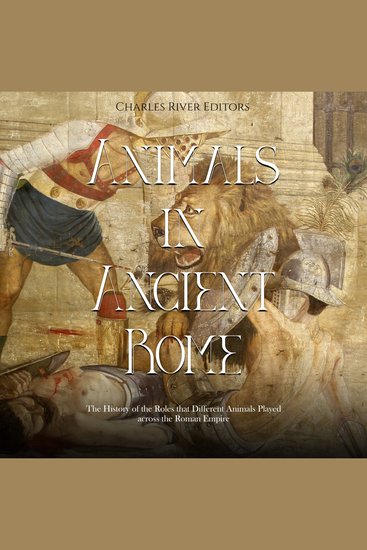
    Rome's complex relationship with animals goes right back to its foundation myth, and even today, the wolf remains a symbol of the Eternal City, forming part of the logo for the capital's football team, A. S. Roma. According to tradition, the city of Rome was founded by Romulus, who, with his brother Remus, was nursed and sheltered by a she-wolf. That tale, widely believed as a historical fact by ancient Romans, had a profound influence on Roman culture, and in part that shaped Roman attitudes toward their animals. The actual cave where Romulus and Remus were said to have been raised, the Lupercal, is thought to have been situated on the Palatine Hill in the very heart of Rome, and there was a claim by some archaeologists it had been found in 2007. True or not, the story of the wolf and its link to the beginnings of Rome continues to intrigue modern citizens, and the recent return of a family of wolves to the outskirts of Rome was greeted with wild enthusiasm. 
    	Other than the tale of the she-wolf with Romulus and Remus, the overriding images and stories of Roman animals that have come down through popular culture to modern times largely concern the vicious animal fights put on in the Colosseum, stories of Christians being thrown to the lions, and Hannibal's invasion of Italy with elephants. Indeed, the widely accepted view is that Romans were uncommonly brutal to their animals and had little empathy for them, and in terms of the Romans' scientific knowledge about animals, it appears much of it came to them from the Greeks.
    Mostra libro
  • Laches - cover

    Laches

    Plato

    • 0
    • 0
    • 0
    "Laches" is a philosophical dialogue by Plato that explores the nature of courage and the role of education in developing moral virtue. The dialogue takes place between Socrates and two generals, Laches and Nicias, who are both renowned for their military expertise. Socrates begins by questioning Laches and Nicias about their understanding of courage. They both agree that courage involves endurance in the face of danger, but they struggle to define it more precisely. Socrates then challenges their beliefs by asking them to consider whether courage is simply a matter of endurance or whether it also involves knowledge and wisdom. Read in English, unabridged.
    Mostra libro
  • Bad Company - Private Equity and the Death of the American Dream - cover

    Bad Company - Private Equity and...

    Megan Greenwell

    • 0
    • 0
    • 0
    A timely work of singular reportage and a damning indictment of the private equity industry told through the stories of four American workers whose lives and communities were upended by the ruinous effects of private equity takeovers. 
    Private equity runs our country, yet few Americans have any idea how ingrained it is in their lives. Private equity controls our hospitals, daycare centers, supermarket chains, voting machine manufacturers, local newspapers, nursing home operators, fertility clinics, and prisons. The industry even manages highways, municipal water systems, fire departments, emergency medical services, and owns a growing swath of commercial and residential real estate. 
    Private equity executives, meanwhile, are not only among the wealthiest people in American society, but have grown to become modern-day barons with outsized influence on our politics and legislation. CEOs of firms like Blackstone, Carlyle, KKR, and Apollo are rewarded with seats in the Senate and on the boards of the country’s most august institutions; meanwhile, entire communities are hollowed out as a result of their buyouts. Workers lose their jobs. Communities lose their institutions. Only private equity wins. 
    Acclaimed journalist Megan Greenwell’s Bad Company unearths the hidden story of private equity by examining the lives of four American workers that were devastated as private equity upended their employers and communities: a Toys R Us floor supervisor, a rural doctor, a local newspaper journalist, and an affordable housing organizer. Taken together, their individual experiences also pull back the curtain on a much larger project: how private equity reshaped the American economy to serve its own interests, creating a new class of billionaires while stripping ordinary people of their livelihoods, their health care, their homes, and their sense of security. 
    In the tradition of deeply human reportage like Matthew Desmond’s Evicted, Megan Greenwell pulls back the curtain on shadowy multibillion dollar private equity firms, telling a larger story about how private equity is reshaping the economy, disrupting communities, and hollowing out the very idea of the American dream itself. Timely and masterfully told, Bad Company is a forceful rebuke of America’s most consequential, yet least understood economic forces.
    Mostra libro
  • Atlantis; The Antediluvian World - cover

    Atlantis; The Antediluvian World

    Ignatius Donnelly

    • 0
    • 0
    • 0
    Atlantis: The Antediluvian World explores the mysteries and possibilities of a lost civilization that may have shaped ancient history. Originally written by Ignatius Donnelly, this groundbreaking work pieces together mythological, geological, and historical clues that suggest Atlantis was once a thriving, technologically advanced society destroyed by a cataclysm. Through compelling arguments and fascinating insights, Donnelly's work has inspired generations to question what we know about human history and what might lie hidden beneath the waves. 
    Perfect for anyone with an interest in ancient mysteries, lost civilizations, and alternative histories, Atlantis: The Antediluvian World challenges us to reconsider humanity's origins and ponder what forgotten knowledge might still influence our present.
    Mostra libro
  • The Abercrombie Age - Millennial Aspiration and the Promise of Consumer Culture - cover

    The Abercrombie Age - Millennial...

    Myles Ethan Lascity

    • 0
    • 0
    • 0
    Be popular and good-looking—it's the key to a happy life. Luckily, with a bit of know-how and money, you, too, can have it all. At least, that's what teen pop culture was selling in surround sound at the turn of the millennium. From movies like Clueless to TV's Dawson's Creek to the music videos on MTV's Total Request Live and the catalogs of Abercrombie & Fitch, a consumer-minded ethos drove pop culture storytelling as millennials came of age in the late 1990s and early 2000s. But in the long shadow of the Great Recession, the upwardly mobile aspirations fostered by the era's popular culture and media seem to have been thwarted. Many millennials today lack the wealth their parents had at the same age, and the gaps between rich and poor rival those of the Gilded Age. 


    The Abercrombie Age reconsiders teen popular culture from the turn of the twenty-first century, revealing how it told young people that life not only could but surely would get better. Far from frivolous or forgettable, the era's superficial, materialistic culture sold millennials unrealistic expectations of what life could offer, setting up a stark juxtaposition with the realities of today.
    Mostra libro
