Unisciti a noi in un viaggio nel mondo dei libri!
Aggiungi questo libro allo scaffale
Grey
Scrivi un nuovo commento Default profile 50px
Grey
Iscriviti per leggere l'intero libro o leggi le prime pagine gratuitamente!
All characters reduced
Mysterious Missing Objects - cover

Mysterious Missing Objects

Mark Chambers

Traduttore A AI

Casa editrice: Publifye

  • 0
  • 0
  • 0

Sinossi

Mysterious Missing Objects explores the captivating realm of history's unexplained disappearances, focusing on lost treasures, missing manuscripts, and vanished artifacts. These irretrievable losses reveal intriguing insights into human nature and the fragility of cultural heritage. Consider the Florentine Diamond, a treasure sparking relentless searches, or the lost scrolls of Alexandria, whose absence potentially erased entire chapters of history.

 
The book uniquely blends History with True Crime, appealing to those fascinated by historical investigations and unsolved mysteries.

 
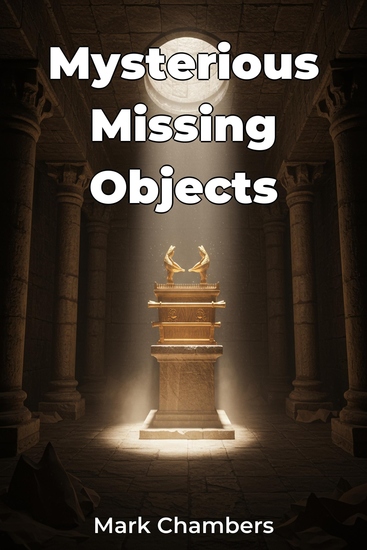
The book progresses methodically, first introducing the concept of "irretrievable loss" and the motivations behind the pursuit of these objects. It then presents detailed case studies, drawing upon historical records and archaeological findings to investigate disappearances like that of the Ark of the Covenant.

 
Finally, it analyzes the broader implications of these losses, considering their impact on historical narratives and ethical considerations surrounding their potential recovery. Through rigorous research and a multi-faceted perspective incorporating forensic science and criminology, Mysterious Missing Objects offers a comprehensive yet accessible overview.

 
It acknowledges the limitations of available information, presenting different viewpoints on controversies surrounding ownership and authenticity. The book invites readers to contemplate the profound impact of what is no longer there, making it valuable for anyone interested in history, archaeology, or the pursuit of missing objects.
Disponibile da: 31/03/2025.
Lunghezza di stampa: 63 pagine.

Altri libri che potrebbero interessarti

  • South Toward Home - Travels in Southern Literature - cover

    South Toward Home - Travels in...

    Margaret Eby

    • 0
    • 0
    • 0
    A literary travelogue into the heart of classic Southern literature. What is it about the South that has inspired so much of America's greatest literature? And why, when we think of Flannery O'Connor or William Faulkner or Harper Lee, do we think of them not just as writers, but as Southern writers? In South Toward Home, Margaret Eby-herself a Southerner-travels through the South in search of answers to these questions, visiting the hometowns and stomping grounds of some of our most beloved authors. From Mississippi (William Faulkner, Eudora Welty, Richard Wright) to Alabama (Harper Lee, Truman Capote) to Georgia (Flannery O'Connor, Harry Crews) and beyond, Eby looks deeply at the places that these authors lived in and wrote about. South Toward Home reveals how these authors took the people and places they knew best and transmuted them into lasting literature. Side by side with Eby, we meet the man who feeds the peacocks at Andalusia, the Georgia farm where Flannery O'Connor wrote her most powerful stories; we peek into William Faulkner's liquor cabinet to better understand the man who claimed civilization began with distillation and the "postage stamp of native soil" that inspired him; and we go in search of one of New Orleans's iconic hot dog vendors, a job held by Ignatius J. Reilly in John Kennedy Toole's A Confederacy of Dunces. From the library that showed Richard Wright that there was a way out to the courtroom at the heart of To Kill a Mockingbird, Eby grapples with a land fraught with history and mythology, for, as Eudora Welty wrote, "One place understood helps us understand all places better." Combining biographical detail with expert criticism, Eby delivers a rich and evocative tribute to the literary South.
    Mostra libro
  • The Crisis of Psychoanalysis - Essays on Freud Marx and Social Psychology - cover

    The Crisis of Psychoanalysis -...

    Erich Fromm

    • 0
    • 0
    • 0
    "This book is must [listening] . . . although it will at times shock and perhaps even offend the sensibilities of traditional therapists." —American Journal of Psychiatry 


    This book brings together Erich Fromm's basic statements on the application of psychoanalytic theory to social dynamics. At the same time, it offers an image of man consonant with the hopes of radical humanism. 


    The Crisis of Psychoanalysis is a collection of nine brilliant essays. Although his work is deeply rooted in Freudian theory, Fromm further develops Freud's doctrines by including both social and ethical dimensions, and applies his discoveries and insights to address the problems we face in society at large.
    Mostra libro
  • The Good Mother Myth - Unlearning Our Bad Ideas About How to Be a Good Mom - cover

    The Good Mother Myth -...

    Nancy Reddy

    • 0
    • 0
    • 0
    Timely and thought-provoking, Nancy Reddy unpacks and debunks the bad ideas that have for too long defined what it means to be a "good" mom.When Nancy Reddy had her first child, she found herself suddenly confronted with the ideal of a perfect mother—a woman who was constantly available, endlessly patient, and immediately invested in her child to the exclusion of all else. Reddy had been raised by a single working mother, considered herself a feminist, and was well on her way to a PhD. Why did doing motherhood "right" feel so wrong?For answers, Reddy turned to the mid-20th century social scientists and psychologists whose work still forms the basis of so much of what we believe about parenting. It seems ludicrous to imagine modern moms taking advice from midcentury researchers. Yet, their bad ideas about so-called “good” motherhood have seeped so pervasively into our cultural norms. In The Good Mother Myth, Reddy debunks the flawed lab studies, sloppy research, and straightforward misogyny of researchers from Harry Harlow, who claimed to have discovered love by observing monkeys in his lab, to the famous Dr. Spock, whose bestselling parenting guide included just one (1!) illustration of a father interacting with his child.This timely and thought-provoking audiobook will make you laugh, cry, and want to scream (sometimes all at once).  Blending history of science, cultural criticism, and memoir, The Good Mother Myth pulls back the curtain on the flawed social science behind our contemporary understanding of what makes a good mom.A Macmillan Audio production from St. Martin’s Press.
    Mostra libro
  • Pancho Villa Expedition The: The History of the US Army’s Attempt to Capture Mexico’s Most Famous Revolutionary - cover

    Pancho Villa Expedition The: The...

    Charles River Editors

    • 0
    • 0
    • 0
    “Pancho Villa,” people whispered at the beginning of the 20th century, "can march 100 miles without stopping, live 100 days without food, go 100 nights without sleep, and kill 100 men without remorse." The legend of Francisco Villa is full of heroism, tragedy and romance, a story about how a poor farmer boy became a bandit after avenging an injustice on his family and transformed into a military genius who fled from an oppressive government to lead the largest revolutionary army in his country's history. He defeated a dictatorship to become Mexico´s liberator, only to fall again in disgrace when his troops abandoned him or were massacred by the enemy. Pancho Villa and his cavalry, Mexicans point out with a certain amount of pride, invaded the United States, and although they came and tried to capture him, they never found him.  
    	At 4:00 a.m. on the morning of March 9, 1916, Villa and about 500 Mexican soldiers attacked the town of Columbus, New Mexico, a rare time instance when the continental United States was attacked by a foreign army with their "boots on the ground." Villa was reportedly desperate and furious because the American government had recognized the hated Carranza´s government. Other historians attribute more banal reasons for the ruthless attack on New Mexico, claiming that an American trader, who was living in Columbus, had supposedly sold Villa defective ammunition.  
    	Whatever the reason, Villa crossed the border after midnight, and a few hours later, his men stormed the peacefully sleeping town, or at least so it seemed. Villa's men attacked Columbus from four directions, shooting high and low, looting shops, and burning everything in its path.  
    	The subsequent military response, not against Mexico, but Pancho Villa specifically, was a kind of sophisticated training for World War I. 	On April 18, American newspapers published these spirited words: "Villa is dead!" Villa had certainly been hurt and was hiding in a cave, but he was very much alive.
    Mostra libro
  • Reality and the Arts - cover

    Reality and the Arts

    Albert A. Anderson

    • 0
    • 0
    • 0
    Art is the creative manifestation of essences. In order to understand the relation between art and reality, we need a philosophical guide. The best way to comprehend how the creative act of imagining enables the mind to seek reality is to employ the kind of dialectical thinking that Plato used in his dialogues. Beginning with the shadows on the wall of the cave in which each person dwells, that process gradually enables us to grasp the essences that are manifested in individual works of art.
     
    Without a philosophical guide, we are likely to encounter only a blur of images in the visual arts, a cacophony of sounds in music, a whirl of activity in the theater, and chaos in the building of cities. It is too much to expect a set of final answers to any serious question about what is true, good, or beautiful. If we abandon the quest for reality we settle for too little. Plato’s dialectical approach offers a path between Scylla and Charybdis.
    Mostra libro
  • A Rare Recording of President John F Kennedy’s Last Speech Before His Assassination - cover

    A Rare Recording of President...

    President John Fitzgerald Kennedy

    • 0
    • 0
    • 0
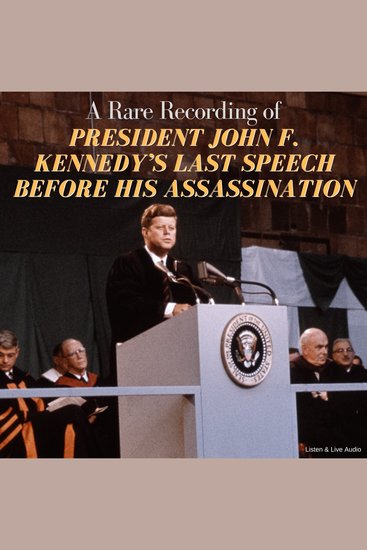
    On November 22, 1963, President John F. Kennedy made a speech to the Fort Worth, Texas, Chamber of Commerce; he was assassinated later that afternoon. Kennedy had traveled to the state to unite Texas Democrats where party leaders were feuding and extremists were contributing to political tensions. Kennedy knew an intra-party feud in Texas could jeopardize his chances of carrying the state for his 1964 re-election campaign.
    Mostra libro