Join us on a literary world trip!
Add this book to bookshelf
Grey
Write a new comment Default profile 50px
Grey
Subscribe to read the full book or read the first pages for free!
All characters reduced
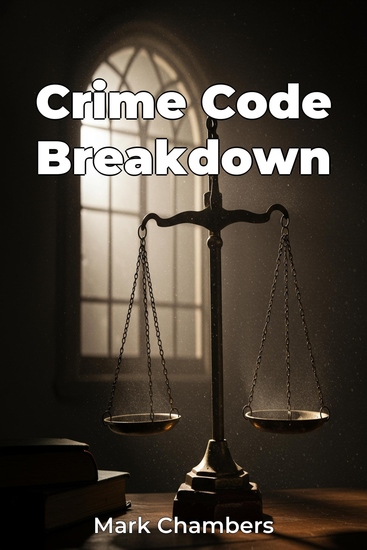
Crime Code Breakdown - cover

Crime Code Breakdown

Mark Chambers

Translator A AI

Publisher: Publifye

  • 0
  • 0
  • 0

Summary

Crime Code Breakdown offers an in-depth exploration of criminal law, dissecting how actions become defined as crimes and the societal implications of these legal definitions. It examines the anatomy of criminal codes, including the essential elements of offenses like mens rea (mental state) and actus reus (criminal act), revealing how these codes reflect evolving societal values and political ideologies. The book uniquely bridges legal analysis with real-world understanding, making complex concepts accessible to legal professionals and general readers.

 
The book traces the evolution of criminal classifications, analyzing the historical context from common law to modern statutory enactments. It highlights the dynamic nature of criminal law, showing how it adapts to emerging threats and societal changes.

 
Beginning with fundamental principles like due process, the book progresses through the structure of criminal codes, examining offenses against persons, property, and public order, culminating in a discussion of sentencing and law reform. Supported by case law and comparative legal studies, Crime Code Breakdown connects criminal law to sociology, criminology, and political science, enriching its analysis. This approach is particularly valuable for those interested in true crime narratives, providing a framework for understanding the legal complexities behind them and offering practical insights for policymakers and engaged citizens interested in criminal justice and law reform.
Available since: 04/05/2025.
Print length: 84 pages.

Other books that might interest you

  • Evolution of a Baby Boomer - Life Beyond Sex Drugs & Rock 'n' Roll - cover

    Evolution of a Baby Boomer -...

    Joyce Fidler

    • 0
    • 0
    • 0
    "Joyce Fidler's life is one of many twists and turns and highs and lows. Sometimes she'll shock you; other times she'll bring you to tears. If you have an alcohol or drug addiction problem, her book will uplift you and encourage you to make important changes in your life. It's not a preachy book; instead, it's very honest and forthright." Terry Hassman-Paulin, Editor at Silver Burdett Ginn (ret.) 
    "A memoir of a frenzied woman" Frank Dungan, TV Producer/Emmy Winning Writer 
    "Joyce Fidler tells a mind-blowing story. Being a musician myself who tripped through that era I knew from the first that this was real, but Fidler's unique POV made it a brand-new experience. I didn't think that I could be shocked, but particular parts of her story left me wide-eyed. The spiritual message left me teary-eyed." Gene Herd, Executive Director of the Hollywood Radio and Television Society (ret.)
    Show book
  • Media Circus - A Look at Private Tragedy in the Public Eye - cover

    Media Circus - A Look at Private...

    Kim Goldman, Tatsha Robertson

    • 0
    • 0
    • 0
    Imagine losing a loved one in the public eye.   A media frenzy ensues and spreads your family name through the news. Reporters ambush you, and across the country, strangers gossip about your personal loss.   Welcome to the circus.   No one understands better than Kim Goldman the complex emotions of individuals suffering a personal tragedy under the relentless gaze of the media. During the famed O.J. Simpson trial, Kim, whose brother, Ron Goldman, was brutally murdered, became the public poster child for victims suffering in the public eye.   In Media Circus, Goldman, now a dedicated victims' advocate who works with families across the country, presents the first collective look at these ordinary, grieving victims—forced to manage their very private trauma and despair in a very public way.   Through candid interviews and detailed, original reporting, Media Circus delivers riveting, humanizing, and inspiring stories from the victims and survivors of violent crimes who found themselves the focus of national media attention. Its heartfelt narratives showcase the unique challenges of coping with and healing from grief when the whole world is watching.   In these pages, the families of other victims tell their stories, including:  Esaw And Emerald Garner, wife and daughter of police brutality victim Eric Garner (2014)  Scarlett Lewis, mother of six-year-old Newtown tragedy victim Jesse Lewis (2012)  Debra Tate, sister of Charles Manson murder victim Sharon Tate (1969)  Judy Shepard, mother of gay hate-crime victim Matthew Shepard (1998)  Mildred Muhammad, ex-wife of the DC Sniper (2002)  Tere Duperrault Fassbender, survivor of family's brutal murder at sea (1961)  Collene Campbell, sister of murdered NASCAR driver Mickey Thompson (1988)  Marie Monville, wife of the Amish Shooter (2006)  Dave And Mary Neese, parents of teen murder victim Skylar Neese (2012)  Scott And Kathleen Larimer, parents of Aurora theater shooting victim John Larimer, and  Shirley Wygal, mother of Aurora theater shooting victim Rebecca Wingo (2012)   Media Circus goes beyond the names and faces to show the real victims behind the stories.
    Show book
  • Camila's Story - Thrown Away Children - cover

    Camila's Story - Thrown Away...

    Louise Allen

    • 0
    • 0
    • 0
    Camila's Story is the 12th instalment in the popular Thrown Away Children series by Louise Allen.
    Show book
  • When Christians Disagree - Lessons from the Fractured Relationship of John Owen and Richard Baxter - cover

    When Christians Disagree -...

    Tim Cooper

    • 0
    • 0
    • 0
    Two Oppositional Figures in Church History Shed Light on Division in the Church Today
    Our current culture seems to be increasingly divided on countless issues, including those affecting the church. But for centuries, theological disagreements, political differences, and issues relating to church leadership have made it challenging for Christians to foster unity and love for one another.
    In this book, author Tim Cooper explores this polarization through the lives of two oppositional figures in church history: John Owen and Richard Baxter. Cooper highlights their individual stories while showing how their contrasting life experiences, personalities, and temperaments led to their inability to work together. After exploring these lessons from the past, readers will gain insights into their own relationships, ultimately learning how to love and live in harmony with their fellow believers despite their disagreements.
    
    - Timely: In today's deeply divided culture, this book offers past examples to help spur unity among believers today
    - Historical: Biographical examination of two Puritan writers from the 17th century: John Owen and Richard Baxter
    - Accessible: Short format and crisp writing style offer an engaging story with no background knowledge required
    Show book
  • Secrets Shadows and the CIA: Inside Covert Operations - Unlock riveting CIA secrets! Dive into thrilling audio lessons for mastering covert operations - cover

    Secrets Shadows and the CIA:...

    Jasper Thornell

    • 0
    • 0
    • 0
    Secrets, Shadows, and the CIA: Inside Covert Operations: 
    ⭐⭐ Simplified Guide & Explanations Included ⭐⭐ 
    Are you looking to delve deeper into the clandestine world of espionage and understand the covert operations of the CIA? 
    Seeking an all-encompassing guide that reveals the hidden truths behind CIA's covert missions? 
    Your search ends here! 
    This guide serves as your ultimate companion for deepening your understanding, applying your knowledge, and engaging in insightful explorations. With this, you're prepared to unlock the secrets. 
    Updated for the latest revelations in CIA covert operations. 
    Key features of this enriched guide: 
    - Profound insights about the inner workings of CIA covert missions 
    - Detailed explanation of key espionage techniques and strategies 
    - Effective methodologies for understanding and analyzing covert operations 
    Our guide stands out with its comprehensive coverage, essential for your grasp of CIA activities. Concepts are not merely touched upon; they are explored with depth and precision. 
    Please note that this guide is not affiliated with any official CIA entity and is purely an independent resource for your benefit. 
    Designed with a clear structure and straightforward language, our guide ensures smooth transitions between topics. Say goodbye to dense jargon and welcome clear, precise, and technically accurate content. 
    So, why wait? Click the BUY NOW button, secure your guide, and begin your journey into the shadows of CIA covert operations!
    Show book
  • Cheka The: The History of the Soviet Agency that Eventually Became the KGB - cover

    Cheka The: The History of the...

    Editors Charles River

    • 0
    • 0
    • 0
    The KGB is one of the most famous abbreviations of the 20th century, and it has become synonymous with the shadowy and often violent actions of the Soviet Union’s secret police and internal security agencies. In fact, it is often used to refer to the Soviet state security agencies throughout its history, from the inception of the inception of the Cheka (Extraordinary Commission) in 1917 to the official elimination of the KGB in 1992. Whether it’s associated with the Russian Civil War’s excesses, Stalin’s purges, and even Vladimir Putin, the KGB has long been viewed as the West’s biggest bogeyman during the second half of the 20th century. 
    	However, the KGB did not appear out of thin air. Naturally, the earliest Soviet leaders utilized intelligence agencies that collected information both abroad and within the Soviet Union, targeting foreign opponents and domestic opponents alike. Lenin did not imagine the scale of the opposition he would have to face after the revolution, and he quickly came to the conclusion that "a special system of organized violence" must be created to implement the dictatorship of the proletariat. 
    	Thus, from nearly the beginning of the Bolshevik takeover of Russia, Lenin and his successors established and relied on a particularly ruthless agency: the All-Russian Extraordinary Commission for Combating Counter-Revolution and Sabotage, later abbreviated to the Extraordinary Commission. Known colloquially as the Cheka (Extraordinary Commission), it soon became as feared by non-socialists as the Tsar’s secret police had ever been. The main means approved by the Council of People's Commissars on December 20, 1917, which the Cheka had to use to fight the counter-revolution, were "seizure of property, resettlement, deprivation of cards, publication of lists of enemies of the people, etc."
    Show book