Unisciti a noi in un viaggio nel mondo dei libri!
Aggiungi questo libro allo scaffale
Grey
Scrivi un nuovo commento Default profile 50px
Grey
Iscriviti per leggere l'intero libro o leggi le prime pagine gratuitamente!
All characters reduced
Meditations - cover

Meditations

Marcus Aurelius

Casa editrice: E-Kitap Projesi & Cheapest Books

  • 0
  • 0
  • 0

Sinossi

Such is the system which underlies the Meditations of Marcus Aurelius. Some knowledge of it is necessary to the right understanding of the book, but for us the chief interest lies elsewhere. We do not come to Marcus Aurelius for a treatise on Stoicism. He is no head of a school to lay down a body of doctrine for students; he does not even contemplate that others should read what he writes.

His philosophy is not an eager intellectual inquiry, but more what we should call religious feeling. The uncompromising stiffness of Zeno or Chrysippus is softened and transformed by passing through a nature reverent and tolerant, gentle and free from guile; the grim resignation which made life possible to the Stoic sage becomes in him almost a mood of aspiration. His book records the innermost thoughts of his heart, set down to ease it, with such moral maxims and reflections as may help him to bear the burden of duty and the countless annoyances of a busy life.
It is instructive to compare the Meditations with another famous book, the Imitation of Christ. There is the same ideal of self-control in both. It should be a man's task, says the Imitation, 'to overcome himself, and every day to be stronger than himself.' 'In withstanding of the passions standeth very peace of heart.' 'Let us set the axe to the root, that we being purged of our passions may have a peaceable mind.' To this end there must be continual self-examination. 'If thou may not continually gather thyself together, namely sometimes do it, at least once a day, the morning or the evening. In the morning purpose, in the evening discuss the manner, what thou hast been this day, in word, work, and thought.' But while the Roman's temper is a modest self-reliance, the Christian aims at a more passive mood, humbleness and meekness, and reliance on the presence and personal friendship of God. The Roman scrutinises his faults with severity, but without the self-contempt which makes the Christian 'vile in his own sight.'

The Christian, like the Roman, bids 'study to withdraw thine heart from the love of things visible'; but it is not the busy life of duty he has in mind so much as the contempt of all worldly things, and the 'cutting away of all lower delectations.' Both rate men's praise or blame at their real worthlessness; 'Let not thy peace,' says the Christian, 'be in the mouths of men.' But it is to God's censure the Christian appeals, the Roman to his own soul. The petty annoyances of injustice or unkindness are looked on by each with the same magnanimity. 'Why doth a little thing said or done against thee make thee sorry? It is no new thing; it is not the first, nor shall it be the last, if thou live long. At best suffer patiently, if thou canst not suffer joyously.' The Christian should sorrow more for other men's malice than for our own wrongs; but the Roman is inclined to wash his hands of the offender. 'Study to be patient in suffering and bearing other men's defaults and all manner infirmities,' says the Christian; but the Roman would never have thought to add, 'If all men were perfect, what had we then to suffer of other men for God?' The virtue of suffering in itself is an idea which does not meet us in the Meditations. Both alike realise that man is one of a great community. 'No man is sufficient to himself,' says the Christian; 'we must bear together, help together, comfort together.' But while he sees a chief importance in zeal, in exalted emotion that is, and avoidance of lukewarmness, the Roman thought mainly of the duty to be done as well as might be, and less of the feeling which should go with the doing of it. To the saint as to the emperor, the world is a poor thing at best. 'Verily it is a misery to live upon the earth,' says the Christian; few and evil are the days of man's life, which passeth away suddenly as a shadow.
Disponibile da: 07/12/2024.
Lunghezza di stampa: 300 pagine.


Altri libri che potrebbero interessarti

  • Foraging Medicinal Herbs and Wild Edible Plants in the Great Lakes Region - Upper Midwest and Ontario - Identify Harvest Prepare and Store Wild Foods and Healing Herbs and Plants - cover

    Foraging Medicinal Herbs and...

    Samantha Deere

    • 0
    • 0
    • 0
    Discover how to become self-sufficient through foraging — cut back on your expenses while living a healthy lifestyle!— Enjoy the freedom of knowing your way in nature and the fun of a foraging journey by yourself or with loved ones. 
    But not every plant you find can be consumed, and some plants may be poisonous, endangered, or at-risk and shouldn’t be harvested. 
    There are a lot of things to consider if you want to forage properly. 
    That’s why this book was created! 
    Inside, you’ll find everything you need to know to get started with foraging. For example:45 edible and medicinal herbs for foraging — know their specific health benefits, which parts to use, and how to consume themThe foraging traditions of the indigenous people in the Great Lakes region — get ready to learn from their ancient practicesHow to forage ethically and sustainably — ensure that you and other foragers get a continuous supplyHow to harvest, prepare and store different plant parts to maximize their utility10 essential things to bring with you when hunting for edible wild food and medicinal plants4 preservation methods to help you save time and moneyHow to identify and avoid poisonous plants — don’t compromise your life and the lives of those you loveHow to harvest highly nutritious plantsUrban foraging: best cities in the Great Lakes region to begin your forager’s journey 
    And much more. 
    The future is uncertain, but if you learn how to be resourceful, you’ll be able to get through the tough times. 
    Start equipping yourself with the proper knowledge today! 
    -> WITH PLANT PICTURES AND SEASONAL FORAGING CALENDAR DOWNLOAD!
    Mostra libro
  • Lake Michigan Gales & Tales - Vanishing Ships Tragic Wrecks and Historic Rescues - cover

    Lake Michigan Gales & Tales -...

    Michael Passwater

    • 0
    • 0
    • 0
    The waters of Lake Michigan are a calm and tranquil place--until they aren't
    Lake Mishigami, as the Ojibwe referred to the big waters of Lake Michigan, has a violent side, especially when the winds roar, creating waves that are freshwater giants. These waves have mercilessly taken many ships?along with their crews and passengers?to the bottom. Many have paid a dear price for mistakenly thinking this massive lake is nothing but an oversized pond. A single monstrous storm in November 1880 sank or damaged north of one hundred ships and claimed nearly one hundred lives. But tragedy on the lake is so often met with heroism by those who brave carnage to save their fellow man. Lake Michigan can go from serene to devilish in less than an hour. Author Michael Passwater delves into these transformations and their aftermaths.
    Mostra libro
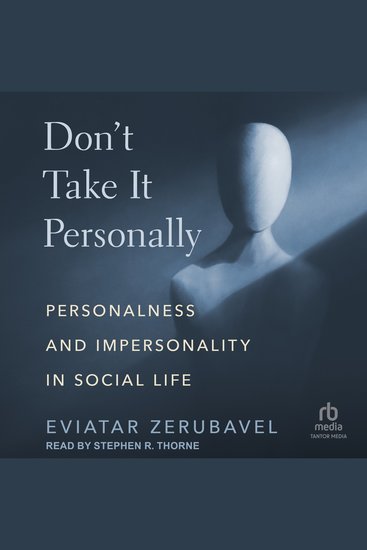
  • Don't Take It Personally - Personalness and Impersonality in Social Life - cover

    Don't Take It Personally -...

    Eviatar Zerubavel

    • 0
    • 0
    • 0
    Along with the concepts of social role, social group, social network, social class, and social structure, the notion of impersonality is one of the pillars of the sociological imagination: the ability to think beyond individuals and see them as members of particular social categories. Although almost every sociologist is at least implicitly cognizant of the fundamental contrast between personalness and impersonality, it has yet to be explicitly conceptualized. 


    Don't Take It Personally comprehensively addresses the fundamental distinction between the specific and generic visions of personhood. Over the course of the book, Eviatar Zerubavel articulates the fundamental features of impersonality; the process of producing impersonality; the impersonal logic underlying the notion of individuals as countable quantities; the relationship between modernity and impersonality; and considers what is gained and what is lost by impersonalizing so much of social life. 


    Drawing on fascinating examples from diverse social contexts, Don't Take It Personally introduces a general framework to better understand the deeper connection between seemingly disparate phenomena, from racial profiling and hate crimes to "secret Santa" gifting.
    Mostra libro
  • Innovating Victory - Naval Technology in Three Wars - cover

    Innovating Victory - Naval...

    Leonard R. Heinz, Vincent P. O'Hara

    • 0
    • 0
    • 0
    Innovating Victory studies how the world's navies incorporated new technologies into their ships, their practices, and their doctrine. It does this by examining six core technologies fundamental to twentieth-century naval warfare including new platforms, new weapons, and new tools. Each chapter considers the state of a subject technology when it was first used in war and what navies expected of it. It then looks at the way navies discovered and developed the technology's best use, in many cases overcoming disappointed expectations. It considers how a new technology threatened its opponents, not to mention its users, and how those threats were managed. Innovating Victory shows that the use of technology is more than introducing and mastering a new weapon or system. Differences in national resources, force mixtures, priorities, perceptions, and missions forced nations to approach the problems presented by new technologies in different ways. Navies that specialized in specific technologies often held advantages over enemies in some areas but found themselves disadvantaged in others. Vincent P. O'Hara and Leonard R. Heinz present new perspectives and explore the process of technological introduction and innovation in a way that is relevant to today's navies, which face challenges and questions even greater than those of 1904, 1914, and 1939.
    Mostra libro
  • Avoiding the Worst - How to Prevent a Moral Catastrophe - cover

    Avoiding the Worst - How to...

    Tobias Baumann

    • 0
    • 0
    • 0
    How can we avoid worst-case scenarios? 
    From Nineteen Eighty-Four to Black Mirror, we are all familiar with the tropes of dystopian science fiction. But what if worst-case scenarios could actually become reality? And what if we could do something now to put the world on a better path? 
    In Avoiding the Worst, Tobias Baumann lays out the concept of risks of future suffering (s-risks). With a focus on s-risks that are both realistic and avoidable, he argues that we have strong reasons to consider their reduction a top priority. Finally, he turns to the question of what we can do to help steer the world away from s-risks and towards a brighter future.
    Mostra libro
  • Fighter - The True Story of the Battle of Britain - cover

    Fighter - The True Story of the...

    Len Deighton

    • 0
    • 0
    • 0
    "The most honest attempt yet to tell how the Battle of Britain really was" —Andrew Wilson, Observer 


    History is swamped by patriotic myths about the aerial combat fought between the RAF and the Luftwaffe over the summer of 1940. In his gripping history of the Battle of Britain, Len Deighton drew on a decade of research and his own wartime experiences to puncture these myths and point towards a more objective, and even more inspiring, truth. 


    "Revolutionised thinking about the Battle of Britain in a way that has not been seriously challenged since" —The Times
    Mostra libro