Junte-se a nós em uma viagem ao mundo dos livros!
Adicionar este livro à prateleira
Grey
Deixe um novo comentário Default profile 50px
Grey
Assine para ler o livro completo ou leia as primeiras páginas de graça!
All characters reduced
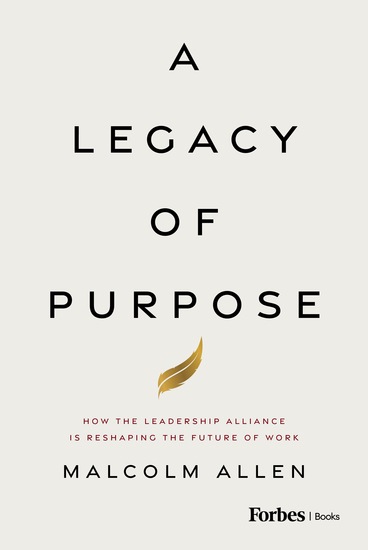
A Legacy of Purpose - How the Leadership Alliance Is Reshaping the Future of Work - cover
LER

A Legacy of Purpose - How the Leadership Alliance Is Reshaping the Future of Work

Malcolm Allen

Editora: Forbes Books

  • 0
  • 0
  • 0

Sinopse

In a time of shifting demographics and evolving workforce demands, the academic pipeline remains critically important but persistently unequal. A Legacy of Purpose reveals how one organization has created a transformative model for diversifying research and academia through mentorship, opportunity, and collaboration.
Disponível desde: 14/10/2025.
Comprimento de impressão: 152 páginas.

Outros livros que poderiam interessá-lo

  • Rare Recording of Carl Jung A - Volume 3 - cover

    Rare Recording of Carl Jung A -...

    Carl Jung

    • 0
    • 0
    • 0
    Carl Jung (1875-1961) was an influential psychologist and author who established the field of analytical psychology. Jung is known for his theorizing about the human unconscious and its relationship to behavior. This recording is part one of a public lecture Jung gave on the concept of synchronicity.
    Ver livro
  • The Fall of Rome - End of a Superpower - cover

    The Fall of Rome - End of a...

    Nick Holmes

    • 0
    • 0
    • 0
    A skilled storyteller, Holmes presents a riveting account of the wars, intrigues and personalities that contributed to Rome's decline, with entire chapters devoted to single battles.' Kirkus Reviews 


    Why did Rome Fall? 


    In this gripping retelling of one of the most momentous chapters in history, Nick Holmes presents a new interpretation of an old story. The fate of Rome was decided not just by emperors, soldiers, and barbarians but also by an environmental disaster. 


    A catastrophic megadrought on the Asian steppes in the fourth century AD forced the migration of entire peoples—Huns, Goths, Vandals, and others—west into the Roman Empire. They met an empire weakened from war with Persia. Rome's misfortunes multiplied as it made tactical errors on the battlefield. Civil war, religious unrest, and political incompetence compounded a worsening situation. The result was one of the greatest disasters in the ancient world—the sack of Rome by the Goths in AD 410.
    Ver livro
  • The Fall of the Russian Empire - The Russian Revolution and Civil War Lenin the Bolsheviks and Stalin - cover

    The Fall of the Russian Empire -...

    Will Forrest

    • 0
    • 0
    • 0
    Are you ready to embark on an exciting journey through some of the most dramatic events in Russian history?  
    In this book, readers will gain an understanding of the Russian Revolution, the Civil War, World War I, the decline of the Russian Empire, and how these events shaped Russia's future. 
    From learning about Lenin and the Red Army to discovering how and why Stalin rose to power and his eventual leadership during World War II and beyond. 
    This book provides an essential look at one of the most important periods in Russian history. Readers will be enthralled by this fascinating tale that delves into every aspect of Russia's struggles and successes. 
    Here are some of the topics included in this book: 
    ·      The Bolsheviks and their role in the Russian Revolution 
    ·      The Russian Civil War 
    ·      The rise of the Communist Party 
    ·      Russia's struggles during World War II 
    For those interested in exploring one of the most significant periods in Russian history this book is for you. Get your copy today and start exploring!
    Ver livro
  • Medieval History - Facts and Insights about Vikings Anglo-Saxons Crusaders and the Plague (3 in 1) - cover

    Medieval History - Facts and...

    Kelly Mass

    • 0
    • 0
    • 0
    This combo of 3 in 1 books consists of the following topics: 
    Anglo-Saxons: In the Early Middle Ages, the Anglo-Saxons were a cultural group that resided in England. They traced their roots back to the arrival of incomers to Britain in the fifth century, who originated from the North Sea coastlands of continental Europe. The ethnogenesis of the Anglo-Saxons, on the other hand, happened in Britain, and the identity wasn't just imported. The contact between getting in groups of people from some Germanic tribe, both amongst themselves and with native British populations, led to the facility of an Anglo-Saxon identity. A lot of the native tribes ultimately incorporated and embraced Anglo-Saxon society and language. 
    Viking History: We all have a typical image of Vikings, from the horns on their helmets to the beards and the clothes they wear. Their ships have a certain charm, and their reputation is that they were brutal, raw, and believed in multiple gods. The Vikings traveled during the Mediterranean, North Africa, the Middle East, and The U.S.A. And Canada. That period is acknowledged as the Viking Age in parts of the countries where they robbed and settled, and the name "Viking" is also used to describe the population of the Scandinavian homelands as a whole. The early middle ages history of Scandinavia, the British Isles, France, Estonia, and Kievan Rus' was exceptionally impacted by the Vikings. 
    Inquisition: Perhaps you have heard of the horrible stories of the Spanish, Portuguese, or French inquisition, the Catholic body of persecutors who would arrest the supposed “heathens” and accuse them of witchcraft, heresies, blasphemy, adultery, and a whole list of other sins or crimes. Torture, interrogations, executions, burnings, and other inhumane methods were used to then force, coerce, or kill the victims of this Catholic organization within the church at the time.
    Ver livro
  • Andrew Jackson - American Lawyer Soldier and 7th President of the United States - cover

    Andrew Jackson - American Lawyer...

    Kelly Mass

    • 0
    • 0
    • 0
    Andrew Jackson was an American attorney, soldier, and statesman who acted as the seventh president of the U.S. from 1829 to 1837. Jackson rose to prominence as a basic in the US Army and served in both homes of Congress before being chosen to the presidency. 
    Jackson, an expansionist president, defended the rights of the "commoner" and the Union against a "corrupt upper class." 
    Jackson ended up being a frontier attorney and married Rachel Donelson Robards after being born in the settler Carolinas an entire decade before the American Revolutionary War. He belonged to the US Legislature and the US Senate from Tennessee for a brief time. After giving up, he served on the Tennessee Supreme Court as a justice from 1798 till 1804. 
    Jackson ended up being a rich, slave-owning planter after buying a residential or commercial property referred to as The Hermitage. In the year 1801, he was selected colonel of the Tennessee militia, and the following year, he was chosen its leader. Throughout the Creek War of 1813 to 1814, he led forces to success in the Battle of Horseshoe Bend. 
    Let’s take a look at what else Andrew Jackson did in his life.
    Ver livro
  • The Forgotten Slave Trade - The White European Slaves of Islam - cover

    The Forgotten Slave Trade - The...

    Simon Webb

    • 0
    • 0
    • 0
    Everybody knows about the transatlantic slave trade. A century before Britain became involved in this terrible business, whole villages and towns in England, Ireland, Italy, Spain, and other European countries were being depopulated by slavers, who transported the men, women, and children to Africa where they were sold. This is the forgotten slave trade; one which saw over a million Christians forced into captivity in the Muslim world. 


    Starting with the practice of slavery in the ancient world, Simon Webb traces the history of slavery in Europe, showing that the numbers involved were vast and that the victims were often treated far more cruelly than black slaves in America and the Caribbean. Castration, used very occasionally against black slaves taken across the Atlantic, was routinely carried out on an industrial scale on European boys who were exported to Africa and the Middle East. Most people are aware that the English city of Bristol was a major center for the transatlantic slave trade in the eighteenth century, but hardly anyone knows that 1,000 years earlier it had been an important staging-post for the transfer of English slaves to Africa. 


    This book will forever change how you view the slave trade and show that many commonly held beliefs about this controversial subject are almost wholly inaccurate and mistaken.
    Ver livro