Unisciti a noi in un viaggio nel mondo dei libri!
Aggiungi questo libro allo scaffale
Grey
Scrivi un nuovo commento Default profile 50px
Grey
Iscriviti per leggere l'intero libro o leggi le prime pagine gratuitamente!
All characters reduced
Satyagraha in South Africa - cover

Satyagraha in South Africa

M. K. Gandhi

Traduttore Valji Govindji Desai

Casa editrice: e-artnow

  • 0
  • 0
  • 0

Sinossi

Satyagraha in South Africa chronicles Mahatma Gandhi's transformative journey in South Africa, where he spent over two decades as a young lawyer. During this period, Gandhi encountered racial discrimination, injustice, and oppression against Indian immigrants, which deeply affected him and shaped his future as a leader and advocate for civil rights and nonviolent resistance.
Disponibile da: 01/01/2024.
Lunghezza di stampa: 315 pagine.

Altri libri che potrebbero interessarti

  • Against Empathy - The Case for Rational Compassion - cover

    Against Empathy - The Case for...

    Anonimo

    • 0
    • 0
    • 0
    A controversial call to arms, Against Empathy argues that the natural impulse to share the feelings of others can lead to immoral choices in both public policy and in our intimate relationships with friends and family. 
    Most people, including many policy makers, activists, scientists, and philosophers, have encouraged us to be more empathetic—to feel the pain and pleasure of others. Yale researcher and author Paul Bloom argues that this is a mistake. Far from leading us to improve the lives of others, empathy is a capricious and irrational emotion that appeals to our narrow prejudices. It muddles our judgment and often leads to cruelty. We are at our best when we are smart enough not to rely on it, and draw upon a more distanced compassion.  
    Based on groundbreaking scientific findings, Against Empathy makes the case that some of the worst decisions that individuals and nations make—from who to give money to, when to go to war, how to respond to climate change, and who to put in prison—are too often motivated by honest, yet misplaced, emotions. With clear and witty prose, Bloom demonstrates how empathy distorts our judgment in every aspect of our lives, from philanthropy and charity to the justice system; from culture and education to foreign policy and war. Without empathy, Bloom insists, our decisions would be clearer, fairer, and ultimately more moral. 
    Bound to be controversial, Against Empathy shows us that, when it comes to major policy decisions and the choices we make in our everyday lives, limiting our empathetic emotions is often the most compassionate choice we can make.
    Mostra libro
  • Evolution Is Wrong - A Radical Approach to the Origin and Transformation of Life - cover

    Evolution Is Wrong - A Radical...

    Erich von Däniken

    • 1
    • 1
    • 0
    A Fascinating Exploration on Why the Darwinists’ Theory No Longer Explains Everything 
    There was once a set of ideas called the theory of evolution, conceived by clever people and confirmed by countless scientists. Then people discovered the electron microscope. This made it possible to make the molecules within the cell visible, and suddenly questions about evolution arose that were not possible before. Which force actually bundles the atoms in the right order? What moves the molecular chains into the correct position? How did the first living unit within the cell actually come about? How does inheritance work, how does information pass on to the next generation? Did humans descend only and exclusively from primates—as Charles Darwin and countless other great minds assumed—or did additional “engines” intervene in evolution?  
    Today it is clear: countless questions can no longer be answered with the previous theory of evolution. There is a form of life called “Blob” (Physarum polycephalum). The “thing” has neither eyes nor ears, neither a mouth nor a nose or even a brain. Nevertheless, it takes in food, overcomes obstacles by the shortest route and exchanges information with other “blobs.” The “blob” contradicts any evolutionary thought that one develops from the other. Or the “gastric-brooding frogs” (Rheobatrachus) found in Australia. They hatch their young in the stomach. Impossible in a slow, evolutionary process.  
    Everywhere there are characteristics of animals that do not want to fit into the theory of evolution anywhere. And man? Are we really the most adapted life-form on this planet? Today, more and more scientists who contradict the previous theory of evolution speak out. The theory fits the changes within the species, but it can no longer be reconciled with the inner workings of the cell. Some other influence that has so far escaped us is affecting evolution. It is called “Intelligent Design.” Intelligent planning is suspected behind this. Anyone or anything—a spirit of the universe? Aliens?—could be behind this planning.  
    Erich von Däniken uses countless examples to demonstrate the impossibility of the previous evolutionary idea. He quotes scientists who argue against the previous teaching, but also those who defend it. Unfortunately, established science still refuses to look at discrepancies and holes in the theory of evolution, even though it is quite obvious that there is more going on with regard to the development of all species, as well as human culture, than could be explained by the theory of evolution alone.
    Mostra libro
  • The Napoleonic Wars – France vs the World - The Rise Battles and Fall of Napoleon’s Empire - cover

    The Napoleonic Wars – France vs...

    Joe Price

    • 0
    • 0
    • 0
    The Napoleonic Wars shaped the course of European and world history, pitting Napoleon Bonaparte’s French Empire against nearly every major power of the time. From his rise to Emperor to his dramatic downfall at Waterloo, this war reshaped borders, warfare, and the fate of nations. 
    This audiobook dives into the epic battles, military strategies, and key figures of the Napoleonic era. Learn how Napoleon’s genius revolutionized warfare, why Europe united against him, and how his ultimate defeat changed the world forever. 
    The Napoleonic Wars – France vs. the World is a must-listen for military history lovers, strategy enthusiasts, and those fascinated by Napoleon’s legacy.
    Mostra libro
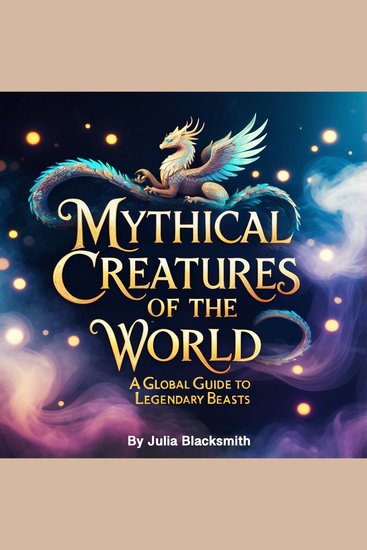
  • Mythical Creatures of the World - A Global Guide to Legendary Beasts - cover

    Mythical Creatures of the World...

    Julia Blacksmith

    • 0
    • 0
    • 0
    Mythical creatures have captivated human imagination for centuries, appearing in folklore, religious texts, and even historical records. These legendary beasts serve as more than just entertaining stories—they reflect cultural values, fears, and the mysteries of the unknown. Across different civilizations, mythical beings have played vital roles in shaping traditions, inspiring art, and even influencing belief systems. From fire-breathing dragons to elusive lake monsters, these creatures continue to spark curiosity and debate. But what is it about these beings that makes them so enduring?  
      
    One reason for their lasting appeal is their connection to human experiences. Many mythical creatures represent forces of nature, embodying storms, oceans, or the deep forests where the unknown lurks. Others symbolize human emotions or moral lessons—such as the cunning trickster fox in Japanese folklore or the powerful yet wise dragon in Chinese mythology. Whether feared, worshipped, or admired, these creatures often serve as cautionary tales or representations of humanity’s struggle with the world around them.  
      
    Common themes emerge across different cultures, even in societies that had no contact with each other. Dragons, for instance, appear in both European and Asian folklore, though their interpretations differ. While European dragons are often portrayed as greedy, fire-breathing monsters to be slain by heroes, their Chinese counterparts are wise and benevolent, associated with strength and good fortune. Likewise, stories of water-dwelling serpents and half-human beings exist in legends from Scandinavia to South America, suggesting that the human mind is naturally drawn to certain archetypes. 
    Mostra libro

  • Populism and Democracy - Examining the Intersection of Populism and Democratic Systems (3 in 1) - cover

    Populism and Democracy -...

    Arlo Holders

    • 0
    • 0
    • 0
    This is a combo of three titles, which are: 
      - Populism vs. Liberalism: Political ideologies form the foundation of how societies organize governance, economics, and social structures. They are systems of ideas and beliefs that provide a framework for political thought and action, influencing policies, institutions, and the behavior of individuals and groups. Among the diverse range of ideologies, populism and liberalism have emerged as two of the most significant and often opposing forces in modern political discourse. This chapter introduces the concepts of populism and liberalism, highlights their importance, and sets the stage for the comparative analysis that follows. 
      - The Populist Playbook: Populism, as a political ideology and movement, is rooted in the idea of a fundamental divide between "the people" and "the elite." It asserts that the common people, often portrayed as hardworking and morally upright, are being oppressed or ignored by an elite class of politicians, businessmen, and intellectuals who are perceived as self-serving and out of touch with the needs of the general public. The term "populism" has evolved over time and can be used to describe a range of political movements and leaders who claim to represent the interests of the ordinary person against established powers. 
      - The Impact of Populism: The roots of populism stretch back to the 19th century, with early movements advocating for the empowerment of ordinary citizens, particularly in agricultural societies. However, the modern manifestation of populism began to take shape in the mid-20th century and accelerated in the 21st century, fueled by growing disillusionment with traditional political elites. The rise of social media, economic inequality, and a globalized world have all contributed to populism's recent resurgence, particularly in Western democracies.
    Mostra libro
  • The Constitution of the United States and The Declaration of Independence - cover

    The Constitution of the United...

    Delegates of the Constitutional...

    • 0
    • 0
    • 0
    Experience the founding ideals of America brought to life in The Constitution of the United States and The Declaration of Independence, narrated by Jason McCoy. This audiobook presents the full texts of the U.S. Constitution, the Bill of Rights, all amendments, and the Declaration of Independence, delivered with clarity and respect for their historic significance. Jason McCoy’s steady and thoughtful narration makes these timeless documents accessible for listeners of all backgrounds, whether for study, reflection, or inspiration. A vital resource for anyone seeking a deeper connection to the principles that define the United States.
    Mostra libro