Unisciti a noi in un viaggio nel mondo dei libri!
Aggiungi questo libro allo scaffale
Grey
Scrivi un nuovo commento Default profile 50px
Grey
Iscriviti per leggere l'intero libro o leggi le prime pagine gratuitamente!
All characters reduced
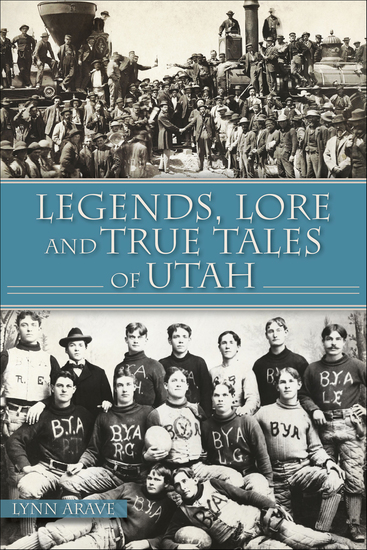
Legends Lore and True Tales of Utah - cover

Legends Lore and True Tales of Utah

Lynn Arave

Casa editrice: The History Press

  • 0
  • 0
  • 0

Sinossi

Legends, Lore and True Tales of Utah explores an eclectic pastOrdinary history books often fail to address the obscure or the unexplained, leaving questions buried in annals of yesteryear. Where were Utah's mythical monsters, including Bigfoot, spotted? How did 'Schoolmarm's Bloomers' become a state symbol? What created the Lagoon Amusement Park's 'dark side'? Why did 'Frankenstein' prowl through the Cache town of Clarkston? Does Sardine Canyon hide the state's fishiest story? Exactly what was the 'Lakemobile' that rolled through the Great Salt Lake? When and why did BYU temporarily ban football? How is it that the first college basketball team to ever play in the state was all women, and they beat the men?  Retired journalist Lynn Arave presents this unique collection, including over a hundred photographs, of the Beehive State's offbeat history.
Disponibile da: 25/07/2022.
Lunghezza di stampa: 226 pagine.

Altri libri che potrebbero interessarti

  • Mankind in Amnesia - cover

    Mankind in Amnesia

    Immanuel Velikovsky

    • 0
    • 0
    • 0
    Immanuel Velikovsky called this book the "fulfillment of his oath of Hippocrates—to serve humanity." In this book, he returns to his roots as a psychologist and psychoanalytical therapist, yet not with a single person as his patient but with humanity as a whole. After an extremely revealing overview of the foundations of the various psychoanalytical systems he makes the step into crowd psychology and reopens the case of Worlds in Collision from a totally different point of view: as a psychoanalytical case study. This way he shows that the blatant reactions to his theories (which are still going on today) have not been surprising but are actually inevitable from a psychological perspective—which equally holds for those who have defined our view of the world. At the same time he is able to reclassify the theories of Siegmund Freud and of C. G. Jung by finding a common basis for them. A journey through history, religion, mythology and art shows the overall range of the collective trauma and gives us—the patients—a message of extraordinary urgency and importance for the future.
    Mostra libro
  • How to Read 10000 Books Every Year - Unlock Your Brain Absorb Knowledge and Master the World of Books - cover

    How to Read 10000 Books Every...

    Mason Keller

    • 0
    • 0
    • 0
    Imagine unlocking the full potential of your mind, gaining knowledge faster than ever before, and transforming your life one book at a time. This is not a dream—it’s a system, a mindset, and a method that anyone can follow. In How to Read 10,000 Books Every Year?, you’ll discover how to turn reading into a superpower that expands your thinking, sharpens your focus, and accelerates your personal and professional growth. 
    Inside, you’ll learn how to:Master speed reading, skimming, and scanning techniques to absorb information efficiently.Leverage audiobooks and digital tools to read anytime, anywhere.Build daily reading habits that stick and maximize every micro-moment.Take notes, retain knowledge, and synthesize ideas across thousands of books.Apply insights to decision-making, creativity, career advancement, and personal transformation.Track progress, set milestones, and maintain motivation to achieve extreme reading goals. 
    Whether you are a lifelong learner, an ambitious professional, or someone who wants to expand your mind and influence, this book offers a practical, step-by-step blueprint for reading more, learning faster, and thinking bigger. 
    Start your journey today. Transform the way you read, the way you think, and the way you live. With the right mindset, habits, and strategies, ten thousand books a year is not just possible—it’s your gateway to a life of knowledge, creativity, and mastery.
    Mostra libro
  • Mornings When I Wake - cover

    Mornings When I Wake

    Brett Alan Dewing

    • 0
    • 0
    • 0
    Mornings When I Wake takes the idea of responding to a book (in this case, Annie Dillard's Holy the Firm) and the "selfing" that arises from the interplay of spirit and text and takes the reader through it experientially, starting in the abstract and slowly moving to the rational. Made up of chapters named for the characters of Holy the Firm, Mornings When I Wake is an ode to Dillard's masterpiece and her overall oeuvre, borrowing themes and styles from many of her books. Put succinctly, it answers the question of what happens when a piece of art lodges in your breastbone.
    Mostra libro
  • Capitalism - The Story behind the Word - cover

    Capitalism - The Story behind...

    Michael Sonenscher

    • 0
    • 0
    • 0
    What exactly is capitalism? How has the meaning of capitalism changed over time? And what's at stake in our understanding or misunderstanding of it? In Capitalism, Michael Sonenscher examines the history behind the concept and pieces together the range of subjects bound up with the word. Sonenscher shows that many of our received ideas fail to pick up the work that the idea of capitalism is doing for us, without us even realizing it. 


    "Capitalism" was first coined in France in the early nineteenth century. It began as a fusion of two distinct sets of ideas. The first involved thinking about public debt and war finance. The second involved thinking about the division of labor. Sonenscher shows that thinking about the first has changed radically over time. Funding welfare has been added to funding warfare, bringing many new questions in its wake. Thinking about the second set of ideas has offered far less room for maneuver. The division of labor is still the division of labor and the debates and discussions that it once generated have now been largely forgotten. By exploring what lay behind the earlier distinction before it collapsed and was eroded by the passage of time, Sonenscher shows why the present range of received ideas limits our political options and the types of reform we might wish for.
    Mostra libro
  • Waterloo - cover

    Waterloo

    Thomas E. Watson

    • 0
    • 0
    • 0
    Excerpt from Chapter One 
    In 1815 the Emperor was no longer a lean, sinewy, tireless, eternally vigilant human tiger—the Napoleon of Rivoli and Marengo. He was no longer the consummate General-in-Chief of Austerlitz and Wagram. The mysterious lethargy which had overwhelmed him at the critical hour of Borodino, when he withheld the order for the Old Guard to charge and convert the Russian defeat into a decisive disaster, had been the first visit of the Evil Genius which was to come again. The strange loss of the power to decide between two totally different lines of action, which, at the Château Düben had kept him idle two days, lolling on a sofa, or sitting at his writing-table tracing on the paper big school-boy letters, was to become a recurrent calamity, puzzling all who knew him, and paralyzing the action of his lieutenants in the most critical emergencies'. 
    At Leipsic the reins had fallen from his hands; only one permanent bridge over the deep river in his rear had been provided to let him out of the death trap; and when the strong currents of the rout tore through the frantic city, the great Napoleon drifted with the furious tide, whistling vacantly. 
    The same unexplainable eclipse of genius, which General E. P. Alexander described as occurring to Stonewall Jackson, in the Malvern Hill movements of our Civil War, happened to the French Emperor, time and again, after that first collapse at Borodino. 
    In Spain he ordered a madly reckless charge of his Polish Light Cavalry against the heights of Sommo Sierra, where the Spanish army was entrenched and where the position easily admitted of successful flanking, got his best troops wastefully butchered—and could not afterward remember who gave the order to charge! 
    In Dresden, in 1813, he had won a brilliant victory which needed only to be ruthlessly pushed; and he was pushing it with all his tremendous driving power when, in the twinkle of an eye, his Evil Genius descended upon him, took his strength away...
    Mostra libro
  • African Americans and the Revolutionary War: The History of Black Soldiers in the American Revolution - cover

    African Americans and the...

    Editors Charles River

    • 0
    • 0
    • 0
    The American Revolution is replete with seminal moments that every American learns in school, from the “shot heard ‘round the world” to the Declaration of Independence, but the events that led up to the fighting at Lexington & Concord were borne out of 10 years of division between the British and their American colonies over everything from colonial representation in governments to taxation, the nature of searches, and the quartering of British regulars in private houses. From 1764-1775, a chain of events that included lightning rods like the Townshend Acts led to bloodshed in the form of the Boston Massacre, while the Boston Tea Party became a symbol of nonviolent protest.  
    	The political and military nature of the Revolutionary War was just as full of intrigue. While disorganized militias fought the Battles of Lexington & Concord, George Washington would lead the Continental Army in the field while men like Thomas Jefferson drafted the Declaration of Independence in Philadelphia and Benjamin Franklin negotiated overseas in France. Benedict Arnold would become one of his nation’s most vital war heroes and its most notorious traitor, French forces would play a crucial role at the end of the war, and the Treaty of Paris would conclude the Revolution with one last great surprise.  
    	Perhaps not surprisingly, the Revolution was far more complex than often depicted, both demographically and politically. Not all the British colonies in North America joined the rebel colonies - East and West Florida remained British (although Britain almost lost both to Spain), while the Bahamas, Bermuda, and the Caribbean colonies remained in the empire. The colonies in what is now Canada also remained loyal, namely Quebec, Newfoundland, Nova Scotia, and Rupert’s Land. 
    Mostra libro