Unisciti a noi in un viaggio nel mondo dei libri!
Aggiungi questo libro allo scaffale
Grey
Scrivi un nuovo commento Default profile 50px
Grey
Iscriviti per leggere l'intero libro o leggi le prime pagine gratuitamente!
All characters reduced
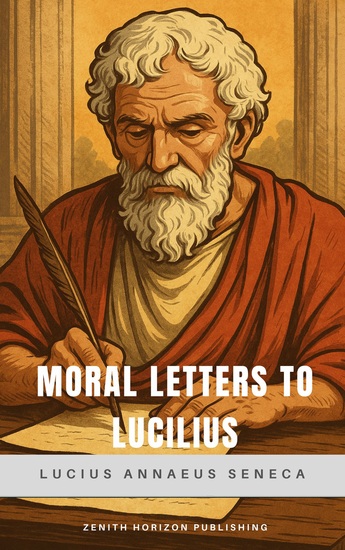
Moral letters to Lucilius  - Complete Stoic Wisdom of Seneca - cover

Moral letters to Lucilius  - Complete Stoic Wisdom of Seneca

Lucius Annaeus Seneca

Casa editrice: Zenith Horizon Publishing

  • 0
  • 0
  • 0

Sinossi

Wisdom forged in ancient Rome. Still relevant. Still radical.

In Moral Letters to Lucilius, Seneca the Younger, one of the great Stoic philosophers, delivers 124 profound letters filled with advice on how to live wisely, die with dignity, and find inner peace amid chaos. Each letter distills timeless insights on topics like anger, wealth, grief, and the pursuit of virtue.

Praised for its clarity and emotional depth, this work is a cornerstone of Stoic literature, studied by philosophers, leaders, and seekers of truth across centuries.

📜 This edition features:

The full, unabridged text of all 124 letters

Modern Kindle formatting and annotations for ease of reading

Elegant illustrations capturing Roman Stoicism

📚 Perfect for fans of Marcus Aurelius, Epictetus, and anyone seeking a guide for a purposeful life.

Read what emperors, warriors, and thinkers have turned to for centuries.
Download the complete edition now.
Disponibile da: 17/06/2025.
Lunghezza di stampa: 238 pagine.


Altri libri che potrebbero interessarti

  • Enki and Sumerian Immortality - Ancient Mythology that has Cultivated Humanity - cover

    Enki and Sumerian Immortality -...

    RYAN MOORHEN

    • 0
    • 0
    • 0
    There is a wide variety of types and genres in these compositions, which are as startling as it is revealing, given the age of the culture involved. In Sumer, nearly a millennium before the Hebrews wrote their Bible, or the Greeks their Iliad and Odyssey, we find a growing body of literature (here and throughout this paper, the term literature is used in the more restricted sense of belles-lettres) that includes such diverse genres as epic tales and myths, hymns and laments - as well as many more "wisdom" compositions, such as maxims, fables, and other didactic compositions. 
    First, we turn to the epic tales of Sumer, the oldest known examples of heroic poetry. Some twelve epic tales that must have been popular in Sumer can now be fully or partially restored. Based on our evidence, they range in length from over four hundred to less than two hundred lines. Consequently, they should be called "epic tales" rather than "epics" since the latter implies a substantial composition.
    Mostra libro
  • The Song Dynasty - Economic and Technological Innovations - cover

    The Song Dynasty - Economic and...

    Jun Liu

    • 0
    • 0
    • 0
    The Song Dynasty (960–1279) emerged from the remnants of the fragmented Five Dynasties and Ten Kingdoms period, establishing a centralized government that would shape China for centuries. Unlike previous dynasties that relied heavily on military conquest, the Song prioritized administration, economic growth, and cultural development, laying the foundation for one of the most prosperous eras in Chinese history. 
    The dynasty is traditionally divided into two periods: the Northern Song (960–1127) and the Southern Song (1127–1279). The Northern Song was founded by Emperor Taizu, who implemented policies to weaken the power of military governors and strengthen civilian rule. This shift reduced the influence of warlords, allowing for a stable bureaucratic system. However, external threats, particularly from the Khitan Liao and later the Jurchen Jin, forced the court to focus on diplomacy and financial strategies rather than military expansion. Eventually, the Jin conquest of the north in 1127 led to the retreat of the Song court to the south, marking the beginning of the Southern Song period. Despite losing control over key northern territories, the Southern Song maintained a flourishing economy, driven by trade, technological advancements, and agricultural productivity. 
    The Song Dynasty’s political structure was characterized by a well-organized bureaucracy based on merit rather than aristocratic privilege. The expansion of the civil service examination system ensured that government officials were selected through rigorous academic testing rather than birthright. This system, rooted in Confucian ideals, emphasized knowledge of classical texts and governance principles, creating a scholar-official class that played a crucial role in state affairs. While this meritocratic system promoted stability, it also created a conservative bureaucracy resistant to radical reforms.
    Mostra libro
  • A Chance to Harmonize - How FDR's Hidden Music Unit Sought to Save America from the Great Depression—One Song at a Time - cover

    A Chance to Harmonize - How...

    Sheryl Kaskowitz

    • 0
    • 0
    • 0
    In 1934, the Great Depression had destroyed the US economy, leaving residents poverty-stricken. First Lady Eleanor Roosevelt urged President Roosevelt to take radical action to help those hit hardest. They set up government homesteads in rural areas across the country, an experiment in cooperative living where people could start over. To boost morale and encourage the homesteaders to find community in their own traditions, the administration brought in artists to lead group activities—including folk music.Working almost entirely (and purposely) under the radar, the music unit would collect more than 800 songs and operate for nearly two years, until they were shut down under fire from a conservative coalition in Congress that deemed the entire homestead enterprise dangerously "socialistic."Despite its early demise, the music unit proved that music can provide hope and a sense of belonging even in the darkest times. It also laid the groundwork for the folk revival that followed.A Chance To Harmonize reveals this untold story and will delight listeners with the revelation of a new and previously undiscovered chapter in American cultural history.
    Mostra libro
  • The Forbidden Daughter - The True Story of a Holocaust Survivor - cover

    The Forbidden Daughter - The...

    Zipora Klein Jakob

    • 0
    • 0
    • 0
    The unforgettable true story of a girl born in the Kovno Ghetto, and the dangerous risk her parents faced in defying the barbarous Nazi law prohibiting childbirth. 
    Elida Friedman was not supposed to have been born. In the Kovno Ghetto in Lithuania, Nazi law forbade Jewish women from giving birth. Yet despite the fear of death, Dr. Jonah Friedman and his wife Tzila, choose to bring a daughter into the world, a little girl they name Elida—meaning non-birth in Hebrew. 
    To increase their child’s chance of survival, the Friedmans smuggle the baby out of the ghetto and into the arms of a non-Jewish farm family when Elida is only three months old. It is the beginning of a life marked by constant upheaval. When the Nazis raze the entire Kovno Ghetto, Jonah and Tzila are among those killed. Their only child is left orphaned and alone, dependent on the kindness of strangers. 
    Despite her circumstances, Elida grows up, changing families, countries, continents, and even names, countless times. Surviving the war and the Holocaust that stole her parents, the young woman never gives up hope. In her lifelong pursuit to find love and belonging, she works to rebuild her identity and triumph over her terrible circumstances. 
    A moving, powerful chronicle of overcoming impossible odds, The Forbidden Daughter is the true story of one unforgettable woman and her will to survive. 
    Supplemental enhancement PDF accompanies the audiobook.
    Mostra libro
  • The End of Feudalism - How Societal Changes Transitioned to Modern Economic Systems - cover

    The End of Feudalism - How...

    Arlo Holders

    • 0
    • 0
    • 0
    Feudalism was a social, political, and economic system that dominated medieval Europe, particularly from the 9th to the 15th century. Its structure was based on the exchange of land for loyalty, military service, and labor. At its core, feudalism established a hierarchical order in which the king, or monarch, granted land, known as fiefs, to vassals (nobles) in exchange for their service. In turn, these vassals would grant portions of their land to serfs or peasants, who worked the land in return for protection and sustenance. This land-based economy was highly localized, with power concentrated in the hands of a few, and much of daily life revolved around agricultural production. 
    The decline of feudalism did not happen overnight but was a gradual process influenced by several interconnected factors. Key to its decline was the increasing centralization of power by monarchs. As monarchs gained more control, often through military conquest or strategic marriages, they began to diminish the power of feudal lords. This shift marked the beginning of the nation-state as a powerful political entity, replacing the decentralized feudal system. Additionally, the rise of a money-based economy undermined the land-based economy that feudalism relied upon. The growth of trade, the development of markets, and the emergence of a merchant class further destabilized feudal structures. 
    Another critical event in the decline of feudalism was the Black Death in the 14th century. The plague decimated large portions of Europe’s population, resulting in severe labor shortages. This, in turn, weakened the traditional feudal relationships between lords and serfs. With fewer workers available, peasants were able to demand better conditions, higher wages, or even freedom from their obligations. This shift in labor dynamics helped to weaken the power of feudal lords, who could no longer rely on a subjugated, large labor force to maintain their estates.
    Mostra libro
  • Exploring the concept of the inner child a psychological perspective - cover

    Exploring the concept of the...

    Ebtehal alroomi

    • 0
    • 0
    • 0
    The concept of the inner child has garnered significant attention in psychological literature, often associated with therapeutic approaches aimed at healing past wounds and fostering emotional growth. This paper delves into the multifaceted nature of the inner child, examining its origins, theoretical underpinnings, herapeutic implications, and empirical evidence supporting its relevance in adult psychology. this paper aims to provide a comprehensive understanding of the inner child phenomenon and its implications for therapeutic interventions.
    Mostra libro