Unisciti a noi in un viaggio nel mondo dei libri!
Aggiungi questo libro allo scaffale
Grey
Scrivi un nuovo commento Default profile 50px
Grey
Iscriviti per leggere l'intero libro o leggi le prime pagine gratuitamente!
All characters reduced
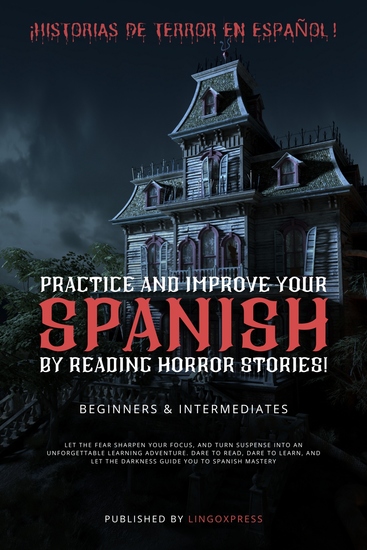
Practice and improve your Spanish by Reading Horror Stories! - ¡Historias de terror en español! - cover

Practice and improve your Spanish by Reading Horror Stories! - ¡Historias de terror en español!

lingoXpress

Casa editrice: lingoXpress

  • 0
  • 0
  • 0

Sinossi

Welcome to a world where darkness and learning intertwine, where each spine-chilling tale not only terrifies but teaches.

 
In this gripping collection, you'll encounter haunted houses, bloody killers, and malevolent spirits, each story crafted to immerse you in fear while expanding your vocabulary and sharpening your grammar skills.

 
As you turn each page, you'll discover:
 
Engaging Vocabulary: Encounter rich, contextualized words that stick with you long after the story ends.
 
Complex Grammar Made Simple: Learn to describe places, things, and situations vividly, using real, thrilling contexts.
 
Emotional Learning: Let the chills and suspense enhance your memory and retention.
 
Adjectives and Adverbs: Horror stories often rely on vivid descriptions to set the scene. Students can learn to use a variety of adjectives and adverbs to create detailed and atmospheric descriptions.
 
Prepositions of Place: Understanding the spatial relationships in a scene is crucial in horror stories. Learners can practice using prepositions like "detrás", "debajo" y "entre".
 
Noun Phrases: Horror stories frequently use complex noun phrases to describe objects and characters in detail. Students can learn to expand their sentences with additional information, making their descriptions more vivid.
 
Relative Clauses: Using relative clauses ("quién", "cuál", "eso") can help learners add more detail to their sentences, enhancing their descriptive abilities.
 
Conditionals: Horror stories often deal with hypothetical situations, making them a perfect medium to practice conditional sentences (if-clauses). For example, "Si hubiera escuchado las advertencias, podría haber sobrevivido."
 
Past Tenses: These stories frequently shift between past simple, past continuous, and past perfect to build suspense and explain backstory. This helps learners understand and use different past tenses appropriately.
 
Passive Voice: The passive voice is often used to create a sense of mystery or focus on the action rather than the subject. For instance, "La puerta se abrió lentamente por una fuerza invisible."
 
Quotations and Reporting Verbs: Horror stories usually include a lot of dialogue, which can help learners practice direct and indirect speech. This is essential for understanding how to report what someone else has said.
 
Perfect for students and lovers of the macabre, this book turns the mundane into the magical and the terrifying into the terrific. The horrors within these pages are not just for fright—they are tools to elevate your Spanish to new, thrilling heights.
Disponibile da: 06/08/2024.
Lunghezza di stampa: 88 pagine.
Altri libri che potrebbero interessarti

  • Learn Persian With Music - cover

    Learn Persian With Music

    Innovative Language Learning, ...

    • 0
    • 0
    • 0
    Can learning Persian be as simple as listening to music? 


    And as easy as remembering song lyrics?


    Just think. You remember song lyrics because lyrics are catchy, repeated throughout the song, and go with the music, right? Now, if you stuck in Persian, you’d easily learn Persian words and phrases the same way! 


    So, yes, learning Persian is as easy as listening to music… with the Learn Persian With Music Audiobook.


    Just press play, and you’ll hear Persian words and phrases repeated to the beat of upbeat and cheerful music. And… follow along!


    You’ll learn 180+ most common Persian words and phrases… while relaxing at home, or while driving to work.


    Learn Persian With Music is the easiest way to start learning Persian.. without getting overwhelmed by complicated explanations. Perfect for new learners with little to no language learning experience.


    What will you learn?
     
    180+ Words & Phrases Including...
     
    • Basic Greetings
     
    • Numbers
     
    • Common Questions and Answers
     
    • Parts of the Body & Talking About Your Wellbeing
     
    • Common Hobbies
     
    • And much more


    Learn Persian With Music includes...
     
    • 15 Songs/Lessons Inside (Each is about 7 minutes long)
     
    • Fast-Paced Review Section at the End of Each Lesson
     
    • 1 Hour 50 Minutes in Total
     
    • Accompanying PDF eBook with the Words, Phrases and Translations


    Download the PDF and read along
    Mostra libro
  • The Straw Man Fallacy - Misrepresenting an Argument to Refute It More Easily - cover

    The Straw Man Fallacy -...

    William Rands

    • 0
    • 0
    • 0
    The Straw Man Fallacy is one of the most pervasive forms of logical misrepresentation, often employed to simplify complex arguments for easier refutation. At its core, this fallacy involves constructing a distorted or exaggerated version of an opponent's position, subsequently attacking this weakened argument instead of addressing the original point. The technique, though logically flawed, can be compelling, as it plays on cognitive biases and simplifies discourse in ways that resonate with audiences. 
    This fallacy derives its name from the image of a straw man, an effigy made of straw that lacks the strength or integrity of a real person. Just as a straw man is easily knocked down, so too is the misrepresented argument—a weaker version created not to understand but to refute. While the method is intellectually dishonest, its use is widespread, spanning casual conversations, heated debates, and high-stakes political rhetoric. 
    Understanding the Straw Man Fallacy begins with recognizing its foundational elements. First, the original argument is altered, often stripped of nuance or exaggerated to absurdity. For example, an individual advocating for environmental regulations might have their argument reframed as "wanting to eliminate all economic progress," a position they never claimed. This misrepresentation not only undermines meaningful dialogue but also diverts attention away from the core issue.
    Mostra libro
  • Learn Conversational Italian Volumes 1 & 2 Bundle - Lessons 1-50 For beginners - cover

    Learn Conversational Italian...

    LinguaBoost

    • 0
    • 0
    • 0
    Learn Conversational Italian Vol. 1 & 2 is an audio course for beginners or for anyone who struggles with becoming fluent in Italian. The focus of this course is to practice speaking conversational Italian from the very first lesson. Each lesson contains useful everyday phrases related to a specific topic. 
    Based on techniques and strategies that make language learners succeed: 
    Learn in short bursts every day. Each lesson takes about 10-15 minutes to complete. 
    Learn in context. Isolated words or random sentences won’t get you far. By learning phrases related to a specific topic or situation, you will see much better results. 
    Focus on high-frequency words. Starting with the most frequently used words will boost your comprehension and communication in your target language. 
    Review the material. Repeating the phrases at certain specified intervals is a powerful technique to help your memory absorb and recall what you have learned. 
    Listen to native speakers. All the phrases are translated and spoken by native speakers.
    Mostra libro
  • PONS Audiotraining Plus ENGLISCH - Für Wiedereinsteiger und Fortgeschrittene (A1-B1) - cover

    PONS Audiotraining Plus ENGLISCH...

    PONS-Redaktion

    • 0
    • 0
    • 0
    Ideal zum mobilen Englisch Lernen und Üben – für Anfänger und Fortgeschrittene
    
    Das Komplettangebot für unterwegs mit einer Laufzeit von über 5 Stunden:
    
    - Lernen und trainieren Sie gezielt Ihren englischen Wortschatz, Ihre Aussprache und Ihre aktive Sprachkompetenz.
    - Mit 145 Tracks und umfangreichem Begleitbuch in PDF-Form.
    - Üben Sie mit Hilfe von zwei unterhaltsamen Geschichten Ihr Hörverstehen und Ihre Kommunikation. 
    Für Anfänger mit Vorkenntnissen bzw. Wiedereinsteiger und Fortgeschrittene
    Mostra libro
  • The Great Dictionary French - English - 130000 Entries - cover

    The Great Dictionary French -...

    Benjamin Maximilian Eisenhauer

    • 0
    • 0
    • 0
    This dictionary contains around 130,000 French terms with their English translations, making it one of the most comprehensive books of its kind. It offers a wide vocabulary from all areas as well as numerous idioms. The terms are translated from French to English. If you need translations from English to French, then the companion volume "The Great Dictionary English - French" is recommended.
    Mostra libro
  • Why Intelligent People Do Stupid Things - The Paradox of Smart Decision-Making - cover

    Why Intelligent People Do Stupid...

    John Harpoon

    • 0
    • 0
    • 0
    Intelligence is often seen as the key to making sound decisions, yet many highly intelligent individuals find themselves making choices that defy logic and reason. This paradox is at the heart of why even the smartest people can sometimes act in ways that are seemingly irrational. Despite possessing vast knowledge, sharp problem-solving skills, and an ability to think critically, intelligent people often fall victim to cognitive biases, emotional triggers, and societal pressures that lead them to make poor decisions. Understanding why this happens requires an exploration into the intricate relationship between intelligence and decision-making. 
      
    At the core of this paradox lies the idea that rationality and intelligence do not always go hand in hand. While intelligence may increase the ability to process information and analyze complex scenarios, it does not always shield individuals from the cognitive biases that distort perception and judgement. In fact, many intelligent individuals are even more susceptible to these biases because they rely heavily on their analytical skills, assuming that their logic will always lead them to the right conclusion. However, this overreliance can blind them to the emotional and social factors that influence decision-making, causing them to overlook key details or make choices based on faulty assumptions. 
      
    Furthermore, decision-making is not solely a rational process; emotions play a crucial role in guiding our actions, and they can often override logic. Intelligent individuals are not immune to emotional influences such as stress, fear, or the desire for instant gratification. These emotions can cloud judgement, leading to impulsive decisions or the failure to consider long-term consequences. This is particularly true in high-pressure situations where the stakes are high, and the need to make quick decisions can push even the most intelligent person into making mistakes.
    Mostra libro