Unisciti a noi in un viaggio nel mondo dei libri!
Aggiungi questo libro allo scaffale
Grey
Scrivi un nuovo commento Default profile 50px
Grey
Iscriviti per leggere l'intero libro o leggi le prime pagine gratuitamente!
All characters reduced
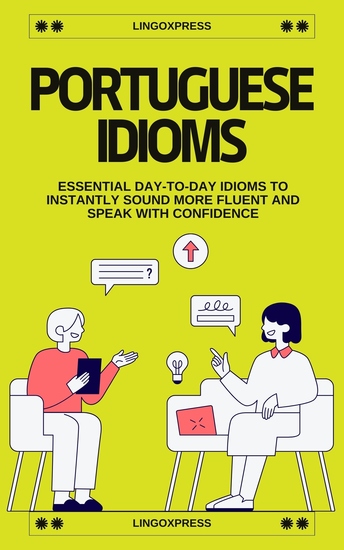
Portuguese Idioms - Essential Day-to-Day Idioms to Instantly Sound More Fluent and Speak with Confidence - cover

Portuguese Idioms - Essential Day-to-Day Idioms to Instantly Sound More Fluent and Speak with Confidence

lingoXpress

Casa editrice: lingoXpress

  • 0
  • 0
  • 0

Sinossi

Learn to speak Portuguese like a pro with Portuguese Idioms: Essential Day-to-Day Idioms to Instantly Sound More Fluent and Speak with Confidence.
 
This book is perfect for anyone who wants to sound more natural when speaking Portuguese. It’s packed with common idioms used in everyday conversations, making it easier to understand Portuguese speakers and express yourself like a native.
 
Each idiom comes with a simple explanation, there are also exercises and examples to show you how to use it. Whether you’re learning Portuguese for fun, travel, or work, this book will boost your confidence and fluency.

 
Inside, you’ll find:
 
Useful idioms explained in plain English.
 
Practice exercises to help you learn faster and memorize the idioms.
 
Easy examples so you can start using the idioms in real-life situations.
 
Get your copy today and start sounding more fluent in Portuguese right away!
Disponibile da: 16/12/2024.
Lunghezza di stampa: 20 pagine.


Altri libri che potrebbero interessarti

  • Acceptance and Commitment Therapy - Embracing Life's Challenges through Acceptance - cover

    Acceptance and Commitment...

    Vivian Westlake

    • 0
    • 0
    • 0
    Life is a complex tapestry of joys, sorrows, successes, and challenges. As humans, we often find ourselves striving to avoid discomfort, suppressing unpleasant emotions, or seeking control over our inner struggles. Yet, these strategies often lead to frustration and a sense of disconnection from what truly matters. Acceptance and Commitment Therapy offers a compelling alternative: a way to embrace life’s full spectrum while committing to actions that align with your values and aspirations. 
    Acceptance and Commitment Therapy is a modern behavioral therapy rooted in the principle of psychological flexibility—the ability to adapt to changing circumstances, remain present, and take meaningful actions even in the face of adversity. Instead of battling unwanted thoughts and emotions, Acceptance and Commitment Therapy encourages acceptance of them as natural elements of human existence. This shift in perspective allows individuals to redirect their energy from avoidance to engagement, fostering a sense of purpose and fulfillment. 
    The framework of Acceptance and Commitment Therapy is built around six core processes: acceptance, cognitive defusion, mindfulness, self-as-context, values clarification, and committed action. These processes are not isolated steps but interconnected skills that work together to enhance well-being. Acceptance teaches you to make room for difficult emotions without judgment or resistance. Cognitive defusion helps you view your thoughts with clarity, reducing their power to dominate your actions. Mindfulness anchors you in the present moment, while self-as-context fosters a stable and compassionate sense of self. Values clarification identifies what truly matters to you, and committed action translates those values into meaningful, goal-directed behavior.
    Mostra libro
  • The Language of the Soul - How the Words You Choose Shape the Life You Live - cover

    The Language of the Soul - How...

    Mark Nepo

    • 0
    • 0
    • 0
    A poetic treasury of spiritual insight, The Language of the Soul uncovers the original meanings of words to help us remember what it means to be fully aliveFor poet and spiritual teacher Mark Nepo, words have always been more than tools for communication—they are vessels of meaning, portals to the sacred, and medicine for the soul. In The Language of the Soul, Nepo explores the deep, often forgotten roots of 228 words from thirty-one languages and traditions, revealing their original, undiluted power to awaken, connect, and heal. Woven with stories from history, mythology, and the author’s own remarkable life journey, this is a rich and contemplative guide to the spiritual essence of language.Just as rivers and mountains erode over time, so too do the meanings of words. Nepo invites readers to walk beside him along a timeless river of understanding, where ancient expressions are reawakened and everyday language is imbued with depth and resonance. Whether it’s a word like “courage” or “forgive” or a lesser-known gem from Sanskrit, Hebrew, or Chinese, each entry becomes a doorway into timeless wisdom, offering moments of insight, stillness, and transformation.For seekers, artists, caregivers, and lovers of language, The Language of the Soul is both a spiritual lexicon and a personal companion. With the lyrical clarity that has made him one of our most beloved spiritual voices, Nepo reminds us that words, when opened with care and wonder, can carry us back to ourselves—and forward into the world with greater compassion, clarity, and grace.
    Mostra libro
  • I Came to Cast Fire - An Introduction to René Girard - cover

    I Came to Cast Fire - An...

    Fr. Elias Carr

    • 0
    • 0
    • 0
    The Catholic anthropologist René Girard (1923–2015) has emerged as one of the most important thinkers of the past century. His sweeping mimetic theory changed the landscape of both the social sciences and Christian theology. And with the rise of social media, political polarization, and globalized conflict, Girard’s ideas have only proven increasingly prophetic with every passing year. But where to begin with this “new Darwin of the human sciences”? His massive body of work remains daunting and disorienting, and secondary literature either academic in tone or limited in scope. General readers—if Girard shows up on their radar at all—face a high barrier of entry to understanding his theory and applying it to daily life.I Came to Cast Fire offers a timely solution: a comprehensive but accessible introduction to the thought of René Girard. In short and digestible chapters, Fr. Elias Carr takes readers through the basics of mimetic theory and how it plays out through history—from the violent origins of religion and culture to the radical revelation that unfolds in Christ—weaving in compelling personal anecdotes along the way. The perfect first step for those new to Girard, I Came to Cast Fire will not only inspire readers to see the world in a new light—the fire of the Paraclete proclaiming the innocence of the victim—but more importantly, to enter into it. 
    Mostra libro
  • Be Here Now - Our Story: The Audiobook - cover

    Be Here Now - Our Story: The...

    Ram Dass

    • 0
    • 0
    • 0
    In his own words— Listen to Ram Dass’ courageous shift from Harvard professor to psychedelic explorer, and his transformational journey East to the feet of his Guru, Maharajji. In celebration of the 50th Anniversary of Be Here Now, we are elated to unearth the Original 1968-1969 Ram Dass Audio which makes up Journey, The Transformation: Our Story–the introductory section of his culture-defining classic. 
    Mostra libro
  • Parenting Like an Australian - One Family's Quest to Fight Fear and Dive Into a Better Braver Life - cover

    Parenting Like an Australian -...

    Damien Cave

    • 0
    • 0
    • 0
    Raise kids to be strong, confident, and happy—by parenting the Australian way 


    Damien Cave and his wife Diana thought they understood what it meant to take risks. As two journalists who traveled the world covering pressing international stories, they were convinced they had seen it all; that is, until they moved to Australia. Suddenly, their kids were being thrown into giant Pacific waves in intensive lifeguard bootcamps, and they were expected to be present and participating instead of obsessing about work or politics. They soon noticed what seemed to be a societal surrender of control to nature and community. In other words? Their American customs were completely disrupted. Living their new beachside life didn't end up being a relaxing retreat, but instead caused a complete reevaluation of the ways they acted as people and parents—and it all had to do with taking unexpected risks and learning how to manage them. 


    New York Times Australia Bureau Chief Damien Cave delivers an impactful and informative account of how risk taking in parenting, and in all aspects of life, creates happier, healthier individuals and communities. Cave's exploration of Australian parenting culture, through gripping research and storytelling, will have you questioning everything you thought you knew about safety, risk, parenting, and, ultimately, being human.
    Mostra libro
  • Anarchy in Action - Case Studies of Anarchist Experiments and Their Outcomes - cover

    Anarchy in Action - Case Studies...

    Arlo Holders

    • 0
    • 0
    • 0
    Anarchism is often misunderstood and misrepresented, seen by many as synonymous with chaos and disorder. However, anarchism is a diverse and complex political philosophy that seeks to create a society free from oppressive hierarchies, such as the state, capitalism, and institutionalized authority. At its core, anarchism advocates for the dismantling of centralized power structures and the establishment of self-governed, voluntary communities based on mutual aid, solidarity, and direct action. Anarchists believe that individuals should have the freedom to organize their lives and work collectively without the interference of coercive institutions. 
    The history of anarchism traces back to the early 19th century, with influential thinkers such as Pierre-Joseph Proudhon, Mikhail Bakunin, and Peter Kropotkin shaping its development. Proudhon is often credited with coining the term “anarchy,” which he defined as “order without power.” Bakunin, one of the most prominent anarchist figures, argued that the state inherently oppresses the individual and stifles freedom, calling for a revolutionary transformation that would replace governmental authority with voluntary associations. Kropotkin, another major figure, emphasized the importance of mutual aid and cooperation, asserting that human beings are naturally inclined to work together for the common good, rather than being solely driven by competition and self-interest.
    Mostra libro