Unisciti a noi in un viaggio nel mondo dei libri!
Aggiungi questo libro allo scaffale
Grey
Scrivi un nuovo commento Default profile 50px
Grey
Iscriviti per leggere l'intero libro o leggi le prime pagine gratuitamente!
All characters reduced
MaGrath - cover

MaGrath

Linda Mooney

Casa editrice: Music And Press

  • 0
  • 0
  • 0

Sinossi

Author Henry Elder came to Alta Novis to learn more about the fabled battle lord and his lady. But rather than re-tell the tales of their already well-known exploits, he wants to hear about the couple from the people who really know them. The people who live, love, interact, and fight alongside with them. He wants to hear those personal anecdotes in order to discover a side of Yulen and Atty D'Jacques that few people know.These are the stories he discovered.MaGrath - Henry feels he's hit the jackpot when Liam MaGrath agrees to tell him a story about the battle lord and lady. He never anticipated the emotional impact he'd receive upon hearing it.
Disponibile da: 28/08/2024.
Lunghezza di stampa: 18 pagine.

Altri libri che potrebbero interessarti

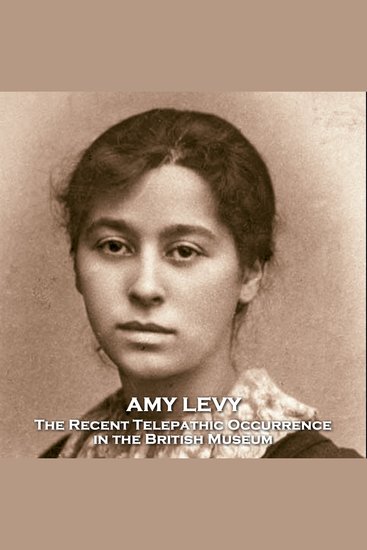
  • The Recent Telepathic Occurrence in the British Museum - From their pens to your ears genius in every story - cover

    The Recent Telepathic Occurrence...

    Amy Levy

    • 0
    • 0
    • 0
    Amy Levy was born in London, England in 1861, the second of seven in a fairly wealthy Anglo-Jewish family. The children read and participated in secular literary activities and became firmly integrated into Victorian life. 
    Her education was at Brighton High School, Brighton, before studies at Newnham College, Cambridge; she was the first Jewish student when she arrived in 1879, but left after four terms. 
    Amy’s writing career began early; her poem ‘Ida Grey’ appeared when she was only fourteen. Her acclaimed short stories ‘Cohen of Trinity’ and ‘Wise in Their Generation,’ were published by Oscar Wilde in his magazine ‘Women's World’. 
    Her poetic writings reveal feminist concerns; ‘Xantippe and Other Verses’, from 1881 includes a poem in the voice of Socrates's wife. ‘A Minor Poet and Other Verse’ from 1884 comprises of dramatic monologues and lyric poems. 
    In 1886, Amy began a series of essays on Jewish culture and literature for the Jewish Chronicle, including ‘The Ghetto at Florence’, ‘The Jew in Fiction’, ‘Jewish Humour’ and ‘Jewish Children’. 
    That same year while travelling in Florence she met the writer Vernon Lee. It is generally assumed they fell in love and this inspired the poem ‘To Vernon Lee’. 
    Her first novel ‘Romance of a Shop’, written in 1888 is based on four sisters who experience the pleasures and hardships of running a London business during the 1880s. This was followed by Reuben Sachs (also 1888) and concerned with Jewish identity and mores in the England of her time and was somewhat controversial. 
    Her final book of poems, ‘A London Plane-Tree’ from 1889, shows the beginnings of the influence of French symbolism. 
    Despite many friendships and an active life, Amy suffered for many years with serious depressions and this, together with her growing deafness, led her to commit suicide by inhaling carbon monoxide on September 10th, 1889. She was 27.
    Mostra libro
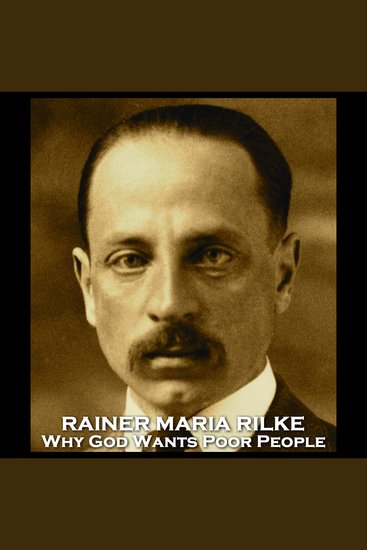
  • Why God Wants Poor People - From their pens to your ears genius in every story - cover

    Why God Wants Poor People - From...

    Rainer Maria Rilke

    • 0
    • 0
    • 0
    René Karl Wilhelm Johann Josef Maria Rilke was born into a troubled marriage on the 4th December 1875 in Prague, then part of the Austro-Hungarian Empire.  His mother, having previously lost a baby girl, would dress the young boy up in girl’s clothing.   
    Later his father dispatched him to a military academy at age 10 but after a miserable 5 years the young Rilke left due to illness and instead entered first Prague and then Munich and finally Berlin university to study art history, philosophy and literature. 
    His initial forays into literature was in poetry.  His intense, mystical and lyrical style was much admired and over time inspired many in succeeding generations.    
    His short prose collection ‘Stories of God’, written in an impassioned burst over several nights was published in 1900 and offers a beguiling view of much of Rilke’s influences and outlook.  
    The following year he married the pioneering sculptor and artist Clara Westhoff.  The union produced one child, a daughter Ruth.   
    He lived in Paris for most of the Century’s first decade where he mixed with many great minds of the time.  Although he continued to write he also worked as a secretary to the sculptor, Rodin.   
    It was only after they settled in Switzerland in 1919 that his writing output was in full flow.  Here he wrote profusely in both German and French, which included much on his previous travels, his left-wing sympathies, his religious and existential thoughts, all part of a unique and consummate style. 
    From 1923 on, Rilke increasingly struggled with his health which was now in constant decline and often spent time rehabilitating at a sanatorium.   
    Rainer Maria Rilke died of leukaemia on the 29th December 1926 in Montreux, Switzerland.  He was 51.
    Mostra libro
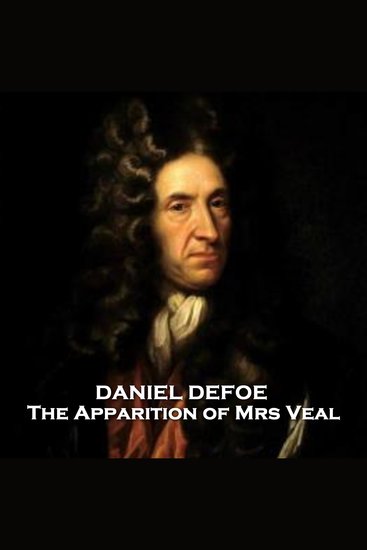
  • The Apparition of Mrs Veal - From their pens to your ears genius in every story - cover

    The Apparition of Mrs Veal -...

    Daniel Defoe

    • 0
    • 0
    • 0
    Daniel Defoe is most well-known for his classic novels Robinson Crusoe and Moll Flanders. Born around 1660, he was also a journalist, a pamphleteer, a businessman, a spy. His life was long and colourful, and the breadth of his work, still highly regarded, is infused with similar vigour. 
    It is said that only the bible has been printed in more languages than Robinson Crusoe. Defoe is also noted for being one of the earliest proponents of the novel. He was extremely prolific and a very versatile writer, producing several hundred books, pamphlets, and journals on various topics including politics, crime, religion, marriage, psychology and the supernatural. He was also a pioneer of economic journalism though was made bankrupt on more on one occasion and usually mired in debt. 
    In later life Defoe was often most seen on Sundays when bailiffs and the like could legally make no move on him.  Allegedly it was whilst hiding from creditors that he died on April 24th, 1731. He was interred in Bunhill Fields, London.
    Mostra libro
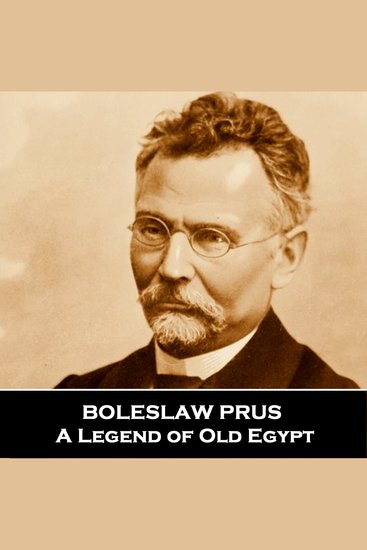
  • A Legend of Old Egypt - From their pens to your ears genius in every story - cover

    A Legend of Old Egypt - From...

    Boleslaw Prus

    • 0
    • 0
    • 0
    Aleksander Głowacki who wrote under the nom de plume Boleslaw Prus was born on 20th August 1847 at Hrubieszów in the Kingdom of Poland, at that time, controlled by the Russian Empire. 
    At three his mother died and then at nine his father.  Female relatives helped raise him but at 15 he joined the Polish uprising against the might of Imperial Russia.  Wounded on the battlefield, arrested and imprisoned, he was later released into the care of a relative and resumed secondary school and then Warsaw University but poverty forced him to leave after two years.  At some point he developed agoraphobia which often caused problems. 
    In 1869, he enrolled in the Forestry Department at Puławy but was soon sacked and so he began a system of self-education that led to work as a newspaper columnist on a wide-ranging series of topics that eventually became the ‘Weekly Chronicles’ and spanned 40 years. 
    With his finances now stabilized he married and then adopted his late brother-in-law’s son.  
    It seems he had doubts as to the scale of his talents and early on adopted the name ‘Boleslaw Prus’ for both his journalistic and literary offerings. 
    His work as a short-story writer met with much acclaim. He wrote several dozen of them, originally published in newspapers and ranging in length from micro-story to novella. His keen observation of everyday life and sense of humor are evident in them.  
    During his career he also wrote novels. After ‘Pharoah’, in 1895, he embarked on a four-month journey taking in Berlin, Dresden, Nuremberg, Rapperswil in Switzerland, where he stayed for two months, and his final destination, Paris.  Here his agoraphobia was so bad he couldn’t cross the Seine.  
    However, his writing continued and in 1911 his novel ‘Changes’, though uncompleted, began to be serialised.  It was never finished. 
    Boleslaw Prus died on 19th May 1912, at his Warsaw apartment.  He was 64.  A National Hero, thousands attended both his funeral service and interment.
    Mostra libro
  • Licensed Premises - cover

    Licensed Premises

    Neil Campbell

    • 0
    • 0
    • 0
    'Nobody believes what they see on TV, so they want to look for something else, an alternate reality, or a conspiracy theory, and it's interesting to explore it, Twitter is fucking full of it, especially now. It's no wonder people round here are into it, but you don't have to read all that shit, just have some mushrooms and wander round Lidl off your tits.'
    In these fourteen northern tales, Campbell takes us from the edgelands of Manchester to the cloistered villages of The Peak District, Northumberland and Scotland, and illuminates the lives of outsiders, misfits, loners and malcontents with an eye for the darkly comic. A wild-eyed man disturbs the banter in a genial bookshop. A fraught woman seeks to flee a collapsing reservoir. A failed academic finds solace in a crime writer's favourite pub. A transit van killer stalks a railway footpath. A poet accused of plagiarism finds his life falling apart.
    Mostra libro
  • Notes From The Underground - cover

    Notes From The Underground

    Fyodor Dostoyevsky

    • 0
    • 0
    • 0
    "I don't want to be happy; I want to be myself."
    
    Notes from Underground (1864), is often considered one of the first existentialist works, exploring themes of free will, alienation, moral ambiguity and the conflict between individualism and societal norms.
    
    Alienated from society and paralysed by a sense of his own insignificance, the anonymous narrator—a bitter, self-aware, and deeply conflicted man—tells the story of his tortured life, describing, with blistering irony, his refusal to become a worker in the 'anthill' and his gradual withdrawal from society, his sharp and relentless inner monologue dissecting human behaviour, societal norms, and the illusion of rational progress.
    Notes from Underground serves as a critique of 19th-century Russian society while also posing deeper questions about the nature of existence, morality, and the individual's place within the world.
    Fyodor Dostoyevsky was a Russian novelist, journalist, and short-story writer renowned for his profound explorations of psychology, morality, and the human condition. Born in Moscow, his tumultuous life was marked by early literary success and followed by arrest and exile due to his radical political activities. He is widely regarded as one of the world's finest novelists, penning classics that include Crime and Punishment, The Idiot, Demons, and The Brothers Karamazov. He had an immense influence on 20th-century fiction and his ideas have profoundly shaped literary modernism, existentialism, and various schools of psychology, theology, and literary criticism.
    Mostra libro