Unisciti a noi in un viaggio nel mondo dei libri!
Aggiungi questo libro allo scaffale
Grey
Scrivi un nuovo commento Default profile 50px
Grey
Iscriviti per leggere l'intero libro o leggi le prime pagine gratuitamente!
All characters reduced
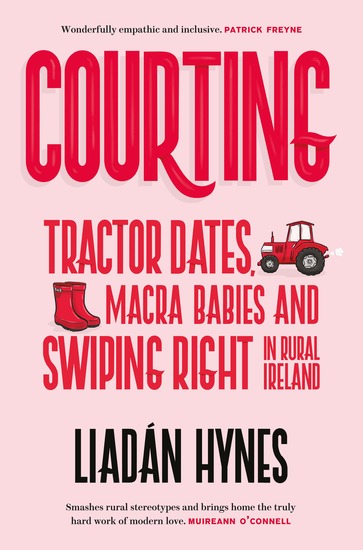
Courting - Tractor Dates Macra Babies and Swiping Right in Rural Ireland - cover

Courting - Tractor Dates Macra Babies and Swiping Right in Rural Ireland

Liadán Hynes

Casa editrice: New Island

  • 1
  • 1
  • 0

Sinossi

'Courting is a wonderfully empathic and inclusive book about love and community and all the different ways people can build a good life.'―Patrick Freyne
Looking for love – the most human quest of them all – has been transformed in recent years, with new technology removing the need to be in 'the right place at the right time'. Dating has never been more convenient, varied or disposable and we Irish have taken to it with gusto ... and not just in cities.
Courting: Tractor Dates, Macra Babies and Swiping Right in Rural Ireland tells a variety of honest and touching stories of trying to meet The One in a rural setting, where the ingredients for successful dating – choice, proximity, free time and, for some, alcohol and anonymity – aren't always guaranteed. Liadán Hynes travels from family farms to tiny islands, village pubs to remote communities, to sit down with childhood sweethearts, long-lost loves and singles, ever hopefuls and lonely hearts, as they navigate this quest through tractor dates, Macra, dating apps and more. They candidly describe swiping for love and moving for it, hooking up and settling down, all while inheriting a 24/7 farm job or coming out, returning to the home place or joining the pandemic exodus.
Revealing the importance of community, diversity and, above all, hope and resilience, Courting is an insightful and unique window into dating in rural Ireland today.
Disponibile da: 03/10/2022.
Lunghezza di stampa: 264 pagine.

Altri libri che potrebbero interessarti

  • What's Wrong with Stereotyping? - cover

    What's Wrong with Stereotyping?

    Erin Beeghly

    • 0
    • 0
    • 0
    What's Wrong with Stereotyping? offers a refreshing and accessibly written philosophical take on the ethics of stereotyping. Stereotyping is woven into every aspect of human experience: conversation, psychology, algorithmic systems, and culture. It relates to generalization and induction, core aspects of rationality. But when and why it is morally wrong to stereotype? This book tackles this deep and enduring puzzle. 


    Core chapters evaluate important ethical wrongs: the failure to treat persons as individuals, disrespect, harm, prejudice, threats to freedoms, and the failure to treat persons as equals. One finds that there is no "essence" of wrongful stereotyping, a single property or set of properties that all problematic cases share in common. Nor are the wrongs of stereotyping reducible to an elegant number, two or three. Instead, wrongful stereotyping is characterized by clusters of wrong-making properties, including all the ones noted here. Listeners will come away with a radically pluralistic, open-ended theory of wrongful stereotyping that they can use to identify wrongful stereotyping in their own lives and our contemporary world. Filled with thought-provoking examples and models for social change, this book emphasizes the messiness of moral reality and the importance of looking to the past in order to understand the ethical perils of stereotyping.
    Mostra libro
  • The Twilight of the Idols - cover

    The Twilight of the Idols

    Friedrich Nietzsche

    • 0
    • 0
    • 0
    In this book, Nietzsche examines and critiques many of the prominent ideas and figures of his time, including morality, religion, and philosophy itself. Nietzsche argues that traditional moral concepts, such as good and evil, are based on outdated and irrational beliefs that hinder the individual's pursuit of a fulfilling life. He also criticizes Christianity and its values, claiming that they are hostile to life and undermine individual freedom. Furthermore, Nietzsche criticizes the philosophical traditions of the past, including Platonism and Kantianism, for their limitations and inability to provide a meaningful framework for life. Instead, Nietzsche proposes a new philosophy, which he calls "the philosophy of the future," that embraces life's complexity and encourages the individual to create their own values. Read in English, unabridged.
    Mostra libro
  • A Rare Recording of James Joyce Reading From Ulysses - cover

    A Rare Recording of James Joyce...

    James Joyce

    • 0
    • 0
    • 0
    In this rare 1924 recording, James Joyce reads from the Aeolus episode of his masterpiece, Ulysses. The recording was arranged and financed by the author’s friend and publisher Sylvia Beach, who brought him by taxi to the HMV (His Master’s Voice) gramophone studio in the Paris suburb of Billancourt. The first session didn’t go well. Joyce was nervous and suffering from his recurring eye troubles. He and Beach returned another day to finish the recording. In her memoir, Shakespeare & Company, Beach writes: "Joyce had chosen the speech in the Aeolus episode, the only passage that could be lifted out of Ulysses, he said, and the only one that was “declamatory” and therefore suitable for recital. He had made up his mind, he told me, that this would be his only reading from Ulysses.I have an idea that it was not for declamatory reasons alone that he chose this passage from Aeolus. I believe that it expressed something he wanted said and preserved in his own voice. As it rings out–"he lifted his voice above it boldly"–it is more, one feels, than mere oratory. The passage parallels the episode in Homer’s Odyssey featuring Aeolus, god of the winds. As a pun, Joyce sets it in a newspaper office where his hero Leopold Bloom stops by to place an ad, only to be stymied by the blustery noise of the printing presses and of the various "windbags" in the office. One character tries to entertain a couple of his friends with a mocking recital of a politician’s speech printed in the day’s newspaper.
    Mostra libro
  • Everyday Freedom - Designing the Framework for a Flourishing Society - cover

    Everyday Freedom - Designing the...

    Philip K. Howard

    • 0
    • 0
    • 0
    Something basic is missing in our culture. Americans know it. Nothing much works as it should. Simple daily choices seem impossible, or fraught with peril. In the workplace, we walk on eggshells. Big projects get stalled in years of review. Endemic social problems such as homelessness become, well, more endemic. 


    Everyday Freedom offers a radical reinterpretation of the corrosion of American culture. The assault on authority after the 1960s, aimed at enhancing freedom, instead created a plague of powerlessness. The teacher in the classroom, the principal in a school, the nurse in the hospital, the official in Washington, the parent on a field trip . . . all have their hands tied. Things don't work, and Americans have lost the freedom to be themselves. 


    Everyday Freedom offers a radical vision for change: Re-empower Americans in their everyday choices. The massive legal structures erected since the 1960s were based on flawed notions that human judgment could be replaced by elaborate dictates. These failed structures must be replaced with simpler frameworks activated by human responsibility and accountability. Nothing will work sensibly until Americans are free to draw on their skills, intuitions, and values when confronting daily challenges. This is the only cure to alienation. This is also the only way to deliver good government.
    Mostra libro
  • Genghis Khan – The Man Who Built the Largest Empire in History - The Untold Story of Genghis Khan’s Rise Military Genius and the Mongol Empire That Shaped the World - cover

    Genghis Khan – The Man Who Built...

    Jules Strosin

    • 0
    • 0
    • 0
    Genghis Khan was more than just a conqueror—he was a visionary leader who built the largest contiguous empire in human history. From his brutal early struggles as a tribal outcast to his rise as the supreme ruler of the Mongol Empire, his story is one of strategy, resilience, and ambition. 
    This audiobook takes you inside the mind of the man who revolutionized warfare, unified warring tribes, and reshaped civilizations across Asia, the Middle East, and Europe. Discover the real Genghis Khan—beyond the myths and legends—in an epic tale of conquest, leadership, and destiny. 
    Genghis Khan – The Man Who Built the Largest Empire in History is an immersive journey into one of history’s most feared and respected rulers. A must-listen for anyone fascinated by power, strategy, and global history.
    Mostra libro
  • Max Planck: A short biography - 5 Minutes: Short on time - long on info! - cover

    Max Planck: A short biography -...

    5 Minutes, 5 Minute Biographies,...

    • 0
    • 0
    • 0
    Max Planck, physicist and nobel prize laureate: Life and works in a short biography! Everything you need to know, brief and concise. Infotainment, education and entertainment at its best!
    Mostra libro