Join us on a literary world trip!
Add this book to bookshelf
Grey
Write a new comment Default profile 50px
Grey
Subscribe to read the full book or read the first pages for free!
All characters reduced
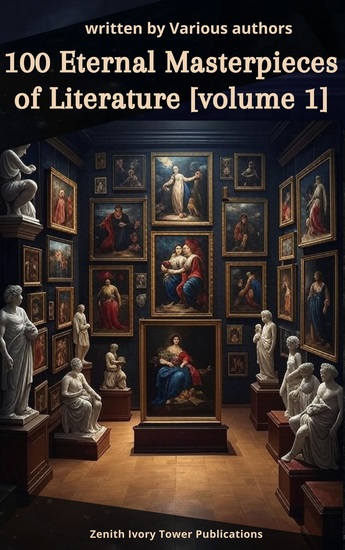
100 Eternal Masterpieces of Literature - A Definitive Collection of the World's Greatest Novels Plays and Stories - cover

100 Eternal Masterpieces of Literature - A Definitive Collection of the World's Greatest Novels Plays and Stories

Lewis Carroll, Louisa May Alcott, Jane Austen, Charlotte Brontë, Emily Brontë, Anne Brontë, Honoré de Balzac, Henri Barbusse, Zenith Ivory Tower Publications

Publisher: Zenith Ivory Tower Publications

  • 0
  • 0
  • 0

Summary

One collection. One hundred masterpieces. Infinite wisdom.
100 Eternal Masterpieces of Literature [Volume 1] is your passport to the greatest works ever written—timeless novels, epic poems, transformative plays, and unforgettable short stories that have shaped cultures, challenged minds, and stirred souls for generations.

Spanning centuries, continents, and genres, this monumental volume brings together essential works from literary giants—from Homer to Shakespeare, Austen to Dostoevsky, Poe to Kafka. Whether you're discovering these classics for the first time or returning to them with new eyes, this collection is a treasure trove of human thought, creativity, and truth.

📚 Includes works by:

Homer (The Iliad, The Odyssey)

William Shakespeare (Hamlet, Macbeth, A Midsummer Night's Dream)

Jane Austen (Pride and Prejudice, Emma)

Leo Tolstoy (War and Peace, The Death of Ivan Ilyich)

Charles Dickens (A Tale of Two Cities, Great Expectations)

Fyodor Dostoevsky (Crime and Punishment, Notes from Underground)

Victor Hugo (Les Misérables)

Edgar Allan Poe (The Raven, The Tell-Tale Heart)

Emily Brontë (Wuthering Heights)

Franz Kafka (The Metamorphosis)

Mark Twain (The Adventures of Huckleberry Finn)

Mary Shelley (Frankenstein)

And dozens more...

Each masterpiece has stood the test of time, offering insight into the human experience—love and loss, courage and cowardice, justice and tyranny, laughter and tragedy.

"The literary canon in one essential volume." — The New York Review of Books
"Perfect for lifelong readers, students, and collectors alike." — Literary Digest
"This collection belongs in every serious reader's library." — Goodreads Reviewer

Whether you're building your classic library or gifting the joy of great literature, this volume is a cultural legacy at your fingertips.

Click 'Buy Now' and own 100 of the most celebrated literary works ever written.
Available since: 07/25/2025.
Print length: 26069 pages.

Other books that might interest you

  • Mutiny - A womans quest for social advancement meets a reporter investigating the truth aboard a ship - cover

    Mutiny - A womans quest for...

    Dorothy Edwards

    • 0
    • 0
    • 0
    Dorothy Edwards, an only child, was born on the 18th August 1902 at Ogmore Vale in Glamorgan. 
     
    Her father was a headmaster and an early activist in the Independent Labour Party.  At age 9 Dorothy, dressed in red, welcomed Keir Hardy on to the stage at Tonypandy during the national coal strike of 1912. She was taught that revolution was at hand, that class barriers would be a thing of the past. 
      
    Dorothy won a scholarship and boarded at Howell's School for Girls in Llandaff before moving to University College of South Wales and Monmouthshire where she read Greek and philosophy. 
     
    Her early hopes to be an opera singer were set to one side after graduating and the death of her father. Instead she took on part-time work to supplement her mother’s pension with whom she now lived. 
     
    Dorothy managed to write a number of short stories which appeared in the literary journals of the day.  She spent several months with her mother in Vienna, all the time revising or writing before embarking on ‘Winter Sonata’, a short novel published in 1928. 
     
    Introductions to several members of the Bloomsbury Group meant a move to London and a division of her time between child-care for the family of Bloomsbury author David Garnett and the promise of an advance payment for her work on a new volume of stories. 
     
    However, Dorothy’s life was starting to spiral out of control; she was attracted to the Welsh nationalist movement but felt that her Welsh provincialism made her, in London at least, feel socially inferior. Leaving her mother dependent on a hired companion consumed her with guilt as did the end of an affair with a married musician. 
     
    On the 5th January 1934, having spent the morning burning her papers, Dorothy Edwards threw herself in front of a train near Caerphilly railway station.  
     
    Her suicide note read: "I am killing myself because I have never sincerely loved any human being all my life. I have accepted kindness and friendship and even love without gratitude, and given nothing in return."
    Show book
  • The Gettysburg Address - cover

    The Gettysburg Address

    Abraham Lincoln

    • 0
    • 0
    • 0
    The complete text of one of the most important speeches in American history, delivered by President Abraham Lincoln during the Civil War. On November 19, 1863, Abraham Lincoln arrived at the battlefield near Gettysburg, Pennsylvania, to remember not only the grim bloodshed that had just occurred there, but also to remember the American ideals that were being put to the ultimate test by the Civil War. A rousing appeal to the nation’s better angels, The Gettysburg Address remains an inspiring vision of the United States as a country “conceived in Liberty, and dedicated to the proposition that all men are created equal.”
    Show book
  • Christine & Alexandra - cover

    Christine & Alexandra

    C. A. Barrington

    • 0
    • 0
    • 0
    This is a true story that spans the sweeping account of a unique affair between two women. In the face of adversity and against all odds, the relationship has blossomed immeasurably and thrived happily. Christine, a 59 year old English lady, meets 33 year old charismatic and lovely Alexandra, in Cape Town in 2002. Alexandra is working in a high-powered job and visiting Christine's neighbour in Simon's Town for Christmas. The women are introduced and a powerful and mutual attraction overtakes them which neither has experienced before. This book encompasses a love story, covert undercover work, and making the most of given opportunities and achievements. It is about late love and immense happiness, and covers the complete gambit of human emotion and the human spirit.
    Show book
  • Surviving the Frontier - Aboriginal Resilience in Australian History - cover

    Surviving the Frontier -...

    Lillian Brooks

    • 0
    • 0
    • 0
    The story of Aboriginal resilience in Australian history is one of survival, adaptation, and unyielding strength in the face of immense challenges. For tens of thousands of years, Aboriginal peoples thrived across the diverse landscapes of the continent, developing complex societies deeply connected to the land. However, with the arrival of European settlers, they faced an unprecedented upheaval that threatened not only their way of life but also their very existence. Despite this, Aboriginal communities endured, finding ways to resist, adapt, and preserve their cultural heritage against overwhelming odds. 
    Colonization brought profound disruptions to Aboriginal societies. Traditional lands were seized, sacred sites were desecrated, and entire communities were forcibly removed from their ancestral homes. The introduction of foreign diseases, combined with violence and systematic dispossession, led to devastating population losses. European settlers viewed the land as something to be owned and exploited, disregarding the deep spiritual and cultural relationship that Aboriginal people had maintained with it for millennia. The introduction of colonial laws and policies further marginalized Aboriginal peoples, stripping them of autonomy and attempting to erase their identities through forced assimilation. 
    Yet, even in the darkest periods of history, Aboriginal resilience remained steadfast. Many Aboriginal nations engaged in active resistance, fighting to defend their land and people. Leaders emerged to challenge European incursions, using knowledge of the terrain to their advantage in conflicts now known as the Frontier Wars. Others found ways to survive within the new colonial framework, forming alliances, working within the pastoral industry, or preserving their culture in secret despite government suppression.
    Show book
  • A Thousand Ways to Pay Attention - A Memoir of Coming Home to My Neurodivergent Mind - cover

    A Thousand Ways to Pay Attention...

    Rebecca Schiller

    • 0
    • 0
    • 0
    It should have been Rebecca Schiller's dream come true: moving her young family to the English countryside to raise goats and coax their own fruit and vegetables from the land. But, as she writes: The summer of striding out toward a life of open fields and sacks of corn, I brought a confused black hole of something pernicious but not yet acknowledged along for the ride. 


    Rebecca's health begins to crumble, with bewildering symptoms: frequent falls, uncontrollable rages, and mysterious lapses in memory. As she fights to be seen by specialists, her fledgling homestead—and her family—hang by increasingly tenuous threads. And when her diagnosis finally comes, it is utterly unexpected: severe ADHD. 


    In her scramble for answers, Rebecca's consciousness alternately sears with pinpoint focus and spirals with connections. Childhood memories resurface with new meaning, and her daily life entwines with the history of women who tended this land before her. Her family weathers their growing pains where generations of acorns have fallen to rise again as trees, where ancient wolves and lynx once stalked the shadows. Written in unsparing, luminous prose, this is an all-absorbing memoir of one woman's newfound neurodivergence—and a clarion call to overturn the narrative that says minds are either normal and good or different and broken.
    Show book
  • The Boys of Winter - The Perfect Rugby Book for Father's Day - cover

    The Boys of Winter - The Perfect...

    Lawrence Dallaglio, Owen Slot

    • 0
    • 0
    • 0
    England have been in four Rugby World Cup finals and only won one of them. In 2003, this team was the one that did it. And this is their story.The image of Jonny Wilkinson's last-minute winning drop goal is etched deep into the nation's consciousness - everyone knows where they were during that iconic moment on the 22nd November 2003. Twenty years on, with their achievement still unmatched, the affection and respect this band of brothers command is as great as ever. There is still no modern player as beloved as Jonny Wilkinson, no captain as celebrated and respected as Martin Johnson, and no coach as revered as Sir Clive Woodward. And there is no one with the aura and drive of Lawrence Dallaglio.In The Boys of Winter, Dallaglio and writer Owen Slot tell the inside story of England's triumphant 2003 Rugby World Cup through interviews with those involved, revealing how the team planned it and executed it; the iconic memories as well as the unseen moment.But what has become of those heroes of our youth? This book also tells the story of how the tournament has shaped the lives of those involved, for better or worse. For many it was the pinnacle, for some a missed opportunity and for others a curse from which they never recovered.- Reveals how the team planned and executed the 2003 Rugby World Cup win- Takes you inside the dressing room and onto the pitch for this historic moment- Uncovers for the first time the impact of the achievement on the players- Explores why this success has never been repeatedThis is the definitive account of a legendary sporting moment and an examination of the costs of our dreams.The audiobook features exclusive content with Lawrence Dallaglio and Owen Slot.
    Show book