¡Acompáñanos a viajar por el mundo de los libros!
Añadir este libro a la estantería
Grey
Escribe un nuevo comentario Default profile 50px
Grey
Suscríbete para leer el libro completo o lee las primeras páginas gratis.
All characters reduced
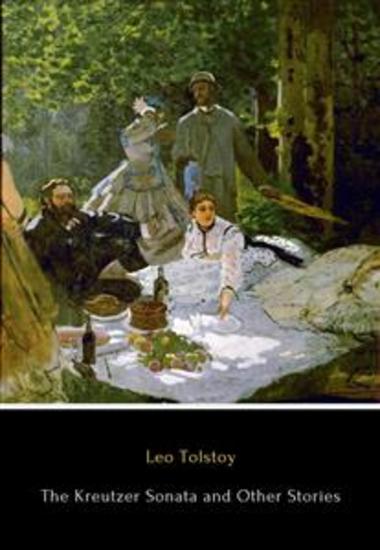
The Kreutzer Sonata and Other Stories - cover

The Kreutzer Sonata and Other Stories

Leo Tolstoy

Editorial: Carousel Books

  • 0
  • 0
  • 0

Sinopsis

The Kreutzer Sonata and Other Stories is a collection of short stories by Leo Tolstoy, named after Beethoven's Kreutzer Sonata. The book was published in 1889 and was promptly censored by the Russian authorities. The work is an argument for the ideal of sexual abstinence and an in-depth first-person description of jealous rage.
Disponible desde: 27/09/2022.

Otros libros que te pueden interesar

  • The Classic Collection of Philip K Dick Science Fiction Short Stories - The Crystal Crypt The Eyes Have It Beyond the Door The Defenders The Gun and others - cover

    The Classic Collection of Philip...

    Philip K. Dick

    • 0
    • 0
    • 0
    Philip Kindred Dick (December 16, 1928 – March 2, 1982), often referred to by his initials PKD, was an American science fiction writer. He wrote 44 novels and about 121 short stories, most of which appeared in science fiction magazines during his lifetime. His fiction explored varied philosophical and social questions such as the nature of reality, perception, human nature, and identity, and commonly featured characters struggling against elements such as alternate realities, illusory environments, monopolistic corporations, drug abuse, authoritarian governments, and altered states of consciousness.  
     Born in Chicago, Dick moved to the San Francisco Bay Area with his family at a young age. He began publishing science fiction stories in 1952, at age 23. He found little commercial success until his alternative history novel The Man in the High Castle (1962) earned him acclaim, including a Hugo Award for Best Novel, when he was 33.[6] He followed with science fiction novels such as Do Androids Dream of Electric Sheep? (1968) and Ubik (1969). His 1974 novel Flow My Tears, the Policeman Said won the John W. Campbell Memorial Award for Best Science Fiction Novel. 
       
     The Crystal Crypt 
     The Eyes Have It 
     Beyond the Door 
     Beyond Lies the Wub 
     The Defenders 
     The Gun 
     Tony and the Beetles 
     The Hanging Stranger 
     Adjustment Team 
     Of Withered Apples 
     Survey Team 
     The Crawlers 
     Meddler 
     Souvenir 
     Human Is
    Ver libro
  • Rising Charity - A Jesse McDermitt Novel - cover

    Rising Charity - A Jesse...

    Wayne Stinnett

    • 0
    • 0
    • 0
    It'd been a long time; a lot of things had changed. Since sailing away from Cane Garden Bay, Jesse McDermitt had changed. Waking one morning, the smell of rum still on his breath, Jesse realizes he doesn't much like the change anymore. The mask that he'd freely put on didn't fit right. It was the mask of a drifting, womanizing boat bum, and it concealed his inner turmoil. Peeling off the mask, he soon realizes what a mess he's in. 
    Weeks of rigorous, open-ocean swims and increasingly deeper free dives helped put the strength back in his body. But physical strength wasn't what was lacking. It wasn't what had finally pulled him into a lifestyle that wasn't his. He'd lost focus on the important things in life, the need to be part of something better. 
    In a secluded anchorage, far from civilization, Jesse powers up his satellite phone for the first time in weeks. There is a message from Charity Styles, asking him for a meeting. She has a line on something they both need, something to focus on. A mission. 
    From award-winning story-teller Wayne Stinnett comes this 14th novel in his exciting Caribbean Adventure Series. Taking the reader from the deep-water canyons of Exuma Sound to the sport-fishing Mecca that is Bimini, Stinnett spins a fascinating tale of redemption and vengeance.
    Ver libro
  • God Sees the Truth But Waits - From their pens to your ears genius in every story - cover

    God Sees the Truth But Waits -...

    Leo Tolstoy

    • 0
    • 0
    • 0
    Leo Tolstoy was born in 1828 in the Russian province of Tula to a wealthy noble family. As a child, he had private tutors but he showed little interest in any formal education. When he went to the University of Kazan in 1843 to study oriental languages and law, he left without completing his courses.  Life now was relaxed and idle but with some writing also taking place.  Gambling debts forced an abrupt change of path and he joined the army to fight in the Crimean War.  He was commended for his bravery and promoted but was appalled at the brutality and loss of life.  He recorded these and other earlier experiences in his diaries which formed the basis of several of his works. 
    In 1852 ‘Childhood’ was published to immediate success and was followed by ‘Boyhood’ and ‘Youth’. 
    His experience in the army and the horrors he witnessed resulted in ‘The Cossacks’ in 1862 and the trilogy ‘Sevastopol Tales’. After the war he travelled around Europe, visiting London and Paris and meeting such luminaries as Victor Hugo and Charles Darwin.  
    It was now that Tolstoy began his masterpiece, ‘War and Peace’. Published in 1869 it was an epic work that changed literature. He quickly followed this with ‘Anna Karenina’.  
    These successes made Tolstoy rich and helped him accomplish many of his dreams but also brought problems as he grappled with his faith and the lot of the oppressed poor. These revolutionary views became so popular that the authorities now kept him under surveillance.  
    He led a life of asceticism and vegetarianism and put his socialist ideals into practice by establishing numerous schools for the poor and food programmes. He also believed in giving away his wealth, which caused much discord with his wife.  
    His writing continued to bring forth classics such as ‘The Death of Ivan Ilyich’ and many brilliant and incisive short stories such as ‘How Much Land Does A Man Need’.  
    In 1901 Tolstoy was excommunicated from the Church and controversially deselected for the Nobel Prize for Literature. 
    Whilst undertaking a pilgrimage by train in October 1910 with his daughter Aleksandra he caught pneumonia in the nearby town of Astapovo.  Leo Tolstoy died on November 9th, 1910, he was 82.
    Ver libro
  • The Queen of Spades - cover

    The Queen of Spades

    Alexander Puskin

    • 0
    • 0
    • 0
    What would you trade for the secret to unimaginable fortune? In Alexander Pushkin's The Queen of Spades, an ambitious young officer becomes entangled in a web of greed, mystery, and the supernatural, all centered around the fateful queen of spades.
    Set in the glittering salons and shadowy streets of St. Petersburg, this story unravels with a mix of elegance and unease. Pushkin's sharp storytelling brings to life characters who are as unpredictable as the hands they're dealt—where ambition collides with madness, and destiny plays its cruelest game.
    Prepare to be captivated by a tale that feels timeless yet full of surprises. As you listen, keep an ear out for the whispers of fate—because in this game, the stakes are higher than they seem.
    Would you dare to play?
    Ver libro
  • A Fight with a Cannon - From their pens to your ears genius in every story - cover

    A Fight with a Cannon - From...

    Victor Hugo

    • 0
    • 0
    • 0
    Victor Marie Hugo was born on 26th February 1802 in Besançon, France.   
    There can be no doubt that Hugo is ranked as the greatest of French authors and poets. In addition to this he fought against social injustice throughout his life and from his frequent elections to the French Assembly. 
    Hugo published his first novel, Han d’Islande (1823), the year after his marriage and so began an immense canon of fiction and poetry not only for France but to World literature.  
    He was elected to the Académie Française in 1841 and the same year came a peerage and entrance to the Higher Chamber as a pair de France, where he spoke against the death penalty, social injustice and in favour of press freedom.  
    In the years leading up to the Revolution of 1848 Hugo began to lean towards Republicanism and greater freedoms.  With the formation of the Second Republic, he was again elected to the Assembly. 
    When Napoleon III seized power in 1851, and established an anti-parliamentary constitution, Hugo openly declared him a traitor to France. This, of course, meant exile where he remained until 1870.  In exile he published his greatest work ‘Les Misérables’, and further widely honoured collections of poetry. 
    Returning home he was again elected to the National Assembly and the Senate.  It was the time of the Franco-Prussian war and with Paris under siege and food ever more scarce, he wrote in his diary that he was now "eating the unknown". 
    Later he was instrumental in strengthening the rights of artists and copyright, steps which led to the international protections of the Berne Convention.  
    Victor Hugo died on 22nd May 1885, aged 83.
    Ver libro
  • The Ransom Of Red Chief - cover

    The Ransom Of Red Chief

    O. Henry

    • 0
    • 0
    • 0
    "The Ransom of Red Chief" is a short story by O. Henry first published in the July 6, 1907 issue of The Saturday Evening Post. It follows two men who kidnap, and demand a ransom for, a wealthy Alabamian's son. Eventually, the men are driven crazy by the boy's spoiled and hyperactive behavior, and they pay the boy's father to take him back.
    The story and its main idea have become a part of popular culture, with many children's television programs depicting versions of the story as one of their episodes. It has also been often used as a classic example of two ultimate comic ironies – a supposed "hostage" actually liking his abductors and enjoying being captured, and his captors getting their just deserts by having the tables turned on them, and being compelled to pay to be rid of him.
    Ver libro