Join us on a literary world trip!
Add this book to bookshelf
Grey
Write a new comment Default profile 50px
Grey
Subscribe to read the full book or read the first pages for free!
All characters reduced
Daddy's Girl - cover

Daddy's Girl

L. T. Meade

Publisher: Interactive Media

  • 0
  • 0
  • 0

Summary

"Daddy's Girl" by L. T. Meade is a heartwarming Victorian novel that tells the story of little Nancy Kingsley, who is cherished by her father. When tragedy strikes and Nancy loses her beloved mother, she must navigate the complexities of life in her father's home, where she faces new relationships and challenges. The novel explores themes of family, love, and resilience as Nancy grows and learns valuable life lessons. With its endearing characters and emotional depth, this book offers a touching portrayal of a father-daughter bond and the trials of a young girl coming of age in the 19th century.
Available since: 09/14/2023.
Print length: 244 pages.

Other books that might interest you

  • Sense and Sensibility - cover

    Sense and Sensibility

    Jane Austen

    • 0
    • 0
    • 0
    Sense and Sensibility is a novel by Jane Austen, published in 1811. It was published anonymously; By A Lady appears on the title page where the author's name might have been. It tells the story of the Dashwood sisters, Elinor (age 19) and Marianne (age 16 1/2) as they come of age. They have an older half-brother, John, and a younger sister, Margaret, 13. The novel follows the three Dashwood sisters as they must move with their widowed mother from the estate on which they grew up, Norland Park. Because Norland is passed down to John, the product of Mr. Dashwood's first marriage, and his young son, the four Dashwood women need to look for a new home. They have the opportunity to rent a modest home, Barton Cottage, on the property of a distant relative, Sir John Middleton. There they experience love, romance, and heartbreak. The novel is likely set in southwest England, London, and Sussex between 1792 and 1797.
    Henry Dashwood, his second wife, and their three daughters live for many years with Henry's wealthy bachelor uncle at Norland Park, a large country estate in Sussex. That uncle decides, in late life, to will the use and income only of his property first to Henry, then to Henry's first son (by his first marriage) John Dashwood, so that the property should pass intact to John's three-year-old son Harry. The uncle dies, but Henry lives just a year after that and he is unable in such short time to save enough money for his wife Mrs Dashwood, and their daughters, Elinor, Marianne, and Margaret, who are left only a small income. On his deathbed, Mr Henry Dashwood extracts a promise from his son John to take care of his half-sisters. But before Henry is long in the grave, John's greedy wife, Fanny, persuades her husband to renege on the promise, appealing to his concerns about diminishing his own son Harry's inheritance, despite the fact that John is already independently wealthy thanks to both his inheritance from his mother, and his wife's dowry. Henry Dashwood's love for his second family is also used by Fanny to arouse her husband's jealousy, and convince him not to help his sisters financially.
    Show book

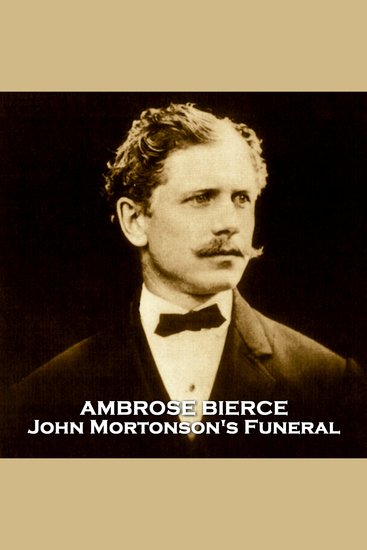
  • John Mortonson's Funeral by Ambrose Bierce - From their pens to your ears genius in every story - cover

    John Mortonson's Funeral by...

    Ambrose Bierce

    • 0
    • 0
    • 0
    Ambrose Gwinnett Bierce was born on 24th June 1842 at Horse Cave Creek in Meigs County, Ohio. His parents were poor but they introduced him to literature at an early age, instilling in him a deep appreciation of books, the written word and the elegance of language.  
    Growing up in Koscuisko County, Indiana poverty and religion were defining features of his childhood, and he would later describe his parents as “unwashed savages” and fanatically religious, showing him little affection but always quick to punish. He came to resent religion, and his introduction to literature appears to be their only positive effect. 
    At age 15 Bierce left home to become a printer’s devil, mixing ink and fetching type at The Northern Indian, a small Ohio paper. Falsely accused of theft he returned to his farm and spent time sending out work in the hopes of being published. 
    His Uncle Lucius advised he be sent to the Kentucky Military Institute. A year later he was commissioned as an Officer.  As the Civil War started Bierce enlisted in the 9th Indiana Infantry Regiment.  
    In April 1862 Bierce fought at the Battle of Shiloh, an experience which, though terrifying, became the source of several short stories. Two years later he sustained a serious head wound and was off duty for several months. He was discharged in early 1865.  
    A later expedition to inspect military outposts across the Great Plains took him all the way to San Francisco. He remained there to become involved with publishing and editing and to marry, Mary Ellen on Christmas Day 1871.  They had a child, Day, the following year.  
    In 1872 the family moved to England for 3 years where he wrote for Fun magazine. His son, Leigh, was born, and first book, ‘The Fiend’s Delight’, was published.  
    They returned to San Francisco and to work for a number of papers where he gained admiration for his crime reporting. In 1887 he began a column at the William Randolph Hearst’s San Francisco Examiner.  
    Bierce’s marriage fell apart when he discovered compromising letters to his wife from a secret admirer. The following year, 1889 his son Day committed suicide, depressed by romantic rejection. 
    In 1891 Bierce wrote and published the collection of 26 short stories which included ‘An Occurrence at Owl Creek Bridge’.  Success and further works including poetry followed.  
    Bierce with Hearst’s resources helped uncover a financial plot by a railroad to turn 130 million dollars of loans into a handout. Confronted by the railroad and asked to name his price Bierce answered “my price is $130 million dollars. If, when you are ready to pay, I happen to be out of town, you may hand it over to my friend, the Treasurer of the United States”.  
    He now began his first foray as a fabulist, publishing ‘Fantastic Fables’ in 1899.  But tragedy again struck two years later when his second son Leigh died of pneumonia relating to his alcoholism.  
    He continued to write short stories and poetry and also published ‘The Devil’s Dictionary’.  
    At the age of 71, in 1913 Bierce departed from Washington, D.C., for a tour of the battlefields where he had fought during the civil war. At the city of Chihuahua he wrote his last known communication, a letter to a friend. It’s closing words were “as to me, I leave here tomorrow for an unknown destination,” Ambrose Bierce then vanished without trace.
    Show book
  • Imaginative Woman An - From their pens to your ears genius in every story - cover

    Imaginative Woman An - From...

    Thomas Hardy

    • 0
    • 0
    • 0
    Thomas Hardy was born in the hamlet of Upper Bockhampton about three miles east of Dorchester in Dorset, England, on 2nd June 1840.  
    Despite a fairly wide education and being an avid reader his parents thought it unlikely he would lead a successful scholarly or clerical career and he was apprenticed in 1856, at age 16, to a local architect whose speciality was in church restoration.  Hardy’s only opportunity to read was in the morning before work between the hours of five and eight.  
    On the back of a failed love affair he moved to London and spent five years working as an assistant to the architect Arthur Blomfield, also a restorer and designer of churches. Hardy though had by now become disillusioned with institutionalised forms of Christianity and abandoned any lingering hopes of ordination in the Anglican Church.  However, his writing of poetry was now flourishing, although it was still rejected for publication.  
    His novel ‘Desperate Remedies’, was published anonymously in 1871 and he now resolved to write full time though he was not yet in a position to achieve financial security or literary success. His second novel, ‘Under the Greenwood Tree’, appeared in 1872 and in 1873 ‘A Pair of Blue Eyes’, the most autobiographical of his works arrived. With ‘Far From the Madding Crowd’ in 1874, came critical acclaim, public attention and financial success. This was repeated in 1878 with ‘The Return of the Native’, and the ensuing years saw him rise to ever greater popularity.  
    His classic ‘The Mayor of Casterbridge’ arrived in 1886 and 5 years later ‘Tess of the d’Urbervilles’. The latter only saw publication after extensive alterations to its plot and the deletion of long passages to lessen the shock to the prudish Victorian audience who were dismayed by the seduction and ruin of a young girl by a rakish aristocrat.  
    ‘Jude the Obscure’, his last novel, suffered the same fate when it was published in 1895.  The uproar so disturbed him that he returned to poetry. In 1898 he had an earlier poetry collection, ‘Wessex Poems’ published. 
    Hardy spent the years between 1903 and 1908 writing ‘The Dynasts’, an epic poem on the Napoleonic Wars. 
    In his twilight years came honours and awards from the great and the good in recognition of his stature as one of the most outstanding of British authors across novels, short stories and poetry. George V conferred on him the Order of Merit in 1910. 
    From 1920 to 1927 he worked, in secret, on his autobiography, which was later published after his death as the work of his second wife, Florence Hardy.  
    Thomas Hardy OM died on the 11th January 1928. 
    His heart was buried alongside his first wife in Stinsford churchyard, Dorchester.
    Show book
  • The Tempest - cover

    The Tempest

    William Shakespeare

    • 0
    • 0
    • 0
    "The Tempest" is a classic tale of magic, betrayal, and redemption. The story centers around the character of Prospero, a powerful magician and the rightful Duke of Milan, who has been exiled to a remote island with his daughter Miranda. After years of living in isolation and perfecting his magical abilities, Prospero seeks revenge against those who wronged him by conjuring a storm that brings his enemies to the island. 
     
    As the story unfolds, we see the struggles and conflicts between the characters, including the devious plots of Prospero's brother Antonio and the love story between Miranda and Ferdinand, the son of the King of Naples. With the help of his spirit servant, Ariel, Prospero manipulates the actions of the other characters and ultimately decides their fate. 
     
    But as Prospero's plans begin to unravel, he must confront his own personal demons and find a way to reconcile with his past. "The Tempest" is a masterful tale that explores themes of power, forgiveness, and the human condition, and is sure to captivate listeners with its timeless language and compelling story."
    Show book
  • The Wood Beyond the World - cover

    The Wood Beyond the World

    William Morris

    • 0
    • 0
    • 0
    In "The Wood Beyond the World," William Morris crafts a captivating tale of adventure and enchantment. Walter, a disenchanted young man, embarks on a voyage that leads him to a mystical land beyond comprehension. There, he encounters a beguiling Lady, a sinister King, and a mysterious Maid, entwining him in their magical intrigues. As Walter navigates this fantastical realm, Morris explores themes of love, destiny, and the eternal struggle between freedom and tyranny.
    Show book
  • Bullet-proof - From their pens to your ears genius in every story - cover

    Bullet-proof - From their pens...

    Bernard Capes

    • 0
    • 0
    • 0
    Bernard Edward Joseph Capes was born on the 30th August 1854 in London.  He was one of 11 children. 
    His early work was as a journalist and this developed into writing many short stories for the periodicals of the time including Blackwood's, Cassell's, Cornhill Magazine, Illustrated London News, Macmillan's Magazine, Mall Magazine, Pearson's Magazine, The Idler, and The Queen. 
    It took him many years to decide that writing full-time could be a sustainable career path.  His initial success came with ‘The Mill of Silence’.  As well as being published it garnered second prize at a competition sponsored by the Chicago Record.  He exceeded that by winning it the following year with ‘The Lake of Wine’.   
    Capes quickly became both prolific and popular.  As well as his stories and articles for the periodicals he wrote around 40 volumes across novels, poetry, history as well as romance and mystery novels. 
    Bernard Capes died on 2nd November 1918 in the flu epidemic.
    Show book