¡Acompáñanos a viajar por el mundo de los libros!
Añadir este libro a la estantería
Grey
Escribe un nuevo comentario Default profile 50px
Grey
Suscríbete para leer el libro completo o lee las primeras páginas gratis.
All characters reduced
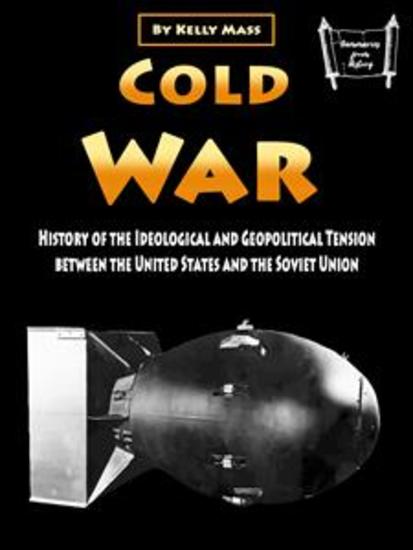
Cold War - History of the Ideological and Geopolitical Tension between the United States and the Soviet Union - cover

Cold War - History of the Ideological and Geopolitical Tension between the United States and the Soviet Union

Kelly Mass

Editorial: Efalon Acies

  • 0
  • 0
  • 0

Sinopsis

Between 1947 and 1991, the United States and the Soviet Union engaged in an escalating geopolitical confrontation known as the Cold War. Historians differ on the exact start and end dates of this period, with some pointing to the Truman Doctrine in 1947 and the dissolution of the Soviet Union in 1991. Throughout this era, there was no direct large-scale warfare between the two superpowers, but they sponsored significant regional conflicts, often referred to as proxy wars, which earned the title of a "cold war." The rivalry began after their temporary alliance and victory over Nazi Germany in 1945, as both countries sought global dominance based on their respective ideologies and geopolitical interests. While nuclear weapons and conventional military forces played a role in this struggle for supremacy, other methods, such as psychological warfare, propaganda, espionage, extensive embargoes, and competition in areas like sports and the Space Race, were also employed.

The Western Bloc, led by the United States and other First World nations, was generally characterized by liberal democratic principles. However, they were often allied with authoritarian regimes, many of which were former colonies of Western powers. On the other hand, the Eastern Bloc, dominated by the Soviet Union and its Communist Party, had a significant influence on the world during and after World War II. Russia supported communist parties and revolutions worldwide, while the United States backed right-wing regimes and movements. The Cold War's battleground extended to nearly every colonial state as they gained independence between 1945 and 1960.
Disponible desde: 16/01/2024.

Otros libros que te pueden interesar

  • Mindful Living: Simple Steps to Save Our Planet - "Embrace Mindful Living! Access impactful audio lessons to effortlessly contribute to saving our planet" - cover

    Mindful Living: Simple Steps to...

    Dorian Halesworth

    • 0
    • 0
    • 0
    "Mindful Living: Simple Steps to Save Our Planet" 
    Embrace Mindful Living for a Sustainable Future: A Simple, Yet Profound Guide with Clear Insights and Explanations 
    Are you eager to enhance your understanding of transforming daily habits into sustainability practices and contribute positively to our planet’s health? 
    Looking for a comprehensive resource that offers all the essential insights for a sustainable lifestyle? 
    Your search ends here! 
    This guide is your ultimate companion for deepening your awareness, applying sustainable strategies, and engaging in practical exercises. With this, you're set for meaningful change. 
    Key Highlights of This Enlightened Guide: 
    - In-depth insights into transforming daily habits for a sustainable future. 
    - Detailed explanations for adopting eco-friendly practices. 
    - Effective strategies for integrating sustainability into everyday life. 
    Our guide sets itself apart through comprehensive coverage, ensuring your efforts lead to impactful results. Concepts are thoroughly explored rather than just touched upon. 
    Please note this guide is an independent resource designed for your benefit, unaffiliated with any official entity. 
    Crafted with a clear structure and straightforward language, our guide ensures seamless transitions between topics. Say farewell to complex terminology and welcome clear, precise, and actionable content. 
    Why wait? Click the BUY NOW button, secure your guide, and begin your journey towards a sustainable future today! 
    Begin the transformation towards mindful living now!
    Ver libro
  • The Cognitive Behavioral Therapy Workbook for Leaders - How Improving Your Mental Health Is Essential to Avoiding Burnout and Leading More Effectively - cover

    The Cognitive Behavioral Therapy...

    PsyD Simon A. Rego, PhD Julian...

    • 0
    • 0
    • 0
    Leaders are expected to be strong, dynamic, intelligent, and level-headed. As a leader, you may feel compelled to embody a "superhuman" standard or make personal sacrifices in order to get a project done well and on time. You might ignore the warning signs of mental health issues such as sleeplessness and fatigue. And, to make matters worse, you may rely on unhealthy behaviors such as consuming alcohol to deal with the overwhelming stress of daily life. So, how can you break this destructive cycle, prioritize your mental health, and optimize performance? 
     
    This workbook offers skills and strategies based in cognitive behavioral therapy (CBT), as well as dialectical behavior therapy (DBT) and acceptance and commitment therapy (ACT), to soothe stress, avoid exhaustion, and build the resilience required to show up as your best self. You'll gain a greater understanding of the specific psychological challenges inherent in leadership positions, the emotional toll it takes professionally and personally, and—most importantly—how to manage these challenges effectively. 
     
    As a leader, admitting that you are struggling can be difficult. You may have feelings of shame, or fears of being stigmatized. But when weighed against the increasing costs to your mental, physical, and emotional well-being, you simply can't afford to ignore it!
    Ver libro
  • Carbon Democracy - Political Power in the Age of Oil - cover

    Carbon Democracy - Political...

    Timothy Mitchell

    • 0
    • 0
    • 0
    Oil is a curse, it is often said, that condemns the countries producing it to an existence defined by war, corruption, and enormous inequality. Carbon Democracy tells a more complex story, arguing that no nation escapes the political consequences of our collective dependence on oil. It shapes the body politic both in regions such as the Middle East, which rely upon revenues from oil production, and in the places that have the greatest demand for energy. 


    Coal was a source of energy so open to disruption that oligarchies in the West became vulnerable to mass demands for democracy. In the mid-twentieth century, however, the development of cheap and abundant energy from oil offered a means to reduce this vulnerability to democratic pressures. The abundance of oil made it possible to reorganize political life around the management of something now called "the economy". The politics of the West became dependent on an undemocratic Middle East. 


    In the twenty-first century, the oil-based forms of modern democratic politics have become unsustainable. Foreign intervention and military rule are faltering in the Middle East, while governments everywhere appear incapable of addressing the crises that threaten to end the age of carbon democracy—the disappearance of cheap energy and the carbon-fueled collapse of the ecological order.
    Ver libro
  • The Short Story - A Very Short Introduction - cover

    The Short Story - A Very Short...

    Andrew Kahn

    • 0
    • 0
    • 0
    What defines a modern short story is much more than a question of length. Despite the efforts of early pioneers like Edgar Allan Poe, the genre was originally synonymous with the anecdote or tale and seen more as entertainment than art. However it has become far more than that, and this Very Short Introduction considers afresh the form's ongoing innovations in plot construction, capacity for psychological insight, and ability to offer intensely concentrated perceptions. 


    This book charts the rise of the short story from its original appearance in magazines and newspapers. For much of the nineteenth century, tales were written for the press, and the form's history is marked by engagement with popular fiction. From the later nineteenth century, the short story earned a reputation for its skillful use of plot design and character study. After the First World War it found outlets in high-brow publications, and single-author collections, as well as anthologies. 


    Exploring the form's techniques and themes, Andrew Kahn considers the continuity and variation in key structures and techniques such as the beginning, the creation of voice, the ironic turn or plot twist, and how writers manage endings. Throughout he draws on examples from an international and flourishing corpus of work, with close analysis of classic and lesser-known stories.
    Ver libro
  • Novelty - A History of the New - cover

    Novelty - A History of the New

    Michael North

    • 0
    • 0
    • 0
    If art and science have one thing in common, it’s a hunger for the new—new ideas and innovations, new ways of seeing and depicting the world. But that desire for novelty carries with it a fundamental philosophical problem: If everything has to come from something, how can anything truly new emerge? Is novelty even possible? In Novelty, Michael North takes us on a dazzling tour of more than two millennia of thinking about the problem of the new, from the puzzles of the pre-Socratics all the way up to the art world of the 1960s and ’70s. The terms of the debate, North shows, were established before Plato, and have changed very little since: novelty, philosophers argued, could only arise from either recurrence or recombination. The former, found in nature’s cycles of renewal, and the latter, seen most clearly in the workings of language, between them have accounted for nearly all the ways in which novelty has been conceived in Western history, taking in reformation, renaissance, invention, revolution, and even evolution. As he pursues this idea through centuries and across disciplines, North exhibits astonishing range, drawing on figures as diverse as Charles Darwin and Robert Smithson, Thomas Kuhn and Ezra Pound, Norbert Wiener and Andy Warhol, all of whom offer different ways of grappling with the idea of originality. Novelty, North demonstrates, remains a central problem of contemporary science and literature—an ever-receding target that, in its complexity and evasiveness, continues to inspire and propel the modern. A heady, ambitious intellectual feast, Novelty is rich with insight, a masterpiece of perceptive synthesis.
    Ver libro
  • Capitalism and Global Power - The Role of Capitalism in Shaping Global Relations (3 in 1) - cover

    Capitalism and Global Power -...

    Arlo Holders

    • 0
    • 0
    • 0
    This book contains these three titles: 
      - Capitalism and Inequality: Capitalism, as an economic system, is based on private ownership of the means of production and the creation of goods or services for profit. In capitalist societies, market forces—supply and demand—determine the distribution of resources and wealth. This system is characterized by competition, limited government intervention, and the pursuit of profit. Over time, capitalism has evolved in response to global events, technological advancements, and changes in social and political structures. However, a fundamental aspect of capitalism that persists is the inherent inequality it creates. 
      - Economic Impacts of Imperialism: Imperialism, as a driving force in global history, established the foundation for much of the modern world's economic and political systems. The roots of imperialism stretch back to ancient civilizations, where conquest and control of territories provided the resources and labor necessary for expansion and prosperity. Over time, the concept evolved, shaped by cultural ambitions, geopolitical competition, and economic incentives. By the late 15th century, the age of exploration began a new phase of empire building, marked by the European powers seeking wealth and influence beyond their borders. 
      - Global Capitalism: The roots of global capitalism can be traced to the rise of industrial capitalism in the 18th and 19th centuries, which laid the foundation for an interconnected global economy. With the expansion of imperialism, the development of transportation technologies like steamships and railways, and the establishment of international financial institutions, economic activity increasingly transcended national boundaries.
    Ver libro