Join us on a literary world trip!
Add this book to bookshelf
Grey
Write a new comment Default profile 50px
Grey
Subscribe to read the full book or read the first pages for free!
All characters reduced
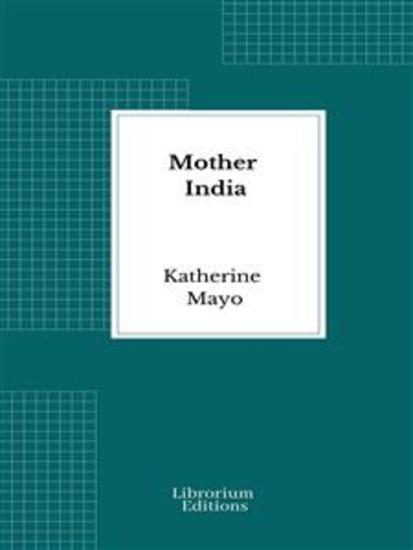
Mother India - cover

Mother India

Katherine May

Publisher: Librorium Editions

  • 0
  • 0
  • 0

Summary

The area we know as India is nearly half as large as the United States. Its population is three times greater than ours. Its import and export trade—as yet but the germ of the possible—amounted, in the year 1924-25, to about two and a half billion dollars.[1] And Bombay is but three weeks’ journey from New York.
Under present conditions of human activity, whereby, whether we will or no, the roads that join us to every part of the world continually shorten and multiply, it would appear that some knowledge of main facts concerning so big and today so near a neighbor should be a part of our intelligence and our self-protection.
But what does the average American actually know about India? That Mr. Gandhi lives there; also tigers. His further ideas, if such he has, resolve themselves into more or less hazy notions more or less unconsciously absorbed from professional propagandists out of one camp or another; from religious or mystical sources; or from tales and travel-books, novels and verses, having India as their scene.
Available since: 08/15/2024.
Other books that might interest you

  • Fort Nassau and Fort Orange: The History of the Dutch’s First Settlements in the New World - cover

    Fort Nassau and Fort Orange: The...

    Charles River Editors

    • 0
    • 0
    • 0
    During the 17th century, the Netherlands, despite having only 1.5 million people in 1600, became a global maritime and trading power. By contrast, France at the time had 20 million people, Spain had 8 million, and England had 5 million. Nevertheless, Amsterdam became one of the most important urban centers in the world and the location of the world’s first stock market, and Dutch merchant ships and pirates plied the Atlantic Ocean, the Indian Ocean, and the Pacific Ocean. The Dutch acquired colonies in the East Indies, where they seized control of the spice trade from the Portuguese, and in the West Indies, they acquired a number of islands from the Spanish (several of which are still Dutch today). They became the only Westerners who were allowed to trade with Shogunate Japan from a small island next to Nagasaki, and they settled the town that ultimately became New York City. Naturally, all of this imperialism generated enormous amounts of wealth that flowed into the Netherlands. 
    	After the Englishman Henry Hudson, under the aegis of the Dutch East India Company, sailed by Manhattan in 1609, he returned home with good news and bad news. Like the other explorers before him, he hadn’t been able to find a water route to the Orient. He had, however, returned with maps (confiscated by the British) and beaver pelts. With that, it became clear that the region around the bay that would take Hudson’s name was a very promising new territory for trade and settlement, which would become a serious bone of contention between the Dutch and the British for the rest of the century. 
    	Dutch colonization had begun in earnest in the region, but it would only last until England’s bloodless conquest of the Dutch possessions in 1664. Prior to that, the colony was known as New Netherland (anglicized from Nieuw Nederland), and included parts of what are now Delaware, Pennsylvania, New Jersey, Connecticut and New York, centered between the Delaware and Connecticut Rivers.
    Show book
  • Bottom Shelf: How a Forgotten Brand of Bourbon Saved One Man's Life - cover

    Bottom Shelf: How a Forgotten...

    Fred Minnick

    • 0
    • 0
    • 0
    A forgotten bottle. A buried legacy. And one man determined to uncover the truth about his favorite bourbon.
     
    Before he became one of the most influential voices in American whiskey, Fred Minnick was a combat veteran wrestling with the invisible wounds of war. What started as a quiet exploration of taste and ritual soon became something more―a way to calm his mind, reconnect with his senses, and slowly rebuild a life.
     
    Today, Fred's palate shapes the industry. His reviews move markets, his instincts set trends. So when he casually named a dusty 1969 bottle of Old Crow as his all-time favorite in an interview, the response was seismic: prices soared from $40 to $3,000 almost overnight. But behind the buzz was a deeper mystery. Once revered by presidents, poets, and distillers alike, Old Crow had been stripped of its legacy and banished to the bottom shelf. Why was one of bourbon's most iconic brands abandoned―and what really happened to the whiskey itself?
     
    Part memoir, part whiskey-world investigation, Bottom Shelf unearths the forgotten history of America's most misunderstood bourbon―and reveals how one man's search for flavor became a fight to rediscover meaning, purpose, and truth in a world full of half-truths and tall tales.
    Show book
  • How I Found Livingstone - cover

    How I Found Livingstone

    Henry Morton Stanley

    • 0
    • 0
    • 0
    Sir Henry Morton Stanley is famously quoted for saying "Dr Livingstone, i Presume?". Born in Wales, he migrated over to the United States at the age of 18, he eventually became an overseas correspondent for the New York Herald. In 1869 Stanley was told by James Gordon Bennett Jr to find Livingstone, a scottish missionary and explorer. When Stanley commented on the cost Bennett's reply was:"Well, I will tell you what you will do. Draw a thousand pounds now; and when you have gone through that, draw another thousand, and when that is spent, draw another thousand, and when you have finished that, draw another thousand, and so on; but, FIND LIVINGSTONE."How I Found Livingstone is Stanley's personnel account of his trip from Zanzibar to Lake Tanganyika on this quest, including time spent exploring the area with Livingstone. 
    - Written by Lizzie Driver (Modified from Wikipedia)
    Show book
  • Brave New Mind - The Art of Serene Readiness - cover

    Brave New Mind - The Art of...

    Eric Maisel

    • 0
    • 0
    • 0
    We live in stressful times. Some say that this is the most challenging time in history, it is fueled by ego, competition, injustice, and anxiety. Just glancing at news headlines each day is enough to cause alarm.Mental health experts, psychologists, therapists, and counselors have reported the rising levels of stress, depression, anxiety, worry, and fear, year after year, for the last two decades.We can either wring our hands and doom-scrolling, or we can do something about it.Brave New Mind offers ways to:Handle increasing stress in all areas of our lives. Join the powers of serenity and alertness of oneself. Cope with depression, anxiety, addiction, and other mental illnesses. Find renewed strength and motivation we have lost. Make new meaning and find our life purpose. Create a brave new mind equal to this moment. Dr. Eric Maisel’s work as a retired psychotherapist provides ways to deal not only with the extreme tension of today’s existence but a path forward. Instead of relying only on medications, readers are guided to fortify and reinvigorate the mind. His optimistic approach redefines the worry of the world. Dr. Maisel has devised this practical, approachable, and inspiring way to face the struggles with calmness and serenity.
    Show book
  • Plato's Meno - cover

    Plato's Meno

    Plato

    • 0
    • 0
    • 0
    A dialogue between Socrates and Meno probes the subject of ethics. Can goodness be taught? If it can, then we should be able to find teachers capable of instructing others about what is good and bad, right and wrong, or just and unjust. Socrates and Meno are unable to identify teachers of ethics, and we are left wondering how such knowledge could be acquired.
     
    To answer that puzzle, Socrates questions one of Meno’s servants in an attempt to show that we know fundamental ideas by recollecting them.
    Show book
  • The Celts - A Very Short Introduction - cover

    The Celts - A Very Short...

    Barry Cunliffe

    • 0
    • 0
    • 0
    Savage and bloodthirsty, or civilized and peaceable? The Celts have long been a subject of enormous fascination, speculation, and misunderstanding. From the ancient Romans to the present day, their real nature has been obscured by a tangled web of preconceived ideas and stereotypes. 
     
    Barry Cunliffe seeks to reveal this fascinating people for the first time, using an impressive range of evidence, and exploring subjects such as trade, migration, and the evolution of Celtic traditions. Along the way, he exposes the way in which society's needs have shaped our visions of the Celts, and examines such colorful characters as St Patrick, Cú Chulainn, and Boudica.
    Show book