Unisciti a noi in un viaggio nel mondo dei libri!
Aggiungi questo libro allo scaffale
Grey
Scrivi un nuovo commento Default profile 50px
Grey
Iscriviti per leggere l'intero libro o leggi le prime pagine gratuitamente!
All characters reduced
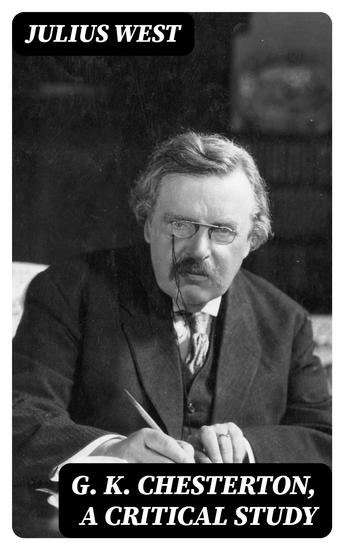
G K Chesterton A Critical Study - cover

G K Chesterton A Critical Study

Julius West

Casa editrice: DigiCat

  • 0
  • 0
  • 0

Sinossi

In "G. K. Chesterton, A Critical Study," Julius West offers a meticulous examination of one of the 20th century's most influential literary figures. West delves into Chesterton's multifaceted works, encompassing his novels, essays, and poetry, employing a blend of literary criticism and biographical exploration. The book is characterized by its analytical depth and eloquent prose, situating Chesterton's contributions within the broader context of early modernist thought and the Socratic form of discourse, which Chesterton famously championed. This critical study not only honors Chesterton's wit and paradoxical style but also tackles the intricacies of his philosophical underpinnings and theological viewpoints, thereby illuminating his impact on contemporary literature and culture. Julius West, a scholar with a profound interest in early 20th-century literature, draws from his extensive background in literary criticism and theology to craft this insightful analysis. His passion for Chesterton's work is evident, fueled by a desire to convey the importance of Chesterton's ideas in an age often bereft of the rich dialogues that define human existence. West's own experiences in literary scholarship lend significant weight to his interpretations and critiques. This book is highly recommended for anyone seeking to navigate the labyrinth of Chesterton's thought and articulate style. Whether a seasoned scholar, a graduate student of literature, or simply a curious reader, West's study functions as both an introductory guide and a profound exploration of Chesterton's enduring legacy, making it an indispensable addition to the libraries of those fascinated by literary criticism and theological inquiry.
Disponibile da: 10/08/2022.
Lunghezza di stampa: 106 pagine.

Altri libri che potrebbero interessarti

  • Cocoa Saves The Day - cover

    Cocoa Saves The Day

    Rekha Balakrishna

    • 0
    • 0
    • 0
    How cocoa farming has helped these women farmers improve their livelihoods and increase income
    Mostra libro
  • Flowers Plants Fruits and Trees - cover

    Flowers Plants Fruits and Trees

    Manly Palmer Hall

    • 0
    • 0
    • 0
    Flowers were chosen as symbols for many reasons. The great variety of flora made it possible to find some plant or flower which would be a suitable figure for nearly any abstract quality or condition. A plant might be chosen because of some myth connected with its origin, as the stories of Daphne and Narcissus; because of the peculiar environment in which it thrived, as the orchid and the fungus; because of its significant shape, as the passion flower and the Easter lily; because of its brilliance or fragrance, as the verbena and the sweet lavender; because it preserved its form indefinitely, as the everlasting flower; because of unusual characteristics as the sunflower and heliotrope, which have long been sacred because of their affinity for the sun.
    Mostra libro
  • Why Do We Say That? 404 Idioms Phrases Sayings & Facts! - An American Idiom Dictionary To Become A Native Speaker By Learning Colloquial Expressions Proverbs & Slang - cover

    Why Do We Say That? 404 Idioms...

    Scott Matthews

    • 0
    • 0
    • 0
    Who decided “break a leg” was a way to say good luck? Why are you “in a pickle” when things go wrong? And why on earth do we tell people to “hold their horses” when there are no horses in sight? 
    You’ve probably used everyday idioms like “break the ice,” or “hit the nail on the head” without giving them a second thought — most of us do. But behind these quirky expressions lie fascinating facts, bizarre backstories, and cultural twists that make the English language endlessly entertaining. 
    In Why Do We Say That? — The Complete 4-in-1 Idiom Collection, you’ll explore a treasure trove of 404 popular idioms, sayings, proverbs, and expressions — all packed with fun trivia, origin stories, and strange-but-true histories. This value-packed bundle combines four best-selling books into one essential volume for curious readers, language lovers, and anyone learning English who wants to speak more naturally and confidently. 
    Each entry explains where the phrase came from, how it evolved over time, and what it really means today — making this the perfect companion for word nerds, trivia buffs, ESL learners, homeschoolers, and lifelong learners alike. 
    Inside you’ll discover: 
    ✔️ Why “kick the bucket” has nothing to do with actual buckets — and everything to do with death 
    ✔️ How “pulling someone’s leg” evolved from a sinister trick to a harmless joke 
    ✔️ What “buttering someone up” has to do with ancient rituals (and actual butter) 
    ✔️ Why we “burn the midnight oil” to work late — and where that expression really comes fromClick the Buy Now button to decode the weird, witty, and wonderful world of English idioms — one unforgettable phrase at a time.
    Mostra libro
  • Worldmask - cover

    Worldmask

    Rabbi Akiva Tatz

    • 0
    • 0
    • 0
    Do you ever wonder what lies behind the mask of this physical world? Do you ever feel that there is more to reality than what meets the eye? Do you ever want to explore the spiritual dimension of existence and discover its secrets? 
    If so, then you will enjoy listening to Worldmask, a bestselling work by Rabbi Akiva Tatz, a renowned expert in Jewish thought and philosophy. In this book, Rabbi Tatz traces some of the Torah themes that express the duality of the world: the outer layer and the inner root. He deals with perplexing philosophical paradoxes, such as the relationship between God and nature, predestination and freewill, and suffering and joy. He shows how the Torah provides us with the keys to unlock the hidden world that exists behind the mask of the physical. 
    Worldmask is a book that will exhilarate and enlighten you, as you journey through the depths of Torah wisdom and uncover the mysteries of creation. It is a book that will challenge and inspire you, as you learn how to apply the Torah’s teachings to your own life and become closer to your Creator. 
    Don’t miss this opportunity to listen to Worldmask, a book that will transform your perspective on reality and reveal the true purpose of your existence.
    Mostra libro
  • A Kidnapped West - The Tragedy of Central Europe - cover

    A Kidnapped West - The Tragedy...

    Milan Kundera

    • 0
    • 0
    • 0
    “We should welcome the context Kundera gives for the struggles between Russia and Europe, and the plight of those caught between them. His defense of small languages, small cultures, and small nations feels pressing.”—Claire Messud, Harper's Magazine 
    “Kundera focuses on the relationship of Europe’s central ‘small nations’ like Czechoslovakia and Ukraine to Western culture and argues that their cultural identities were increasingly threatened.”—New York Book Review  
    A short collection of brilliant early essays that offers a fascinating context for Milan Kundera’s subsequent career and holds a mirror to much recent European history.  It is also remarkably prescient with regard to Russia’s current aggression in Ukraine and its threat to the rest of Europe. 
    Milan Kundera’s early nonfiction work feels especially resonant in our own time. In these pieces, Kundera pleads the case of the “small nations” of Europe who, by culture, are Western with deep roots in Europe, despite Russia imposing its own Communist political regimes in Hungary, Czechoslovakia, Poland, Ukraine, and elsewhere. Kundera warns that the real tragedy here is not Russia but Europe, whose own identity and culture are directly challenged and threatened in a way that could lead to their destruction. He is sounding the alarm, which chimes loud and clear in our own twenty-first century. 
    The 1983 essay translated by Edmund White (“The Tragedy of Central Europe”), and the 1967 lecture delivered to the Czech Writers’ Union in the middle of the Prague Spring by the young Milan Kundera (“Literature and the Small Nations”), translated for the first time by Linda Asher, are both written in a voice that is at once personal, vehement, and anguished. Here, Kundera appears already as one of our great European writers and truly our contemporary. Each piece is prefaced by a short presentation by French historian Pierre Nora and Czech-born French political scientist Jacques Rupnik.
    Mostra libro
  • Prelude to Philosophy - An Introduction for Christians - cover

    Prelude to Philosophy - An...

    Mark W. Foreman, J. P. Moreland

    • 0
    • 0
    • 0
    "The unexamined life is not worth living," according to Socrates, but pursuing the examined life strikes many as daunting, unappealing and even unnecessary. Is philosophy important? Why do I need philosophy if I have the Bible? Aren't philosophers simply engaged in meaningless disputes that are irrelevant to everyday life? 


    Mark Foreman addresses these and other questions in this "prelude" to the subject. Unlike a full introduction to philosophy, this book is a preliminary discussion that dispels misunderstandings and explains the rationale for engaging in philosophical reasoning. 


    In the first half of the book, Foreman defines the task of philosophy, compares it to other disciplines and demonstrates its practical value to Christians interested in developing a more thoughtful faith. The second half introduces the listener to logic and argumentation, the essential tools of a philosopher. Concise and straightforward, Prelude to Philosophy is a guide for those looking to embark on the "examined life."
    Mostra libro