Join us on a literary world trip!
Add this book to bookshelf
Grey
Write a new comment Default profile 50px
Grey
Subscribe to read the full book or read the first pages for free!
All characters reduced
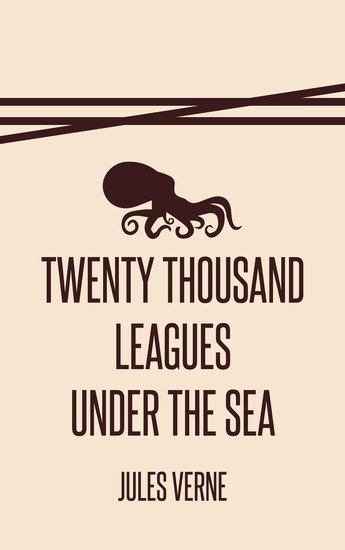
Twenty Thousand Leagues Under the Sea - cover

Twenty Thousand Leagues Under the Sea

Jules Verne

Publisher: CLXBX

  • 0
  • 0
  • 0

Summary

Twenty Thousand Leagues Under the Sea is Jules Verne's most iconic science fiction masterpiece—a thrilling voyage into the depths of the oceans that combines adventure, imagination, and visionary science. The novel follows Professor Pierre Aronnax, his loyal servant Conseil, and the skilled harpooner Ned Land as they set out to investigate a mysterious sea creature rumored to be attacking ships across the world's oceans.

Their pursuit leads them aboard the Nautilus, an advanced submarine far beyond its time, commanded by the enigmatic and brilliant Captain Nemo. Taken on an extraordinary underwater journey, the travelers explore sunken civilizations, coral forests, and the wonders of marine life, while also confronting the dangers of the deep, including giant sea creatures and hostile human forces.

As the voyage unfolds, Captain Nemo emerges as a complex and haunted figure—both a scientific genius and a man driven by profound personal loss. Through him, Verne explores themes of freedom, isolation, revenge, and the ethical use of technology. Rich in scientific detail and poetic description, the novel brings the underwater world vividly to life.

A cornerstone of modern science fiction, Twenty Thousand Leagues Under the Sea remains a timeless classic, inspiring generations of readers with its sense of wonder, innovation, and the boundless mystery of the oceans.
Available since: 02/05/2026.
Print length: 371 pages.

Other books that might interest you

  • Hamlet - cover

    Hamlet

    Tom Wheelwright, E.A. Copen,...

    • 0
    • 0
    • 0
    Shakespeare’s most famous play is one of the greatest stories in the literature of the world. 
    Distressed by his father’s death and his mother’s over-hasty remarriage, Hamlet, prince of Denmark is faced by a specter from beyond the grave bearing a grim message of murder and revenge. The young prince is driven to the edge of madness by his struggle to understand the situation he finds himself in and to do his duty. Many others, including Hamlet’s beloved, the innocent Ophelia, are swept up in his tragedy. 
    Hamlet is played by Simon Russell Beale. Imogen Stubbs plays Ophelia, Jane Lapotaire is Gertrude, and Bob Peck is Claudius. Polonius is played by Norman Rodway. 
    ACT IScene 1. The ghost of Old Hamlet, King of Denmark, has appeared to officers guarding the castle of Elsinore. When the apparition is witnessed by Horatio, friend of the Dead King’s son, he fears that it portends ill. He decides to tell young Hamlet, hoping that the ghost might reveal to him the cause of its restlessness.Scene 2. The dead king’s brother, Claudius, has assumed the crown and married the widowed Queen Gertrude. He dispatches emissaries to Norway where the king’s nephew Fortinbras is threatening Denmark with war. The King and Queen urge young Hamlet to cast off his dark mood. Once alone, the prince vents his violent grief at his father’s death and outrage at his mother’s “incestuous” remarriage. Wen Horatio tells Hamlet about the ghost, he too suspects foul play.Scene 3. Laertes warns his sister, Ophelia, not to take seriously Hamlet’s attentions because, being a prince, he is not free to make his own choices in matters of love. Scene 4. Hamlet and Horatio meet on the battlements. The ghost appears and beckons to Hamlet to follow him. Scene 5. The ghost describes to Hamlet how it was murdered by Claudius. It urges him to revenge the crime. 
    ACT IIScene 1. Polonius, a garrulous counsellor and father to Ophelia and Laertes, instructs Reynaldo to investigate the kind of life Laertes is leading in Paris. Ophelia describes Hamlet’s bizarre behavior to Polonius who attributes this to her recent rejection of him.Scene 2. The King and Queen ask Rosencrantz and Guildenstern, old friends of Hamlet, to discover the cause of the prince’s erratic behavior. The King of Norway has stopped Fortinbras’ preparations for war against Denmark. Polonius takes Hamlet’s scathing and capricious wit as proof of his insanity. Hamlet greets Rosencrantz and Guildenstern warmly, but becomes suspicious of their motives. He is, however, pleased to hear that a company of players has arrived at Elsinore. Once alone, he berates himself for his failure to undertake his revenge. He plans to have the players enact King Hamlet’s murder and to observe Claudius’ reaction as a way of ascertaining his guilt. 
    Act IIIScene 1. Rosencrantz and Guildenstern have failed to uncover the reason for Hamlet’s behavior. Hamlet shocks Ophelia with his crude and bitter contempt for women and marriage. Their conversation is overheard by Claudius, who recognizes that it is not thwarted love that is responsible for Hamlet’s dangerous instability. He resolves to send him on a diplomatic mission to England to get him away from the court. Polonius suggests that Gertrude should persuade Hamlet to confide in her; he himself will eavesdrop on their conversation.Scene 2. Hamlet tells Horatio to watch Claudius during the play for signs of guilt. As a murder identical to that of King Hamlet is enacted, Claudius rises in fright and calls for lights, thus ending the performance. Hamlet is summoned to his mother’s closet and vows to “speak daggers to her, but use none.”Scene 3. Claudius orders Rosencrantz and Guildenstern to accompany Hamlet to England. Once alone he expresses agony at his dreadful crime. Hamlet comes upon him trying to pray, but desists from killing him on the grounds that, were Claudius to die in prayer, his soul might go to heaven rather than hell.Scene 4. Hamlet harangues
    Show book
  • Robinson Crusoe - cover

    Robinson Crusoe

    Daniel Defoe

    • 0
    • 0
    • 0
    Robinson Crusoe is a novel by Daniel Defoe, first published on 25 April 1719. The first edition credited the work's protagonist Robinson Crusoe as its author, leading many readers to believe he was a real person and the book a travelogue of true incidents.
    Epistolary, confessional, and didactic in form, the book is presented as an autobiography of the title character (whose birth name is Robinson Kreutznaer)—a castaway who spends 28 years on a remote tropical desert island near Trinidad, encountering cannibals, captives, and mutineers, before ultimately being rescued. The story has been thought to be based on the life of Alexander Selkirk, a Scottish castaway who lived for four years on a Pacific island called "Más a Tierra", now part of Chile, which was renamed Robinson Crusoe Island in 1966.
    Despite its simple narrative style, Robinson Crusoe was well received in the literary world and is often credited as marking the beginning of realistic fiction as a literary genre. It is generally seen as a contender for the first English novel. Before the end of 1719, the book had already run through four editions, and it has gone on to become one of the most widely published books in history, spawning so many imitations, not only in literature but also in film, television and radio, that its name is used to define a genre, the Robinsonade.
    Famous works of the author Daniel Defoe:
    Robinson Crusoe, Captain Singleton, Memoirs of a Cavalier, A Journal of the Plague Year, Colonel Jack, Moll Flanders, Roxana: The Fortunate Mistress.
    Show book
  • The complete novels of Bram Stoker - cover

    The complete novels of Bram Stoker

    Bram Stoker

    • 0
    • 0
    • 0
    What if fear could be elegant, atmospheric, and unforgettable?
    
    The Complete Novels of Bram Stoker gathers all the major novels of the legendary author who defined gothic horror for generations. Best known as the creator of Dracula, Stoker combined suspense, folklore, psychological tension, and the supernatural to create stories that still haunt readers today.
    
    This comprehensive collection goes beyond Dracula, revealing Stoker's wider imaginative range—dark mysteries, cursed lands, ancient legends, and battles between reason and the unknown. His novels explore fear not only as terror, but as obsession, desire, and the struggle against unseen forces.
    
    Written in rich Victorian prose and layered with atmosphere, Stoker's works laid the foundation for modern horror, vampire fiction, and supernatural thrillers.
    
    Inside this eBook, you'll explore:
    
    All of Bram Stoker's novels in one complete collection
    
    Gothic horror, supernatural mystery, and dark adventure
    
    The literary roots of modern vampire and horror fiction
    
    A cornerstone collection of classic gothic literature
    
    Read, studied, and adapted worldwide, Bram Stoker's novels remain essential reading for anyone drawn to gothic fiction, classic horror, and timeless suspense.
    
    Open the door to darkness and imagination. Buy now and experience the complete novels of Bram Stoker.
    Show book
  • The Cask of Amontillado - cover

    The Cask of Amontillado

    Edgar Allan Poe

    • 0
    • 0
    • 0
    "The Cask of Amontillado" is a short story by the American writer Edgar Allan Poe, first published in the November 1846 issue of Godey's Lady's Book. The story, set in an unnamed Italian city at Carnival time, is about a man taking fatal revenge on a friend who, he believes, has insulted him. Like several of Poe's stories, and in keeping with the 19th-century fascination with the subject, the narrative follows a person being buried alive – in this case, by immurement. As in "The Black Cat" and "The Tell-Tale Heart", Poe conveys the story from the murderer's perspective.
    The story's narrator, a nobleman named Montresor, describes his revenge against fellow noble Fortunato. Angry over numerous injuries and an unspecified insult, Montresor resolves to avenge himself without being caught, and also to make sure that Fortunato knows he is responsible...
    Show book
  • In Search of the Castaways - cover

    In Search of the Castaways

    Jules Verne

    • 0
    • 0
    • 0
    In Search of the Castaways is a sweeping adventure novel by Jules Verne that celebrates courage, loyalty, and the unrelenting human drive to explore the unknown. The story begins when a mysterious message, written in three fragmented languages, is discovered inside a bottle retrieved from the sea. The message hints at the fate of Captain Grant, a shipwrecked explorer lost somewhere along the 37th parallel of the Southern Hemisphere.
    
    Determined to rescue the missing captain, Lord and Lady Glenarvan lead an ambitious expedition aboard the yacht Duncan. Joined by Captain Grant's brave children, Mary and Robert, and the absent-minded yet brilliant geographer Jacques Paganel, the group embarks on an extraordinary journey across three continents—South America, Australia, and New Zealand.
    
    Each stage of the voyage is filled with perilous landscapes, dramatic encounters, and narrow escapes, from earthquakes and floods to hostile environments and unforeseen dangers. As the travelers follow the slender clues left behind by the castaway, they must rely on intelligence, teamwork, and unwavering hope to overcome seemingly impossible odds.
    
    Blending thrilling adventure with rich geographical detail and scientific insight, In Search of the Castaways is a masterful tale of exploration and perseverance. One of Jules Verne's most beloved novels, it remains a timeless classic that captures the excitement of discovery and the power of determination in the face of uncertainty.
    Show book
  • The Maltese Cat - Celebrated author of The Jungle Book Kipling brings another marvellous story from the perspective of an animal this time about a game of polo set in India during British rule - cover

    The Maltese Cat - Celebrated...

    Rudyard Kipling

    • 0
    • 0
    • 0
    Joseph Rudyard Kipling was born in Mumbai, India on 30th December 1865.   
     
    As was the custom in those days, he and his sister were sent back to England when he was 5.  The ill-treatment and cruelty by the Portsmouth couple they boarded with Kipling said contributed to the onset of his literary life.  
     
    At 16 he returned to India to work on a local paper where he was soon contributing and writing.  It also exposed him to the issues of identity and national allegiance which pervade much of his work.  
     
    In 1886, his ‘Departmental Ditties’, collection of verse appeared in print followed by 39 short stories for his newspaper over only 8 months.  These were then published as ‘Plain Tales from the Hills’, shortly after his 22nd birthday.  
     
    He continued his prolific pace of writing before being dismissed in a dispute and, taking his pay-off and the profits from the sale of some publishing rights, decided to return to London, travelling via Rangoon, Hong Kong, Japan and the United States, all the while writing articles, and arriving at Liverpool in October 1889. 
     
    Over the next two years he saw further works published as books and in magazines, as well as a nervous breakdown for which he was prescribed a sea voyage, to South Africa, Australia, New Zealand and India.  
     
    Happier times came with marriage to Caroline Starr Balestier in January 1892.  The honeymoon began in Vermont and ended in Yokahama where they heard their bank had failed.  They returned to Vermont and settled.  Caroline was now pregnant and he was planning the ‘Jungle Books’.  
     
    A failed arbitration between the US and England resulted in an argument between Caroline’s brother and Kipling, and then his arrest.  At the hearing he was mortified by the exposure of his private life and after settling the matter they returned to England and life in Torquay.  ‘Kim’ was published in 1902, and ‘Just So Stories for Little Children’, a year later.  
     
    In 1907 he was awarded the Nobel Prize for Literature with the citation “in consideration of the power of observation, originality of imagination, virility of ideas and remarkable talent for narration which characterise the creations of this world-famous author”.   
     
    When the Great War erupted, he scorned those who refused conscription.  His son enlisted and was killed at the Battle of Loos in September 1915, at 18, an exploding shell had ripped his face apart.  This death inspired Kipling’s writing thereafter, but the tragedy broke his life and by 1930 his prolific pen had almost ceased. 
     
    Rudyard Kipling died on 18th January 1936 from a perforated duodenal ulcer.  He was 70.  His ashes are buried at Poets’ Corner in Westminster Abbey. 
     
    In the Maltese Cat Kipling returns once more to India and the British Empire.  A polo match is being played.  The fierce competitive instincts of two social classes are fighting for dominance.  All told through the voice of the Maltese Cat, the most cunning of the horses.
    Show book