Unisciti a noi in un viaggio nel mondo dei libri!
Aggiungi questo libro allo scaffale
Grey
Scrivi un nuovo commento Default profile 50px
Grey
Iscriviti per leggere l'intero libro o leggi le prime pagine gratuitamente!
All characters reduced
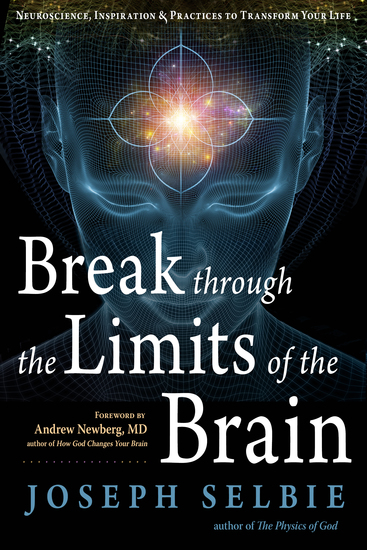
Break Through the Limits of the Brain - Experience Superconscious Awareness Intuition Vitality Creativity and Fulfilling Divine Joy - cover

Break Through the Limits of the Brain - Experience Superconscious Awareness Intuition Vitality Creativity and Fulfilling Divine Joy

Joseph Selbie

Casa editrice: New Page Books

  • 1
  • 1
  • 0

Sinossi

A life-changing guide to understanding your brain and how to change it—for good.Break Through the Limits of the Brain explores the neuroscience of sacred, superconscious experience. It offers proven ways to break through the brain’s limits into a life-changing, life-enhancing awareness that is beyond our everyday consciousness; an awareness that is intuitive, creative, energized, joyful, and spirit-filled. Selbie explains how and why the brain’s neural circuits reinforce thoughts, emotions, and behaviors that keep us immersed in limited conscious awareness—and how radical neuroplasticity enables our innate ability to rewire the brain to break through to unlimited superconscious awareness. The book offers many practices: the Hong Sau technique of meditation for deepening concentration, energization exercises for increasing life-force and vitality, methodical introspection techniques for identifying neurally reinforced negative patterns of thought, emotion, and behavior and affirmations for directly rewiring them. These practices will help you bring superconscious awareness into your life that enables, awakens, and supports success, vitality, creativity, health, peace of mind, and lasting, fulfilling happiness.Break Through the Limits of the Brain provides strong scientific support for superconscious awareness; scientific support provided by quantum physics and M-theory for the existence of a subtle, nonlocal reality; a reality in which we exist simultaneously with physical reality; a reality of which we can become aware by breaking through the limits of the brain. The book debunks scientific materialism’s brain-based explanation for consciousness and intelligence—the brain-as-supercomputer model—and explains the view of many prominent and open-minded scientists that an all-pervading intelligent consciousness is not only the source of our own consciousness but also the foundation of reality—an age-old sacred belief shared by saints, sages, mystics, and those who’ve had near-death experiences.Meditation is a central theme of the book—what it is; how to do it; why it works; its physical, mental, and emotional benefits as measured by neuroscientists; and how it rewires the brain for us to experience superconscious awareness and to achieve whatever we put our mind to.
Disponibile da: 01/09/2022.
Lunghezza di stampa: 256 pagine.

Altri libri che potrebbero interessarti

  • Abortion - a personal story a political choice - cover

    Abortion - a personal story a...

    Pauline Harmange

    • 0
    • 0
    • 0
    From the author of I Hate Men, a personal and political reflection on abortion rights. 


    Discussion about abortion and associated rights are often limited to either "anti-abortion" or "pro-choice," the latter of which focuses on the importance of having the right to choose, rather than on what that right means for real people. 


    In this timely essay, Pauline Harmange provides an intimate, detailed account of her abortion. Reminiscent of Annie Ernaux's Happening, Abortion is nuanced, complex, honest, and precise. Harmange gives voice to the emotions, reflections, and contradictions that someone could experience when they choose to terminate a pregnancy. 


    At a time in which women's reproductive rights are being called into question around the world, Abortion is a clarion call, a powerful personal testimony, and a resolutely political vision: to restore power to our experiences, all our experiences, by sharing them, and to transform society for the better.
    Mostra libro
  • Hypnosis to boost confidence in public - A guided meditation - DST Hypno with Stu Newman - cover

    Hypnosis to boost confidence in...

    Stuart Newman

    • 0
    • 0
    • 0
    Do you struggle with low self-confidence in public?  
    Do you feel like your voice is not heard or that you are too scared to speak up?  
    Then DST Hypno with Stu Newman could be just what you need. 
    With hypnosis, Stu can help boost your confidence and give back the power of speaking up for yourself.  
    Not only will it make a huge difference in how others perceive and treat you, but it will also help increase your sense of worthiness.  
    Imagine being able to walk into any room full of people feeling confident enough to say whatever needs saying without fear or hesitation!  
    Don't wait another second - take advantage of DST Hypno's services today and start living life on YOUR terms!
    Mostra libro
  • The Messianic Character of American Education - cover

    The Messianic Character of...

    R. J. Rushdoony

    • 0
    • 0
    • 0
    Rushdoony's study tells us an important part of American history: exactly what has public education been trying to accomplish? Before the 1830s and Horace Mann, no schools in the U.S. were state supported or state controlled. They were local, parent-teacher enterprises, supported without taxes, and taking care of all children. They were remarkably high in standard and were Christian. From Mann to the present, the state has used education to socialize the child. The school's basic purpose, according to its own philosophers, is not education in the traditional sense of the 3 R's. Instead, it is to promote "democracy" and "equality," not in their legal or civic sense, but in terms of the engineering of a socialized citizenry. Public education became the means of creating a social order of the educators design. Such men saw themselves and the school in messianic terms. This book was instrumental in launching the Christian school and homeschool movements.
    Mostra libro
  • Biggest Tank Battles of World War II The: The History of the Most Decisive Tank Encounters between the Allies and Axis - cover

    Biggest Tank Battles of World...

    Editors Charles River

    • 0
    • 0
    • 0
    The tank was first developed by the British and French during World War I as a means to break the deadlock on the Western Front. More so than any previous war, the balance of power lay with the defense, as machine guns, trenches, bunkers, barbed wire, and rapid-firing rifles all made frontal assaults on established positions prohibitively costly. In the closing months of the war, the tank partially evened up that balance, even as the war’s commanders initially proved unsure of how to use them. While it cannot be said that the tank won the war, it contributed to its end and if the fighting had continued another year, the mass production that had started in Allied countries may have proved decisive. 
    	World War II was the culmination of a quarter century of tank development, and it would also be the first major test of tanks in mobile warfare during which they had to face other tanks. However, many of the tanks were constructed with the static warfare of the Western Front in mind and were thus slow and had short operational ranges. Others were too light to face opposing tanks or the new generation of anti-tank weapons that hadn’t existed in World War I. The unsuitability of these tank models for this new kind of warfare was quickly recognized, and the belligerent powers scrambled to create better designs. As each new, improved model came off the assembly lines, the opposing powers rushed to create a tank that could beat it. In that regard, World War II was also a war between rival engineers. 
    	The beginning of World War II found the major powers developing tanks to some extent, but lingering ideas from World War I affected the development of tanks during the Interwar period.
    Mostra libro
  • Narrative of Henry Box Brown - The Tract Of The Quiet Way - cover

    Narrative of Henry Box Brown -...

    Henry Box Brown

    • 0
    • 0
    • 0
    Henry Box Brown's 'Narrative' unfolds a remarkable escape from slavery. In a daring journey, Brown courageously mailed himself to freedom in a wooden crate. This first-hand account vividly details the brutality of bondage and the relentless pursuit of liberty. Brown's resilience and ingenuity shine, illustrating the indomitable spirit against oppression. A powerful narrative, it echoes the enduring quest for freedom and stands as a testament to human determination and the triumph over adversity. Read in English, unabridged.
    Mostra libro
  • The Shocking Truth about Virtual Reality - cover

    The Shocking Truth about Virtual...

    Zoey Fraisers

    • 0
    • 0
    • 0
    Virtual reality (VR) has long been a concept of science fiction, but today, it is a rapidly evolving technology shaping industries, entertainment, and even human interactions. From its early beginnings as a theoretical concept to the sophisticated headsets and immersive environments of today, VR has transformed from a novelty into a powerful tool that influences the way people work, learn, and socialize. While the promise of virtual worlds seems limitless, there are also significant concerns about its long-term effects on society, privacy, and even human psychology.  
    The origins of VR date back further than most people realize. The idea of creating artificial environments that simulate reality can be traced back to the early 20th century. Flight simulators in the 1920s provided the first taste of what would later become VR training programs. In the 1960s, innovators such as Ivan Sutherland and Morton Heilig developed early prototypes of head-mounted displays and immersive cinema experiences. However, technological limitations prevented these early experiments from reaching mainstream adoption. It wasn’t until the late 20th and early 21st centuries that computing power, graphics capabilities, and internet connectivity made VR a viable and widely accessible technology.  
    Breakthroughs in VR hardware and software have enabled increasingly realistic and engaging experiences. High-resolution headsets, motion tracking, and artificial intelligence now allow users to step into digital environments that respond dynamically to their movements and actions. Industries ranging from gaming and entertainment to healthcare and education have embraced VR as a revolutionary tool. Doctors use VR to simulate surgeries, businesses conduct remote meetings in virtual spaces, and educators transport students to historical landmarks without ever leaving the classroom.
    Mostra libro