Unisciti a noi in un viaggio nel mondo dei libri!
Aggiungi questo libro allo scaffale
Grey
Scrivi un nuovo commento Default profile 50px
Grey
Iscriviti per leggere l'intero libro o leggi le prime pagine gratuitamente!
All characters reduced
What Does History Teach? - Two Edinburgh Lectures - cover

What Does History Teach? - Two Edinburgh Lectures

John Stuart Blackie

Casa editrice: DigiCat

  • 0
  • 0
  • 0

Sinossi

John Stuart Blackie's "What Does History Teach?" serves as a thoughtful examination of the lessons embedded within historical narratives, emphasizing the interconnectedness of past events and contemporary thought. This philosophical treatise adopts a reflective literary style, engaging readers through eloquent prose that marries anecdotal evidence with rigorous analysis. Blackie draws on a wide array of historical sources, from ancient civilizations to recent histories, to elucidate how these lessons shape moral understanding, citizenship, and civilization itself within the broader context of 19th-century intellectual thought, an era marked by fervent inquiries into human experience and identity. John Stuart Blackie (1809-1895) was a Scottish scholar, poet, and educator whose diverse academic pursuits greatly informed his writing. Educated at the University of Edinburgh, he traveled extensively across Europe, where exposure to different cultures and philosophical ideas nourished his belief in the importance of history as a moral guide. His passion for learning and ability to synthesize knowledge from various disciplines led him to create this compelling work, which reflects his own experiences and insights into the role of history in shaping human character and societal values. This book is highly recommended for readers interested in the intersection of history, philosophy, and moral education. Blackie's insightful synthesis encourages critical reflection and will appeal to historians, educators, and anyone seeking to understand how historical precedents inform modern-day dilemmas. His engaging style and profound insights make "What Does History Teach?" a valuable addition to the library of any thoughtful scholar.
Disponibile da: 16/09/2022.
Lunghezza di stampa: 56 pagine.
Altri libri che potrebbero interessarti

  • The Owl and the Nightingale - A New Verse Translation - cover

    The Owl and the Nightingale - A...

    Simon Armitage

    • 0
    • 0
    • 0
    Simon Armitage narrates a complete verse translation of this spirited and humorous medieval English poem
    The Owl and the Nightingale, one of the earliest literary works in Middle English, is a lively, anonymous comic poem about two birds who embark on a war of words in a wood, with a nearby poet reporting their argument in rhyming couplets, line by line and blow by blow. In this engaging and energetic verse translation, Simon Armitage captures the verve and humor of this dramatic tale with all the cut and thrust of the original.
    
    In an agile iambic tetrameter that skillfully amplifies the prosody and rhythm of the original, Armitage's translation moves entertainingly from the eloquent and philosophical to the ribald and ridiculous. Sounding at times like antagonists in a Twitter feud, the owl and the nightingale quarrel about a host of subjects that still resonate today—including love, marriage, identity, cultural background, class distinctions, and the right to be heard. Adding to the playful, raucous mood of the barb-trading birds is Armitage, who at one point inserts himself into the poem as a "magistrate . . . to adjudicate"—one who is "skilled with words & worldly wise / & frowns on every form of vice."
    
    Featuring the Middle English text on facing pages and an introduction by Armitage, this volume will delight readers of all ages.
    Mostra libro
  • The Republic - cover

    The Republic

    Plato

    • 0
    • 0
    • 0
    The Republic by Plato is a philosophical text that addresses the question of justice. In the text, Plato argues that justice is not simply a matter of following the laws of the city, but rather is something that must be based on the ideal state of the city. For Plato, the ideal state is one in which all citizens are able to participate in the ruling of the city.
    Mostra libro
  • The Black Man's President - Abraham Lincoln African Americans & the Pursuit of Racial Equality - cover

    The Black Man's President -...

    Michael Burlingame

    • 0
    • 0
    • 0
    In a little-noted eulogy delivered after Lincoln's assassination, Frederick Douglass called the president "emphatically the black man's president," the "first to show any respect for their rights as men." Douglass pointed not just to Lincoln's official acts and utterances, like the Emancipation Proclamation or the Second Inaugural Address, but also to the president's own personal experiences with Black people. 


    But Lincoln's description as "emphatically the black man's president" rests on more than his relationship with Douglass or on his official words and deeds. Lincoln interacted with many other African Americans during his presidency. His unfailing cordiality to them, his willingness to meet with them in the White House, to honor their requests, to invite them to consult on public policy, to treat them with respect whether they were kitchen servants or leaders of the Black community, to invite them to attend receptions, to sing and pray with them in their neighborhoods—all those manifestations of an egalitarian spirit justified the tributes paid to him by Frederick Douglass and other African Americans. 


    Historian David S. Reynolds observed that only by examining Lincoln's "personal interchange with Black people do we see the complete falsity of the charges of innate racism that some have leveled against him over the years."
    Mostra libro
  • Three Questions - The Wisdom of the Present Moment and the Power of Compassion - cover

    Three Questions - The Wisdom of...

    Leo Tolstoy, Tim Zengerink

    • 0
    • 0
    • 0
    What are the most important things in life—and how do we know when to act on them? 
    In Three Questions, Leo Tolstoy delivers a timeless story about a king in search of wisdom. When scholars fail to give him clear answers, a visit to a humble hermit reveals the truth through action rather than words. 
    This modern audiobook adaptation captures the heart of Tolstoy’s parable with simple, clear language, making its message of mindfulness, service, and human connection resonate for today’s listener. 
    What You’ll Hear in This Modern Translation: 
    •	A short, beautiful story about life’s most meaningful questions 
    •	A journey of discovery through compassion, humility, and presence 
    •	A timeless lesson told with quiet power and emotional warmth 
    Included in This Edition: 
    Refined for clarity and accessibility, this audiobook preserves the original’s soul while making its message more relatable than ever. 
    Listen today—and rediscover what truly matters.
    Mostra libro
  • No Child Left Inside - Transforming the Next Generation Through Experiential Learning - cover

    No Child Left Inside -...

    Bryn Lottig

    • 0
    • 0
    • 0
    Learning through experience within an outdoor community provides an opportunity for the next generation to figure out who they are, separate and apart from the noise. Within an intentional, safe environment, even the most alienated kids can develop social, emotional, and communication skills that will amplify their connectedness, and independence. When kids recognize that they can do hard things, provide value to the group, and rely on others, the course of their life can change.  Written for educators, parents, and leaders, No Child Left Inside: Transforming the Next Generation Through Experiential Learning will show you how to create experiences for kids so they can drill skills and safely explore personal strengths, as well as limitations. By providing a space where kids can celebrate and transcend their differences, you can help them learn how to communicate honestly, deeply connect with those around them, and foster empathy, commitment, and accountability within the community. When you facilitate activities that prove to kids that they’re capable of great things and figuring out a challenge as a team, you help instill within them greater confidence and agency.
    Mostra libro
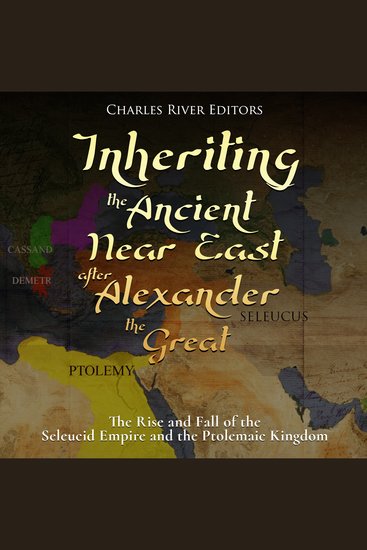
  • Inheriting the Ancient Near East after Alexander the Great: The Rise and Fall of the Seleucid Empire and the Ptolemaic Kingdom - cover

    Inheriting the Ancient Near East...

    Editors Charles River

    • 0
    • 0
    • 0
    On his deathbed, some historians claim that when he was pressed to name a successor, Alexander the Great muttered that his empire should go “to the strongest”. Other sources claim that he passed his signet ring to his general Perdiccas, thereby naming him successor, but whatever his choices were or may have been, they were ignored. Alexander’s generals, all of them with the loyalty of their own corps at their backs, would tear each other apart in a vicious internal struggle that lasted almost half a century before four factions emerged victorious: Macedonia, the Seleucid Empire in the east, the Kingdom of Pergamon in Asia Minor, and the Ptolemaic dynasty in Egypt. During the course of these wars, Alexander’s only heir, the posthumously born Alexander IV, was murdered, extinguishing his bloodline for ever.  
    	For a time, the Seleucids commanded the largest empire in the world as it stretched from the high plains and deserts of what is now Afghanistan in the east to parts of the Levant and Asia Minor in the west. The empire’s early kings were strong and shrewd and committed to the ideas of Hellenism as much as holding power and expanding the realm of their empire, but later rulers did not prove as capable. In time, the Seleucid royal house often descended into orgies of violence which were driven by ambitious men and women.   
    	Although Alexander never lived to rule over Egypt, one of his generals, Ptolemy I, did, and it was he who established the last great pharaonic dynasty in Egypt, known as the Ptolemaic Dynasty. Despite the infighting among them, one thing Alexander’s generals did agree upon was their Hellenistic culture. Most famously, Ptolemy’s line firmly established the Hellenistic culture of the Greeks while ruling over Egypt, and by marrying within their family line, the Ptolemaic pharaohs kept their Hellenistic heritage until the very end of Ptolemy’s line, which died with Cleopatra in 30 BC.
    Mostra libro