Unisciti a noi in un viaggio nel mondo dei libri!
Aggiungi questo libro allo scaffale
Grey
Scrivi un nuovo commento Default profile 50px
Grey
Iscriviti per leggere l'intero libro o leggi le prime pagine gratuitamente!
All characters reduced
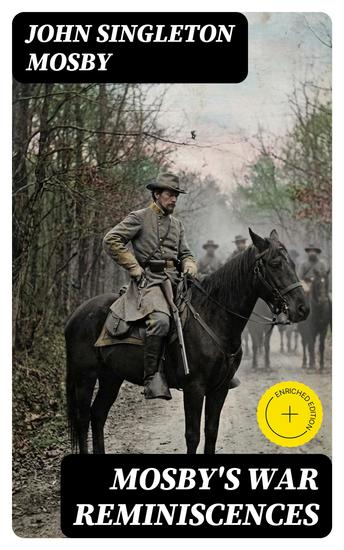
Mosby's War Reminiscences - Enriched edition Civil War Memoirs - cover

Mosby's War Reminiscences - Enriched edition Civil War Memoirs

John Singleton Mosby

Casa editrice: DigiCat

  • 0
  • 0
  • 0

Sinossi

In "Mosby's War Reminiscences," John Singleton Mosby offers a compelling and introspective account of his experiences as a Confederate cavalry officer during the American Civil War. Written with a blend of vivid storytelling and analytical reflection, this memoir delves into the intricacies of guerrilla warfare, the strategic significance of his operations in Virginia, and the personal conflicts faced by soldiers. Mosby employs a first-person narrative style, capturing the dualities of bravery and fear, loyalty and betrayal, all while situating his recounting within the broader context of a country torn apart by war. John Singleton Mosby, known as the "Gray Ghost" of the Confederacy, was driven by a profound sense of duty and an unwavering loyalty to his cause. His firsthand experiences, coupled with his background as a lawyer and his deep understanding of military tactics, shaped his perspective on the war. Mosby's role as a commander of the 43rd Battalion Virginia Cavalry further informed his insights, making his reminiscences a critical primary source for understanding the Southern experience during the conflict. For readers interested in a nuanced and personal perspective on the American Civil War, "Mosby's War Reminiscences" is an invaluable addition to the scholarly exploration of this tumultuous period. Mosby's articulate reflections not only illuminate the harsh realities of war but also provoke profound considerations on the moral complexities faced by those who fought. This memoir is essential for historians, students, and anyone seeking to grasp the human element behind military strategy.

In this enriched edition, we have carefully created added value for your reading experience:
- A succinct Introduction situates the work's timeless appeal and themes.
- The Synopsis outlines the central plot, highlighting key developments without spoiling critical twists.
- A detailed Historical Context immerses you in the era's events and influences that shaped the writing.
- A thorough Analysis dissects symbols, motifs, and character arcs to unearth underlying meanings.
- Reflection questions prompt you to engage personally with the work's messages, connecting them to modern life.
- Hand‐picked Memorable Quotes shine a spotlight on moments of literary brilliance.
- Interactive footnotes clarify unusual references, historical allusions, and archaic phrases for an effortless, more informed read.
Disponibile da: 11/10/2022.
Lunghezza di stampa: 158 pagine.

Altri libri che potrebbero interessarti

  • Chemically Imbalanced - Everyday Suffering Medication and Our Troubled Quest for Self-Mastery - cover

    Chemically Imbalanced - Everyday...

    Joseph E. Davis

    • 0
    • 0
    • 0
    Everyday suffering—those conditions or feelings brought on by trying circumstances that arise in everyone’s lives—is something that humans have grappled with for millennia. But the last decades have seen a drastic change in the way we approach it. In the past, a person going through a time of difficulty might keep a journal or see a therapist, but now the psychological has been replaced by the biological: instead of treating the heart, soul, and mind, we take a pill to treat the brain. 
     
    Chemically Imbalanced is a field report on how ordinary people dealing with common problems explain their suffering, how they’re increasingly turning to the thin and mechanistic language of the “body/brain,” and what these encounters might tell us. Drawing on interviews with people dealing with struggles such as underperformance in school or work, grief after the end of a relationship, or disappointment with how their life is unfolding, Joseph E. Davis reveals the profound revolution in consciousness that is underway. We now see suffering as an imbalance in the brain that needs to be fixed, usually through chemical means. This has rippled into our social and cultural conversations, and it has affected how we, as a society, imagine ourselves and envision what constitutes a good life. Davis warns that what we envision as a neurological revolution, in which suffering is a mechanistic problem, has troubling and entrapping consequences. And he makes the case that by turning away from an interpretive, meaning-making view of ourselves, we thwart our chances to enrich our souls and learn important truths about ourselves and the social conditions under which we live.
    Mostra libro
  • Summary: The Devil in the White City - Murder Magic and Madness at the Fair That Changed America by Erik Larson: Key Takeaways Summary & Analysis Included - cover

    Summary: The Devil in the White...

    Brooks Bryant

    • 0
    • 0
    • 0
    Disclaimer: This is not the official book, but a summary & it does not accompany the official. 
    Architect Daniel H. Burnham faces the mammoth task of constructing the fairground, a utopian city which would come to be known as "The White City." His vision of grandeur, innovation, and beauty aims to surpass the Parisian Eiffel Tower and establish America's cultural ascendancy in the world. Through herculean efforts, Burnham coordinates a vast number of workers, battling time constraints, tragedy, and countless other hurdles to turn his dream into reality. 
    In contrast, lurking in the shadows of this shimmering facade, Dr. H. H. Holmes utilizes the fair's attractions to lure victims into his specially constructed "Murder Castle," a horrifying structure equipped with secret passageways, gas chambers, and a crematorium. His charming demeanor and ruthless intelligence facilitate a series of grim murders, marking him as one of America's first recorded serial killers. 
    As you journey through our summary, explore the dual narratives that paint a vivid picture of the time period, encapsulating the heights of human achievement and the dark underbelly of its sins. Larson's meticulous research and mesmerizing storytelling breathe life into a bygone era, delving into the minds of the men who shaped it — one with a vision of beauty, the other with a vision of horror. 
    Witness the transformative period in American history, where unprecedented feats of ingenuity stood side by side with unimaginable cruelty. "The Devil in the White City" unveils the thin line between genius and madness, progress and destruction, that defines humanity.
    Mostra libro
  • The Path to a Limitless Mindset - How to Rewire Your Brain for Success - cover

    The Path to a Limitless Mindset...

    Caleb David

    • 0
    • 0
    • 0
    Unlock your mind's extraordinary potential and embark on a transformative journey toward personal success. The Path to a Limitless Mindset reveals how your brain’s neuroplasticity—the ability to rewire itself—can be harnessed to develop a growth mindset and open the door to limitless possibilities. 
    In this book, you’ll explore groundbreaking insights from psychology and neuroscience that explain how mindset influences your actions, decisions, and achievements. Whether you're looking to break free from self-doubt, overcome obstacles, or cultivate resilience, this guide provides practical techniques to help you reshape your thoughts and habits for lasting success. 
    Discover how to:Rewire your brain to break free from limiting beliefs.Embrace challenges and setbacks as opportunities for growth.Cultivate resilience and mental agility in the face of adversity.Develop a mindset that attracts success in every area of your life. 
    With actionable steps, real-life examples, and inspiring insights, The Path to a Limitless Mindset is your guide to transforming your mental landscape and unlocking your full potential. Step into a life of abundance, growth, and unstoppable achievement!
    Mostra libro
  • Attention Implies That There is No Centre - Brockwood Park and Gstaad 1975 - Dialogue 5 - cover

    Attention Implies That There is...

    Jiddu Krishnamurti

    • 0
    • 0
    • 0
    Attention implies that there is no centre - 22 June 1975 
    • Consciousness, because it is in constant movement, has never found an energy 
    which is not contradictory, which is not produced by desire and thought. 
    • Can thought ever see its own movement and the futility of its own movement? • Attention implies that there is no centre. 
    • Is there a perception, a seeing outside the space which is part of consciousness? • Therearetwohumanbeings,onegetsconditionedandtheotherdoesn’t.Why? 
    How has it happened the other doesn’t get conditioned? 
    • How does this perception which is beyond attention, beyond awareness, 
    beyond concentration come about? 
    • Thought is rather superficial, it’s merely a very small part of the operation of the 
    brain. 
    • Can consciousness be completely empty of its content? • Order and disorder
    Mostra libro
  • The Day the World Came to Town - 9 11 in Gander Newfoundland - cover

    The Day the World Came to Town -...

    Anonimo

    • 0
    • 0
    • 0
    Perfect for fans of the musical Come From Away! 
    When 38 jetliners bound for the United States were forced to land at Gander International Airport in Canada by the closing of U.S. airspace on September 11, the population of this small town on Newfoundland Island swelled from 10,300 to nearly 17,000. The citizens of Gander met the stranded passengers with an overwhelming display of friendship and goodwill. As the passengers stepped from the airplanes, exhausted, hungry and distraught after being held on board for nearly 24 hours while security checked all of the baggage, they were greeted with a feast prepared by the townspeople. Local bus drivers who had been on strike came off the picket lines to transport the passengers to the various shelters set up in local schools and churches. Linens and toiletries were bought and donated. A middle school provided showers, as well as access to computers, email, and televisions, allowing the passengers to stay in touch with family and follow the news.
    Mostra libro
  • Economic Structures and Global Relations - Examining the Impact of Various Economic Systems on Global Stability (3 in 1) - cover

    Economic Structures and Global...

    Arlo Holders

    • 0
    • 0
    • 0
    This book bundle contains the following 3 titles: 
    - Mercantilism Explained: Mercantilism, a dominant economic theory from the 16th to the 18th century, played a pivotal role in shaping the economic and political landscape of early modern Europe. Rooted in the belief that a nation's wealth and power were measured by its stockpile of precious metals, particularly gold and silver, mercantilism emphasized the importance of maintaining a favorable balance of trade. Nations sought to maximize exports while minimizing imports, often employing protectionist policies to achieve this goal. This approach reflected the belief that global wealth was finite, creating fierce competition among nations to secure the largest share of resources and economic advantage. 
    - Communism vs. Capitalism: An economic system refers to the structure and methods a society uses to produce, distribute, and consume goods and services. It defines how resources are allocated, how wealth is distributed, and how economic decisions are made. Different societies have developed various economic systems over time, influenced by their unique historical, cultural, and political contexts. Among these systems, capitalism and communism are two of the most prominent and contrasting economic ideologies that have shaped the global landscape. 
    - Economic Impacts of Imperialism: Cultural and ideological factors also played a role in shaping imperialism. The belief in the superiority of certain civilizations over others justified the conquest and subjugation of indigenous peoples. Religion was another motivator, with missionary efforts often accompanying territorial expansion. Christianity, in particular, became a tool for legitimizing imperial control, as colonizing powers framed their endeavors as missions to civilize and convert native populations. 
    Mostra libro