Unisciti a noi in un viaggio nel mondo dei libri!
Aggiungi questo libro allo scaffale
Grey
Scrivi un nuovo commento Default profile 50px
Grey
Iscriviti per leggere l'intero libro o leggi le prime pagine gratuitamente!
All characters reduced
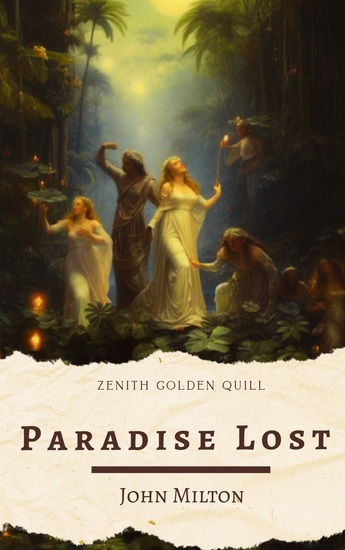
Paradise Lost - The Definitive Poem of the Fall from Grace Power and Redemption - cover

Paradise Lost - The Definitive Poem of the Fall from Grace Power and Redemption

John Milton, Zenith Golden Quill

Casa editrice: Zenith Golden Quill

  • 0
  • 0
  • 0

Sinossi

"Better to reign in Hell than serve in Heaven."

With those immortal words, Paradise Lost launched one of the greatest literary journeys in history. In this epic poem, John Milton reimagines the biblical tale of the Fall—from Lucifer's rebellion to Adam and Eve's expulsion from Eden—with sublime language, cosmic stakes, and profound psychological depth.

Combining theology, mythology, and politics, Milton's vision remains a cornerstone of English literature, exploring the tension between obedience and free will, love and loss, faith and ambition.

This beautifully formatted edition includes illustrations, annotations, and a scholarly foreword—making it ideal for first-time readers, students, and collectors alike.

"A towering work of genius. Milton's Satan is one of literature's most complex creations." — The New York Review of Books
"Paradise Lost is to poetry what Shakespeare is to drama." — The Guardian

Click Buy Now to experience the power, beauty, and tragedy of Milton's unforgettable verse.
Disponibile da: 14/05/2025.
Lunghezza di stampa: 286 pagine.

Altri libri che potrebbero interessarti

  • Primordial - Poems - cover

    Primordial - Poems

    Mai Der Vang

    • 0
    • 0
    • 0
    Mai Der Vang's poetry—lyrically insistent and visually compelling—constitutes a groundbreaking investigation into the collective trauma and resilience experienced by Hmong people and communities, the ongoing cultural and environmental repercussions of the war in Vietnam, the lives of refugees afterward, and the postmemory carried by their descendants. Primordial is a crucial turn to the ecological and generational impact of violence, a powerful and rousing meditation on climate, origin, and fate. 


    With profound and attentive care, Vang addresses the plight of the saola, an extremely rare and critically endangered animal native to the Annamite Mountains in Laos and Vietnam. Remarkably, the saola has only been known to the outside world since 1992, and sightings are so rare that it has now been more than a decade since the last known image of one was captured in a camera trap photo in 2013. 


    Primordial examines the saola's relationship to Hmong refugee identity and cosmology and a shared sense of exile, precarity, privacy, and survival. Can a war-torn landscape and memory provide sanctuary, and what are the consequences for our climate, our origins, our ability to belong to a homeland? Written during a difficult pregnancy and postpartum period, Vang's poems are urgent stays against extinction.
    Mostra libro
  • The Two Gentlemen of Verona - cover

    The Two Gentlemen of Verona

    William Shakespeare

    • 0
    • 0
    • 0
    Step into the captivating world of William Shakespeare's "The Two Gentlemen of Verona" with our immersive digital audiobook. Lose yourself in the timeless tale of friendship, love, and the complexities of the human heart as you listen to the eloquent prose brought to life by skilled narrators. Whether you're a Shakespeare enthusiast or a newcomer to his works, our audio adaptation will transport you to a world of passion, humor, and enduring themes, making this classic play a captivating and accessible experience for all. Join us on this audio journey and let the Bard's words resonate in your heart like never before.
    Mostra libro
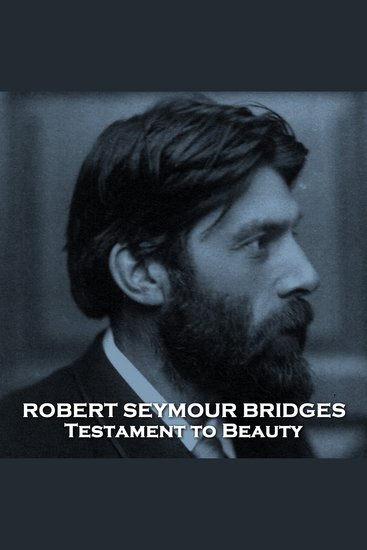
  • Testament to Beauty - A former Poet Laureate demonstrates his poetic talents in this tender and beautiful verse - cover

    Testament to Beauty - A former...

    Robert Seymour Bridges

    • 0
    • 0
    • 0
    Robert Seymour Bridges, OM was born on 23rd October 1844 at Walmer in Kent where he spent his early childhood in a house overlooking the anchoring ground of the British fleet.  
    His father died aged only 47 in 1853. A year later his mother remarried and the family relocated to Rochdale, where his stepfather was the vicar.  
    In 1854 Bridges was sent to Eton College and attended until 1863.  After Eton he went to Corpus Christi College at Oxford. There he became good friends with Gerard Manley Hopkins and would later compile an edition of his poems that is now considered a major contribution to English literature. 
    He graduated from Oxford, in 1867, with a second-class degree in literae humaniores.  Initially he planned to join the Church of England and travelled to the Middle East to broaden his religious horizons.  However, he soon decided that life as a physician would be a better path and, after 8 months studying German (that being the language of many scientific papers at the time) he began his study of medicine at St. Bartholomew's Hospital in 1869.  His long-term ambition was that by the age of forty he could retire from medicine to devote himself to writing. 
    Unfortunately Bridges failed his final medical examinations in 1873 and, as unable to immediately retake the papers, spent six months in Italy learning Italian as well as immersing himself in its art. In July 1874 he went to Dublin to continue his medical studies. Re-examined in December he passed and became a house physician at St Bartholomew's Hospital. It was whilst here that he engaged in a series of highly critical remarks about the Victorian medical establishment. One such was his claim that whilst working as a young doctor he saw a staggering 30,940 patients in one year. 
    A bout of severe pneumonia and lung disease forced his retirement from the medical profession in 1882 and so, slightly ahead of schedule, he began his literary career in earnest.  He already been writing for several years and had published his first poetry collection in 1873.  
    After his illness and a trip to Italy, Bridges moved, with his mother, to Yattendon in Berkshire.  It was during this time, from 1882 to 1904, that Bridges wrote most of his best-known lyrics as well as eight plays and two masques, all in verse.  
    It was also here, in 1884, that he married Monica Waterhouse. They would go on to have three children and spend the rest of their lives in rural seclusion, in an idyllic marriage, first at Yattendon, then at Boars Hill, Oxford. 
    Bridges made an important contribution to hymnody with the publication in 1899 of his Yattendon Hymnal. This collection of hymns became a bridge between the Victorian hymnody of the late 19th century and the modern hymnody of the early 20th century. He was also a chorister at Yattendon church for 18 years. 
    In 1902 Monica and his daughter Margaret became seriously ill with tuberculosis, and a move from Yattendon to a healthier climate was in order. After several temporary homes they moved abroad to spend a year in Switzerland before returning to settle again in England at Chilswell House, which Bridges had designed, and built on Boar's Hill overlooking Oxford University.   
    His greatest achievement though was still some years ahead of him.  The office of Poet Laureate was held by Alfred Austin but with his death it was offered first to Rudyard Kipling, who refused it, and then to Bridges. He was appointed Poet Laureate in 1913 by George V, the only medical graduate to have ever held the office. Bridges, at this time, was neither highly regarded nor well known but a safe pair of hands in a World rapidly being overshadowed by the storms about to erupt over Europe and the First World War. 
    The events of this War, including the wounding of his son, Edward, had a sobering effect on Bridges' poetry. His work became fiercely patriotic. In 1915 edited a volume of prose and poetry, The Spirit of Man, intended to appeal to readers living in war time
    Mostra libro

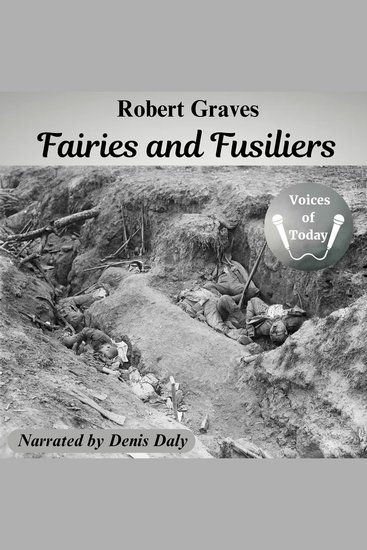
  • Fairies and Fusiliers - cover

    Fairies and Fusiliers

    Robert Graves

    • 0
    • 0
    • 0
    Fairies and FusiliersBy Robert GravesNarrated by Denis DalyPoet, soldier, novelist, translator and critic Robert Graves (1895 - 1985) was deeply familiar with both war and death.  Three times during his life Graves was considered to be on the point of death due to serious illness.  One of these was after his participation in the Battle of the Somme, after which he had been actually pronounced dead due to severe wounding.Graves enlisted as soon as the First World War was declared, and was rapidly promoted to lieutenant and later to captain.  Among his fellow soldiers was another poet, Siegfried Sassoon.  Together with Wilfred Owen, who did not survive, Graves and Sassoon represented the new generation of war poets - perceptive critical surveyors of the horrific and wasteful futility of modern warfare, drawing their judgements from bitter personal experience. Fairies and Fusiliers is a collection of 47 short poems and was dedicated to Graves' former regiment, the Royal Fusiliers.Production copyright 2024 Voices of Today
    Mostra libro
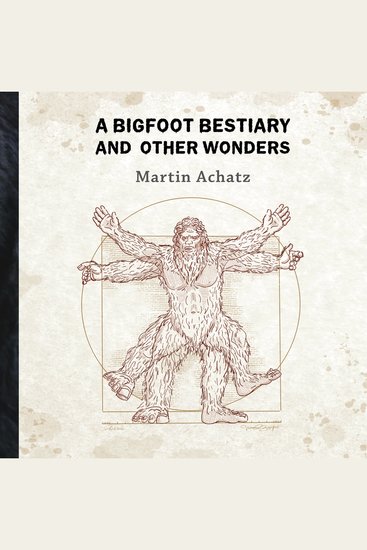
  • A Bigfoot Bestiary and Other Wonders - cover

    A Bigfoot Bestiary and Other...

    Martin Achatz

    • 0
    • 0
    • 0
    A Bigfoot Bestiary and Other Wonders is a compendium of natural and unnatural astonishment, anatomizing all those big, hairy monsters that haunt the human condition. Follow their footprints through these pages, and Martin Achatz may just make you a believer in the greatest mystery of all: Love with a capital "L". 
    "Martin Achatz knows what it is to be big and hairy and to express the animal inside us. To paraphrase the Zen koan, live as if you were already Bigfoot. If Iowa Poet Laureate Marvin Bell has his Dead Man poems, Michigan's Achatz has rendered poetical the great ape of the Northwoods, and he eloquently and determinedly immerses us in the dream, meanwhile paying homage to Robert Frost, Pablo Neruda, Wallace Stevens, Flannery O'Connor, and all the other wonderful monsters." --Bonnie Jo Campbell, author of The Waters and American Salvage 
    "Martin Achatz reimagines the legendary Bigfoot in his newest book, a funny and moving collection of poems that is playfully serious. Achatz melds cryptozoologic wonder with the heartrending stuff of the everyday world ... a fierce Sasquatch howl that illuminates and reveals the fragile state of our collective humanity." --W. Todd Kaneko, author of This Is How the Bone Sings 
    "I believe Martin Achatz intended these pages to impart joy (and other wonders) to those who read with an open paintbox at the ready, its colors so pure they demand that monster landscapes be captured and dimensioned within the nether worlds of dreams and the genius of second readings. A 5-star book without doubt." -- Sue Harrison, international bestselling author of The Midwife's Touch 
    Author of The Mysteries of the Rosary and a former U.P. Poet Laureate, Martin Achatz lives in Ishpeming, Michigan with his family. In his spare time, he chases comets and Bigfoot.
    Mostra libro
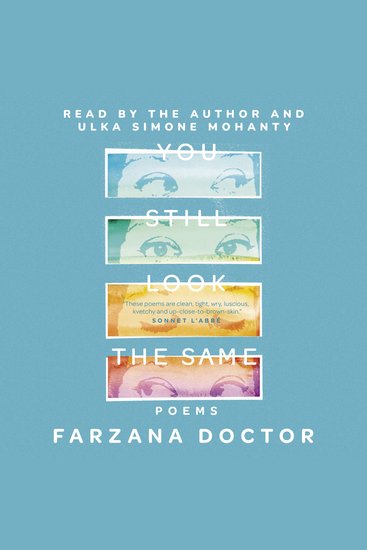
  • You Still Look the Same - cover

    You Still Look the Same

    Farzana Doctor

    • 0
    • 0
    • 0
    A moving collection of poetry about navigating mid-life, full of humour and wit, from acclaimed novelist Farzana Doctor.
    		 
    This debut poetry collection from acclaimed novelist Farzana Doctor is both an intimate deep dive and a humorous glance at the tumultuous decade of her forties. Through crisp and vivid language, Doctor explores mid-life breakups and dating, female genital cutting, imprints of racism and misogyny, and the oddness of sex and love, and urges us to take a second look at the ways in which human relationships are never what we expect them to be.
    Mostra libro