Unisciti a noi in un viaggio nel mondo dei libri!
Aggiungi questo libro allo scaffale
Grey
Scrivi un nuovo commento Default profile 50px
Grey
Iscriviti per leggere l'intero libro o leggi le prime pagine gratuitamente!
All characters reduced
Beacon Lights of History: The Middle Ages - Exploring the Vibrant Tapestry of Medieval Life and Culture - cover

Beacon Lights of History: The Middle Ages - Exploring the Vibrant Tapestry of Medieval Life and Culture

John Lord

Casa editrice: Good Press

  • 0
  • 0
  • 0

Sinossi

In "Beacon Lights of History: The Middle Ages," John Lord delves into the intricate tapestry of medieval civilization, illuminating the pivotal figures and events that shaped this transformative period. With a blend of narrative flair and scholarly rigor, Lord interweaves biographical sketches of prominent leaders, thinkers, and cultural movements, capturing the essence of an era characterized by both enlightenment and turmoil. His eloquent prose reflects the romanticism of the 19th century while ensuring a historical accuracy that appeals to the intellect, offering readers a comprehensive view of social, political, and spiritual dynamics during the Middle Ages. John Lord (1810-1894), an American historian and lecturer, was deeply influenced by the philosophical currents of his time, particularly the transcendentalist movement and a burgeoning interest in historical narrative. His career as a public speaker and educator allowed him to engage with various topics of his era, instilling in him a passion for making history accessible and engaging to the general public. This inclination is evident in his work, where he seeks not only to present facts but to inspire his readers through the tales of human perseverance and achievement. "Beacon Lights of History: The Middle Ages" is not just a compilation of historical accounts; it is an invitation to explore the rich and complex past that continues to resonate in contemporary society. Readers intrigued by history, literature, and human experience will find themselves captivated by Lord's engaging storytelling, inspiring a deeper appreciation for the enduring legacies of the Middle Ages.
Disponibile da: 12/08/2023.
Lunghezza di stampa: 234 pagine.

Altri libri che potrebbero interessarti

  • The Land of Peek-a-Boo - cover

    The Land of Peek-a-Boo

    Roz Rosenbluth

    • 0
    • 0
    • 0
    Fun sound-effects and whimsical music help tell the story of “The Land Of Peek-a-Boo!” Tina loves to play Peek-a-Boo with her brother Timmy. When Tina jumps out of the closet and yells “Peek-A-Boo”, her brother is afraid.  And when Tina jumps out of the toy chest and yells “Peek-A-Boo,” Timmy tells her to STOP! Tina loves to scare Timmy and doesn't understand why he doesn't want to play this game. Find out what happens when Tina has a dream and goes to The Land of Peek-A-Boo. Will Tina understand how Timmy feels after being frightened in Peek-A-Boo Land? A positive ending adds interest to this adorable story and encourages a lifelong love for storytime.
    Mostra libro
  • Critical AI in K-12 Classrooms - A Practical Guide for Cultivating Justice and Joy - cover

    Critical AI in K-12 Classrooms -...

    Marie K. Heath, Stephanie Smith...

    • 0
    • 0
    • 0
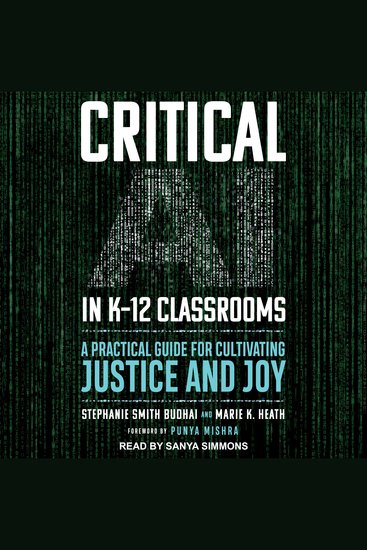
    Artificial intelligence is rapidly integrating into today's classrooms, but unlike other new technologies, AI has the potential to harm, making it difficult to take advantage of its benefits. In Critical AI in K–12 Classrooms, Stephanie Smith Budhai and Marie K. Heath draw attention to the biases embedded within AI algorithms, such as those powering OpenAI's ChatGPT and DALL-E, to guide students and teachers in developing strategies to best incorporate AI—or not—into equitable learning. 
    AI's reliance on existing data and knowledge systems means Black, queer, those with disabilities, and other marginalized students are at greater risk of being harmed by built-in limitations and bias. Budhai and Heath show how to circumvent if not actively resist such harms as machine learning, NLPs, LLMS, and GenAI enter the classroom. Their practical guide creatively answers the concerns of educators committed to forward-thinking yet fair instruction and the needs of students eager to use AI for just ends. 
    Critical AI in K–12 Classrooms meets the challenges of a key STEM technology with an eye toward cultivating a more just world. Balancing responsible learning with the joy of discovery, Budhai and Heath build a framework for AI instruction that all educators can confidently use.
    Mostra libro
  • The Republic - cover

    The Republic

    Plato

    • 0
    • 0
    • 0
    The Republic (Greek: Politeia) is a Socratic dialogue, written by Plato around 380 BC, concerning the definition of (justice), the order and character of the just city-state and the just man, reason by which ancient readers used the name On Justice as an alternative title (not to be confused with the spurious dialogue also titled On Justice). The dramatic date of the dialogue has been much debated and though it must take place some time during the Peloponnesian War, "there would be jarring anachronisms if any of the candidate specific dates between 432 and 404 were assigned".    It is Plato's best-known work and has proven to be one of the most intellectually and historically influential works of philosophy and political theory. In it, Socrates along with various Athenians and foreigners discuss the meaning of justice and examine whether or not the just man is happier than the unjust man by considering a series of different cities coming into existence "in speech", culminating in a city (Kallipolis) ruled by philosopher-kings; and by examining the nature of existing regimes.    The participants also discuss the theory of forms, the immortality of the soul, and the roles of the philosopher and of poetry in society. Short Summary (Epilogue): X.1—X.8. 595a—608b. Rejection of Mimetic Art X.9—X.11. 608c—612a. Immortality of the Soul X.12. 612a—613e. Rewards of Justice in Life X.13—X.16. 613e—621d. Judgment of the Dead The paradigm of the city — the idea of the Good, the Agathon — has manifold historical embodiments, undertaken by those who have seen the Agathon, and are ordered via the vision. The centre piece of the Republic, Part II, nos. 2–3, discusses the rule of the philosopher, and the vision of the Agathon with the allegory of the cave, which is clarified in the theory of forms.    The centre piece is preceded and followed by the discussion of the means that will secure a well-ordered polis (City). Part II, no. 1, concerns marriage, the community of people and goods for the Guardians, and the restraints on warfare among the Hellenes. It describes a partially communistic polis. Part II, no. 4, deals with the philosophical education of the rulers who will preserve the order and character of the city-state. In Part II, the Embodiment of the Idea, is preceded by the establishment of the economic and social orders of a polis (Part I), followed by an analysis (Part III) of the decline the order must traverse. The three parts compose the main body of the dialogues, with their discussions of the "paradigm", its embodiment, its genesis, and its decline. The Introduction and the Conclusion are the frame for the body of the Republic.    The discussion of right order is occasioned by the questions: "Is Justice better than Injustice?" and "Will an Unjust man fare better than a Just man?" The introductory question is balanced by the concluding answer: "Justice is preferable to Injustice". In turn, the foregoing are framed with the Prologue (Book I) and the Epilogue (Book X). The prologue is a short dialogue about the common public doxai (opinions) about "Justice". Based upon faith, and not reason, the Epilogue describes the new arts and the immortality of the soul.
    Mostra libro
  • Do the Birds Still Sing in Hell? - cover

    Do the Birds Still Sing in Hell?

    Horace Greasley

    • 0
    • 0
    • 0
    Even in the most horrifying places on earth, hope still lingers in the darkness, waiting for the opportunity to take flight. 


    When war was declared Horace Greasley was just twenty-years old. After seven weeks' training with the 2/5th Battalion, the Royal Leicestershire Regiment, Horace found himself facing the might of the German Army in a muddy field south of Cherbourg, in northern France, with just thirty rounds in his ammunition pouch. 


    Horace's war didn't last long . . . On May 25, 1940 he was taken prisoner and so began the harrowing journey to a prisoner-of-war camp in Poland. Those who survived the grueling ten-week march to the camp were left broken and exhausted, all chance of escape seemingly extinguished. 


    But when Horace met Rosa, the daughter of one of his captors, his story changed; fate, it seemed, had thrown him a lifeline. Horace risked everything in order to steal out of the camp to see his love, bringing back supplies for his fellow prisoners. In doing so he offered hope to his comrades, and defiance to one of the most brutal regimes in history.
    Mostra libro
  • The History of the Peloponnesian War Volume 2 - cover

    The History of the Peloponnesian...

    Anonimo

    • 0
    • 0
    • 0
    The History of the Peloponnesian War by Thucydides is a foundational work of historical and political writing, chronicling the 5th-century BCE conflict between Athens and Sparta. Renowned for its objectivity, analytical depth, and realism, Thucydides examines the causes, events, and consequences of the war, emphasizing human nature, power dynamics, and the fragility of democracy. He dissects pivotal moments like the Plague of Athens, the Sicilian Expedition, and the Melian Dialogue, revealing how fear, honor, and interest drive nations to war. A timeless exploration of politics, ethics, and the costs of imperial ambition.
    Mostra libro
  • Julius Caesar - The Famous Roman Emperor Who Transformed the Republic - cover

    Julius Caesar - The Famous Roman...

    Kelly Mass

    • 0
    • 0
    • 0
    Gaius Julius Caesar remains one of the most influential and recognizable figures in history. A brilliant military commander and astute statesman, Caesar played a decisive role in the events that led to the collapse of the Roman Republic and the rise of the Roman Empire. His life and career were marked by political ambition, military conquests, and transformative reforms that forever changed the Roman world.  
    Born into a patrician family, Caesar rose to prominence in Roman politics through strategic alliances and persuasive rhetoric. In 60 BC, he formed the First Triumvirate with Marcus Licinius Crassus and Gnaeus Pompeius Magnus, known as Pompey. This informal political alliance dominated Roman politics for several years, enabling Caesar to secure the consulship in 59 BC. The Triumvirate sought to advance the interests of the Populares, a political faction advocating for the rights of the common people, in opposition to the Optimates, the conservative faction of the Roman Senate. Powerful senators such as Cato the Younger and orator Cicero resisted Caesar’s growing influence, leading to increased political tensions.  
    To solidify his power, Caesar launched a series of military campaigns known as the Gallic Wars from 58 BC to 51 BC. These campaigns significantly expanded Roman territory, bringing Gaul (modern-day France and Belgium) under Roman control. Caesar's military success earned him wealth, popularity, and the unwavering loyalty of his legions. His invasion of Britain and the daring construction of a bridge over the Rhine River showcased his strategic prowess and ambition. These victories, however, unsettled Pompey, who grew increasingly aligned with the Senate following Crassus’ death in 53 BC. Fearing Caesar’s rising power, the Senate ordered him to disband his army and return to Rome as a private citizen. 
    Mostra libro