Unisciti a noi in un viaggio nel mondo dei libri!
Aggiungi questo libro allo scaffale
Grey
Scrivi un nuovo commento Default profile 50px
Grey
Iscriviti per leggere l'intero libro o leggi le prime pagine gratuitamente!
All characters reduced
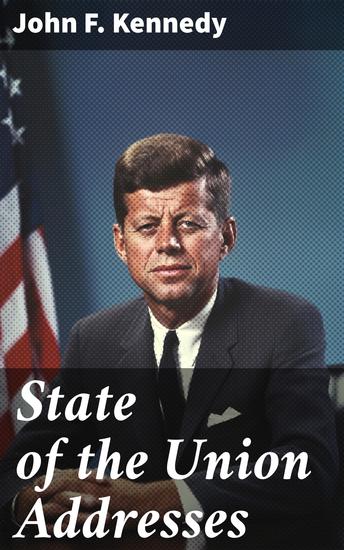
State of the Union Addresses - A Presidential Vision: Kennedy's Rhetoric and America's Future - cover

State of the Union Addresses - A Presidential Vision: Kennedy's Rhetoric and America's Future

John F. Kennedy

Casa editrice: Good Press

  • 0
  • 0
  • 0

Sinossi

John F. Kennedy's "State of the Union Addresses" presents a compelling synthesis of political rhetoric, national vision, and moral philosophy as articulated through Kennedy'Äôs various addresses from 1961 to 1963. Drawing from a rich tradition of American oratory, these addresses reflect Kennedy's commitment to progressivism during a time of Cold War tensions, civil rights struggles, and socio-economic challenges. The literary style is marked by eloquent prose and vivid imagery, showcasing Kennedy's deft command of language designed to inspire and unite a nation. Each address serves not only as a political statement but also as a poignant reminder of the ideals upon which America was founded, emphasizing liberty, equality, and fraternity in an era of uncertainty. John F. Kennedy, the 35th President of the United States, experienced a nuanced understanding of political culture formed through his family's legacy and his education at Harvard. His formative years shaped his worldview and informed his vision for America, leading him to address critical domestic and global issues with an optimistic yet pragmatic outlook. Kennedy's ability to communicate directly and powerfully resonates with both his political ambitions and his personal convictions, as he sought to engage the American public in meaningful dialogue. This compilation is a must-read for anyone interested in political history, rhetorical studies, or American identity in the 20th century. Kennedy's addresses not only illuminate the challenges of his presidency but also propose visions for a brighter future, offering timeless relevance amid contemporary discourse. Readers will find themselves inspired by the forceful rhetoric and hopeful vision that continues to resonate today.
Disponibile da: 26/10/2023.
Lunghezza di stampa: 46 pagine.

Altri libri che potrebbero interessarti

  • How Polarization Begets Polarization - Ideological Extremism in the US Congress - cover

    How Polarization Begets...

    Samuel Merrill III, Thomas L....

    • 0
    • 0
    • 0
    Extreme polarization in American politics is perhaps the most confounding political phenomenon of our time. This book binds together polarization in Congress and polarization in the electorate within an ever-expanding feedback loop. This loop is powered by the discipline exerted by the respective political parties on their Congressional members and district candidates and endorsed by the voters in each Congressional district who must choose between the alternatives offered. Tight national party discipline produces party delegations in Congress that are widely separated from one another but each ideologically narrowly distributed. 


    As district constituencies become more polarized and are egged on by activists, parties are further motivated to appeal to their respective bases rather than to voters in the ideological center. America has indeed acquired parties with clear platforms—once thought to be a desirable goal—but these parties are now feuding camps. What resolution might there be? Just as the progressive movement slowly replaced the Gilded Age, might a new reform effort replace the current squabble? Or could an asymmetry develop in the partisan constraints that would lead to ascendancy of the center, or might a new and over-riding issue generate a cross-cutting dimension, opening the door to a new politics? Only the future will tell.
    Mostra libro
  • American Restraint - Taming Hyper-Individualism & Hyper-Capitalism - cover

    American Restraint - Taming...

    Patrick Trepanier

    • 0
    • 0
    • 0
    AN IMPORTANT NEW BOOK ON HOW TO FIX AMERICA BY A POLITICAL OUTSIDER. 
    America is broken. America is divided. 80% of Americans believe the country is on the wrong track. And everything you need to know about the Divided States of America can be explained by two relentless forces: hyper-individualism and hyper-capitalism.  
    American Restraint explores how both hyper-individualism and hyper-capitalism are what is fundamentally ripping our country apart. Traditional solutions and status quo politicians can’t help us.  
    Patrick Trepanier is a powerful new voice addressing the real root causes and solutions for our divided country. 
    The first solution is in the Constitution…an Article V Convention of States. A Convention proposing three popular amendments: a balanced budget amendment, term limits for Congress, and limits to the power and jurisdiction of the federal government.   
    Then we need more “innovation and experimentation” by individual states to restrain the forces of hyper-individualism and hyper-capitalism. 
    American Restraint challenges decades of failed Democratic and Republican policies and calls for new pragmatic solutions that put the needs of children, families and communities first.   
    This groundbreaking new book also provides a framework to restore respect for religion, rebuild the middle class, restrain toxic consumerism, restore community trust, restrain the Wall Street Casino, restrain Big Tech’s control over our lives, reduce illegal competition for American jobs, promote resilience and service to help disadvantaged Americans. 
    American Restraint. The handbook to fix America.  
    Mostra libro
  • Summary of Tucker Carlson’s The Long Slide - cover

    Summary of Tucker Carlson’s The...

    Falcon Press

    • 0
    • 0
    • 0
    Buy now to get the main key ideas from Tucker Carlson’s The Long Slide 
      
    The Long Slide (2021) is a collection of magazine articles by Fox News host Tucker Carlson. These articles hold a special place in Carlson’s heart, for they remind him of a time when the country was not so divided and journalism was still open-minded. In fact, he believes that magazines would refuse to print some of these articles if they were offered today. His topics are eclectic, ranging from spud guns to the difficult lives of civilian contractors in Iraq. As a collection, the articles showcase both his adventures and his ideas. 
     
    Mostra libro
  • Black Lives Native Lands White Worlds - A History of Slavery in New England - cover

    Black Lives Native Lands White...

    Jared Ross Hardesty

    • 0
    • 0
    • 0
    Shortly after the first Europeans arrived in seventeenth-century New England, they began to import Africans and capture the area's indigenous peoples as slaves. By the eve of the American Revolution, enslaved people comprised only about 4 percent of the population, but slavery had become instrumental to the region's economy and had shaped its cultural traditions. This story of slavery in New England has been little told. 


    In this concise yet comprehensive history, Jared Ross Hardesty focuses on the individual stories of enslaved people, bringing their experiences to life. He also explores larger issues such as the importance of slavery to the colonization of the region and to agriculture and industry, New England's deep connections to Caribbean plantation societies, and the significance of emancipation movements in the era of the American Revolution. Thoroughly researched and engagingly written, Black Lives, Native Lands, White Worlds is a must-listen for anyone interested in the history of New England.
    Mostra libro
  • Farewell Address Republican National Convention - cover

    Farewell Address Republican...

    Ronald Reagan

    • 0
    • 0
    • 0
    On August 15, 1988, in the Louisiana Superdome, Reagan delivered a message for economic freedom. We transformed our government from one that was consuming our prosperity into one that would get out of the way of those who create prosperity.  
    Reagan notes the “inflated rhetoric of our friends in Atlanta last month. But then, inflation is their specialty.” As John Adams said, “Facts are stubborn things.”  
    When we came to Washington, we suffered the worst back-to-back years of inflation in 60 years, interest rates over 21 percent, declining productivity, weekly wages, and family income, the highest tax bill in history, and a 21 percent misery index. 
    The Soviet Union invaded Afghanistan. Iran stormed our embassy and took Americans hostage. The world questioned our resolve. 
    We responded by cutting taxes and creating over 17 million jobs. Inflation is below 4 percent and interest rates cut in half. “I noticed they don’t call it Reaganomics anymore.”  
    We rebuilt our armed forces, and liberated Grenada. During our administration “not 1 inch of ground has fallen to the Communists.” We're working on the Strategic Defense Initiative to protect ourselves and our allies against nuclear terror. 
    Liberal elites resisted our defense buildup, our tax cuts, cutting fat out of government, and appointing judges committed to the Constitution. I’ve supported a balanced budget amendment and line-item veto, and every year the liberals said no.  
    We need Republican majorities in both houses. America needs George Bush. “Go out there and win one for the Gipper.” 
    God put this land between two great oceans to be found by people with a love of freedom, freedom of association, of worship, of hope and opportunity. Here, it’s sunrise every day with new opportunities and dreams to build. 
    Audio recording courtesy of the Ronald Reagan Presidential Library. 
    AspenLeafMedia.com
    Mostra libro
  • Democracy Under Fire - Donald Trump and the Breaking of American History - cover

    Democracy Under Fire - Donald...

    Lawrence R. Jacobs

    • 0
    • 0
    • 0
    Before Trump even ran for President, his disdain for the rules, procedures, and norms of American democracy and the US Constitution was well-known and led prominent Republicans to repudiate him as "unfit" for the GOP nomination. Given the clear-eyed assessment of candidate Trump, why did the Republican Party nominate him as its presidential candidate in 2016 and then stand by him during the next four years? 


    Much of the attention paid to Trump's rise to power has focused on his corrosive personality and divisive style of governing. But he alone is not the problem. The vulnerability is much broader and deeper. The ascendance of Trump is the culmination of nearly 250 years of political reforms that gradually ceded party nominations to small cliques of ideologically-motivated party activists, interest groups, and donors. 


    In Democracy under Fire, Lawrence Jacobs provides a highly engaging history of political reforms since the late-eighteenth century that over time dangerously weakened democracy, widened political inequality as well as racial disparities, and rewarded toxic political polarization. Jacobs's searing indictment of political reformers concludes with recommendations to restrain the unbridled ambition of politicians who thrive on division and instead generate broad citizen engagement with tangible policy making.
    Mostra libro