Join us on a literary world trip!
Add this book to bookshelf
Grey
Write a new comment Default profile 50px
Grey
Subscribe to read the full book or read the first pages for free!
All characters reduced
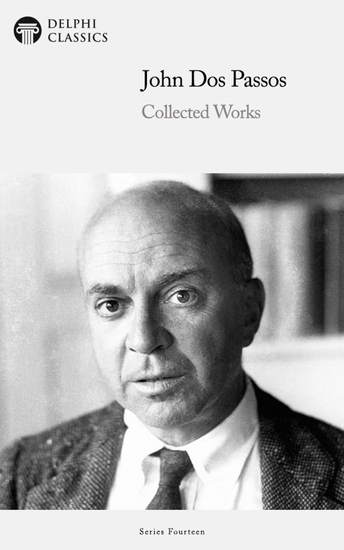
Delphi Collected Works of John Dos Passos Illustrated - US version - cover

Delphi Collected Works of John Dos Passos Illustrated - US version

John Dos Passos

Publisher: Delphi Publishing Ltd

  • 0
  • 0
  • 0

Summary

One of the major novelists of the post-World War I lost generation, John Dos Passos established a reputation as a social historian and radical critic of American life. His experimental novels are written in non-linear form, blending elements of biography, song lyrics and news reports to portray a vibrant tapestry landscape of early twentieth-century American culture. This eBook presents Dos Passos’ collected works (the most complete possible in the US), with numerous illustrations, rare texts, informative introductions and the usual Delphi bonus material. (Version 1)
 
* Beautifully illustrated with images relating to Dos Passos’ life and works* Concise introductions to the major texts* All 8 novels in the US public domain, with individual contents tables* Rare novels appearing for the first time in digital publishing, including the unfinished novel ‘Century’s Ebb’* Images of how the books were first published, giving your eReader a taste of the original texts* Excellent formatting of the texts* The play ‘The Garbage Man’ and Dos Passos’ poetry — available in no other collection* Includes a wide selection of Dos Passos’ non-fiction* Features the seminal autobiography ‘The Best Times’ – discover the author’s literary life* Ordering of texts into chronological order and genres
 
Please note: due to US copyright restrictions, seven novels (including the U.S.A. trilogy) cannot appear in this edition. When new texts become available, they will be added to the eBook as a free update.
 
CONTENTS:
 
The NovelsOne Man’s Initiation — 1917 (1920)Three Soldiers (1921)Streets of Night (1923)Manhattan Transfer (1925)Chosen Country (1951)The Great Days (1958)Midcentury (1961)Century’s Ebb (1975)
 
The PlayThe Garbage Man (1926)
 
The PoetryPoems from ‘Eight Harvard Poets’ (1917)A Pushcart at the Curb (1922)
 
The Non-FictionRosinante to the Road Again (1922)Facing the Chair (1927)Orient Express (1927)The Men Who Made the Nation (1957)Mr. Wilson’s War (1962)Brazil on the Move (1963)The Portugal Story (1969)Easter Island (1970)
 
The AutobiographyThe Best Times (1966)
Available since: 10/28/2023.
Print length: 6220 pages.

Other books that might interest you

  • Margaret's Patient (Unabridged) - cover

    Margaret's Patient (Unabridged)

    L. M. Montgomery

    • 0
    • 0
    • 0
    Lucy Maud Montgomery (November 30, 1874 - April 24, 1942), published as L. M. Montgomery, was a Canadian author best known for a series of novels beginning in 1908 with Anne of Green Gables. The book was an immediate success. The title character, orphan Anne Shirley, made Montgomery famous in her lifetime and gave her an international following.
    Margaret's Patient: Margaret paused a moment at the gate and looked back at the quaint old house under its snowy firs with a thrill of proprietary affection. It was her home; for the first time in her life she had a real home, and the long, weary years of poorly paid drudgery were all behind her.
    Show book
  • The Master of the World - cover

    The Master of the World

    Jules Verne

    • 1
    • 0
    • 0
    A deviously brilliant inventor is out to control the world in this 1904 thriller by the pioneering science fiction author.Reports of strange occurrences in the mountains of South Carolina have reached the desk of government agent John Strock. Though the Blue Ridge Mountains are not volcanic, rumblings and smoke have led some to fear an eruption. Then new reports emerge of unidentified objects racing across air, land, and water at incredible speeds. Behind it all is a mastermind named Robur whose ambition is as boundless as his genius. On his quest to stop Robur, Agent Strock is taken captive and finds himself onboard the Terror: a single vehicle with capacities far beyond anything mankind has seen before. Though global powers offer Robur enormous sums for his invention, he chooses to keep it—and its unrivaled power—for himself.
    Show book
  • A Dialogue Among Clever People - From their pens to your ears genius in every story - cover

    A Dialogue Among Clever People -...

    Leo Tolstoy

    • 0
    • 0
    • 0
    Leo Tolstoy was born in 1828 in the Russian province of Tula to a wealthy noble family. As a child, he had private tutors but he showed little interest in any formal education. When he went to the University of Kazan in 1843 to study oriental languages and law, he left without completing his courses.  Life now was relaxed and idle but with some writing also taking place.  Gambling debts forced an abrupt change of path and he joined the army to fight in the Crimean War.  He was commended for his bravery and promoted but was appalled at the brutality and loss of life.  He recorded these and other earlier experiences in his diaries which formed the basis of several of his works. 
    In 1852 ‘Childhood’ was published to immediate success and was followed by ‘Boyhood’ and ‘Youth’. 
    His experience in the army and the horrors he witnessed resulted in ‘The Cossacks’ in 1862 and the trilogy ‘Sevastopol Tales’. After the war he travelled around Europe, visiting London and Paris and meeting such luminaries as Victor Hugo and Charles Darwin.  
    It was now that Tolstoy began his masterpiece, ‘War and Peace’. Published in 1869 it was an epic work that changed literature. He quickly followed this with ‘Anna Karenina’.  
    These successes made Tolstoy rich and helped him accomplish many of his dreams but also brought problems as he grappled with his faith and the lot of the oppressed poor. These revolutionary views became so popular that the authorities now kept him under surveillance.  
    He led a life of asceticism and vegetarianism and put his socialist ideals into practice by establishing numerous schools for the poor and food programmes. He also believed in giving away his wealth, which caused much discord with his wife.  
    His writing continued to bring forth classics such as ‘The Death of Ivan Ilyich’ and many brilliant and incisive short stories such as ‘How Much Land Does A Man Need’.  
    In 1901 Tolstoy was excommunicated from the Church and controversially deselected for the Nobel Prize for Literature. 
    Whilst undertaking a pilgrimage by train in October 1910 with his daughter Aleksandra he caught pneumonia in the nearby town of Astapovo.  Leo Tolstoy died on November 9th, 1910, he was 82.
    Show book
  • Christmas Formula - From their pens to your ears genius in every story - cover

    Christmas Formula - From their...

    Stella Benson

    • 0
    • 0
    • 0
    Stella Benson was born on the 6th January 1892 in Easthope, Shropshire to parents who were landed gentry. 
    Her early years involved frequent household moves which was difficult for the child as she suffered from ill-health.  Some of her early education was spent at schools in Germany and Switzerland and by 10 she had developed a lifelong habit of keeping a diary. 
    In the following years her parents separated, and she rarely saw her father. When she did, he encouraged to pause her writing until she had further experience and could better make sense of the world.  When he died, she learned he had been an alcoholic. 
    A winter spent in the West Indies provided material for her first novel ‘I Pose’ published the following year in 1915. 
    During the War years she became involved in the women's suffrage movement and dedicated time outside of writing to support the troops and help the poor. 
    In 1918 she decided to travel spending much time in California, where she also tutored at the University of California, and continued to write.  In China she met her future husband and after marrying in London, journeyed with him to his various Custom postings through Nanning, Beihai, and Hong Kong and the Far East. 
    The works continued to flow novels, short stories, travel essays all helped to build a deserved and burgeoning reputation. 
    Although her works are now in the forgotten and neglected department her writing style, characters, and narratives more than capably demonstrate her obvious talents.   
    Stella Benson died of pneumonia on the 7th December 1933, at Hạ Long in the Vietnamese province of Tonkin.  She was 40.
    Show book
  • The Diary of a God - From their pens to your ears genius in every story - cover

    The Diary of a God - From their...

    Barry Pain

    • 0
    • 0
    • 0
    Barry Eric Odell Pain was born at 3 Sydney Street in Cambridge on 28th September 1864. He was one of 4 children. 
    He was educated at Sedbergh School and then Corpus Christi College, Cambridge where he read classics and contributed to and edited Granta. 
    Four years of service as an Army coach followed before he moved to London. In 1889, Cornhill Magazine published his short story ‘The Hundred Gates’.  This opened the way for Pain to advance his literary career on several fronts. He became a contributor to Punch and The Speaker, as well as joining the staff of both the Daily Chronicle and Black and White.  
    In 1897 he succeeded Jerome K Jerome as editor of To-Day but still contributed regularly, until 1928, to the Windsor Magazine. 
    It is often said that Pain was discovered by Robert Louis Stevenson, who compared his work to that of Guy de Maupassant.  It’s an apt comparison. Pain was also a master of disturbing prose but able to inject parody and light comedy into many of his works.  A simple premise could in his hands suddenly expand into a world very real but somehow emotionally fraught and on the very edge of darkness as many of these short stories demonstrate.   
    Despite applying his talents to several genres and forms today Pain is more readily thought of, especially during the first decade of the 20th Century, as perhaps the leading British humorist of his day.  These stories reveal a darker side and beg to differ. 
    Barry Pain died on 5th May 1928 in Bushey, Hertfordshire.
    Show book
  • O Pioneers! - cover

    O Pioneers!

    Willa Cather

    • 0
    • 0
    • 0
    The first part of Willa Cather’s Great Plains trilogy, O Pioneers! follows the tragedies and triumphs of Alexandra Bergson, a strong and independent young woman who inherits the family farm following the death of her father. Alexandra’s passion and shrewd instinct guide her towards success as she continues to buy more of the surrounding land and resist the challenges imposed by the harsh Nebraskan prairie. Different challenges await her when a former love resurfaces and her brother becomes romantically involved with a married woman. A powerful story gently told, O Pioneers! is a compelling portrait of love versus duty, and the indomitable spirit of America’s pioneer families.
    Show book