¡Acompáñanos a viajar por el mundo de los libros!
Añadir este libro a la estantería
Grey
Escribe un nuevo comentario Default profile 50px
Grey
Suscríbete para leer el libro completo o lee las primeras páginas gratis.
All characters reduced
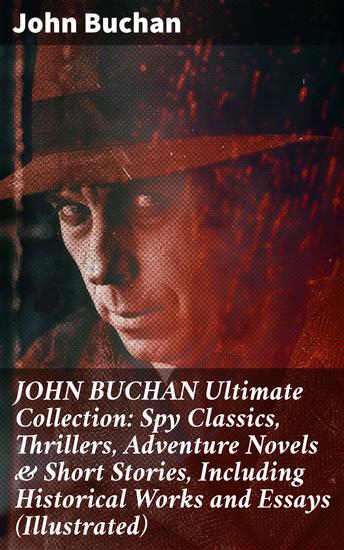
JOHN BUCHAN Ultimate Collection: Spy Classics Thrillers Adventure Novels & Short Stories Including Historical Works and Essays (Illustrated) - cover

JOHN BUCHAN Ultimate Collection: Spy Classics Thrillers Adventure Novels & Short Stories Including Historical Works and Essays (Illustrated)

John Buchan

Editorial: Good Press

  • 0
  • 0
  • 0

Sinopsis

In the "JOHN BUCHAN Ultimate Collection: Spy Classics, Thrillers, Adventure Novels & Short Stories, Including Historical Works and Essays (Illustrated)," readers are immersed in a compendium of Buchan's most compelling narratives that traverse the realms of espionage and adventure. This anthology is not merely a collection but a literary tapestry woven from the threads of early 20th-century concerns, such as national identity and imperialism. Buchan's eloquent prose and gripping storytelling style'Äîcharacterized by vivid descriptions and sharp characterizations'Äîdraw the reader into the psyche of his protagonists as they navigate treacherous landscapes both literal and metaphorical, such as in the acclaimed novel, "The Thirty-Nine Steps." John Buchan, a Scottish author and statesman, was profoundly influenced by his own experiences, including his time as a war correspondent during World War I and his tenure in politics. His knowledge of geographies and cultures, combined with a deep understanding of human nature, fueled his narratives that often reflect the anxieties of his era, including the inter-war period's socio-political turbulence. Notably, Buchan's background in law and history imbues his writings with a rich historical context that enhances their depth and authenticity. This comprehensive collection is a must-read for enthusiasts of classic literature, espionage, and adventure. Whether you are familiar with Buchan's work or new to his profound narratives, this illustrated anthology offers insights into both the genre and the historical moment from which it arose. It is an essential addition to any literary library and an engaging journey through the mind of one of the early masters of the spy thriller.
Disponible desde: 11/01/2024.
Longitud de impresión: 1210 páginas.

Otros libros que te pueden interesar

  • The Maltese Cat - Celebrated author of The Jungle Book Kipling brings another marvellous story from the perspective of an animal this time about a game of polo set in India during British rule - cover

    The Maltese Cat - Celebrated...

    Rudyard Kipling

    • 0
    • 0
    • 0
    Joseph Rudyard Kipling was born in Mumbai, India on 30th December 1865.   
     
    As was the custom in those days, he and his sister were sent back to England when he was 5.  The ill-treatment and cruelty by the Portsmouth couple they boarded with Kipling said contributed to the onset of his literary life.  
     
    At 16 he returned to India to work on a local paper where he was soon contributing and writing.  It also exposed him to the issues of identity and national allegiance which pervade much of his work.  
     
    In 1886, his ‘Departmental Ditties’, collection of verse appeared in print followed by 39 short stories for his newspaper over only 8 months.  These were then published as ‘Plain Tales from the Hills’, shortly after his 22nd birthday.  
     
    He continued his prolific pace of writing before being dismissed in a dispute and, taking his pay-off and the profits from the sale of some publishing rights, decided to return to London, travelling via Rangoon, Hong Kong, Japan and the United States, all the while writing articles, and arriving at Liverpool in October 1889. 
     
    Over the next two years he saw further works published as books and in magazines, as well as a nervous breakdown for which he was prescribed a sea voyage, to South Africa, Australia, New Zealand and India.  
     
    Happier times came with marriage to Caroline Starr Balestier in January 1892.  The honeymoon began in Vermont and ended in Yokahama where they heard their bank had failed.  They returned to Vermont and settled.  Caroline was now pregnant and he was planning the ‘Jungle Books’.  
     
    A failed arbitration between the US and England resulted in an argument between Caroline’s brother and Kipling, and then his arrest.  At the hearing he was mortified by the exposure of his private life and after settling the matter they returned to England and life in Torquay.  ‘Kim’ was published in 1902, and ‘Just So Stories for Little Children’, a year later.  
     
    In 1907 he was awarded the Nobel Prize for Literature with the citation “in consideration of the power of observation, originality of imagination, virility of ideas and remarkable talent for narration which characterise the creations of this world-famous author”.   
     
    When the Great War erupted, he scorned those who refused conscription.  His son enlisted and was killed at the Battle of Loos in September 1915, at 18, an exploding shell had ripped his face apart.  This death inspired Kipling’s writing thereafter, but the tragedy broke his life and by 1930 his prolific pen had almost ceased. 
     
    Rudyard Kipling died on 18th January 1936 from a perforated duodenal ulcer.  He was 70.  His ashes are buried at Poets’ Corner in Westminster Abbey. 
     
    In the Maltese Cat Kipling returns once more to India and the British Empire.  A polo match is being played.  The fierce competitive instincts of two social classes are fighting for dominance.  All told through the voice of the Maltese Cat, the most cunning of the horses.
    Ver libro
  • Rilla of Ingleside - cover

    Rilla of Ingleside

    Lucy Montgomery

    • 0
    • 0
    • 0
    A poignant coming-of-age story set against the backdrop of World War I. It follows Rilla Blythe, the youngest of the Anne Shirley-inspired Blythe family, as she navigates adolescence during turbulent times. Initially carefree, Rilla matures rapidly amidst wartime challenges, including her brothers’ enlistment and the strain on her tight-knit community. Through heartbreak and hope, she discovers inner strength, love, and resilience. Montgomery beautifully intertwines personal growth with the broader impact of war, creating a touching tale of courage, sacrifice, and enduring optimism.
    Ver libro
  • The Adventure of the Mazarin Stone - cover

    The Adventure of the Mazarin Stone

    Arthur Conan Doyle

    • 0
    • 0
    • 0
    The Adventure of the Mazarin Stone is one of 12 Sherlock Holmes short stories by Arthur Conan Doyle in The Case-Book of Sherlock Holmes. It was first published in the Strand Magazine in October 1921.Watson arrives in 221B Baker Street where the page boy Billy shows him a wax effigy of Holmes placed near a curtained window in the sitting room. The effigy produces a shadow on the curtain that, when viewed from outside, is the unmistakable profile of Sherlock Holmes. Using this visual trick, Holmes aims to give a perfect target to a would-be murderer with a rifle. Holmes names his murderer as Count Negretto Sylvius, the diamond thief he has been following in disguise. He gives the criminal's address to Watson, then sends the doctor out the back for the police. As the Count arrives, Holmes has Billy invite him inside, then takes him by surprise when he attempts an assault on the effigy. Holmes then offers the Count and his helper, boxer Sam Merton, freedom if they give up the jewel, or jail if not.He invites them to discuss the deal while he plays violin in the next room. When the Count decides to double-cross Holmes and takes the stone from his secret pocket to show Sam in window light, the detective springs from the chair in place of his replica and grabs the £100K jewel. His bedroom has a gramophone and secret passage to behind the curtain.After the police take away the villains, Lord Cantlemere sweeps in. Unlike the Prime Minister and Home Secretary, he did not want Holmes. When tricked into insisting on arrest for whoever is found possessing the diamond, he finds the jewel in his pocket – where Holmes has placed it – and apologizes. Finally, Holmes can eat.Famous works of the author Arthur Conan Doyle: A Study in Scarlet, The Sign of the Four, The Adventures of Sherlock Holmes, The Memoirs of Sherlock Holmes, The Hound of the Baskervilles, The Return of Sherlock Holmes, The Valley of Fear, His Last Bow, The Case-Book of Sherlock Holmes, Stories of Sherlock Holmes, The Lost World.
    Ver libro
  • Call of Cthulhu The (Unabridged) - cover

    Call of Cthulhu The (Unabridged)

    H. P. Lovecraft

    • 0
    • 0
    • 0
    "The Call of Cthulhu" is one of H. P. Lovecraft's best-known short stories. Written in the summer of 1926, it was first published in Weird Tales, February 1928. It is the only story written by Lovecraft in which the extraterrestrial entity Cthulhu himself makes a major appearance. It is written in a documentary style, with three independent narratives linked together by the device of a narrator discovering notes left by a deceased relative. The narrator pieces together the whole truth and disturbing significance of the information he possesses, illustrating the story's first line: "The most merciful thing in the world, I think, is the inability of the human mind to correlate all its contents. We live on a placid island of ignorance in the midst of black seas of infinity; and it was not meant that we should voyage far."
    Ver libro
  • Sherlock Holmes: His Last Bow - cover

    Sherlock Holmes: His Last Bow

    Sir Arthur Conan Doyle

    • 0
    • 0
    • 0
    His Last Bow is one of the 56 Sherlock Holmes short stories written by Sir Arthur Conan Doyle and one of eight stories in the volume His Last Bow. 
    Sir Arthur Conan Doyle (May 22, 1859-July 7, 1930) was a British author most noted for his stories about the detective Sherlock Holmes, which are generally considered a major innovation in the field of crime fiction. 
    Public Domain (P)2017 Listen & Live Audio
    Ver libro
  • The Time Machine - cover

    The Time Machine

    H. G. Wells

    • 0
    • 0
    • 0
    In The Time Machine we are thrown 800,000 years forward - into an age where the Earth is slowly dying. There we discover two bizarre peoples—the ethereal Eloi and the subterranean Morlocks.
    
    Published in 1895, Wells' masterpiece captivated readers on the threshold of a new century.
    Ver libro