Unisciti a noi in un viaggio nel mondo dei libri!
Aggiungi questo libro allo scaffale
Grey
Scrivi un nuovo commento Default profile 50px
Grey
Iscriviti per leggere l'intero libro o leggi le prime pagine gratuitamente!
All characters reduced
Novanglus Essays - cover

Novanglus Essays

John Adams

Casa editrice: DigiCat

  • 0
  • 0
  • 0

Sinossi

In "Novanglus Essays," John Adams presents a compelling series of writings that articulate the American colonies' justifications for their resistance against British rule in the years leading up to the Revolution. Through a masterful blend of persuasive rhetoric and philosophical reasoning, Adams employs a distinctly Enlightenment literary style, characterized by clarity, reasoned argumentation, and eloquent prose. This body of work not only serves as a political manifesto but also as a profound exploration of the principles of liberty, governance, and the rights of individuals—pivotal themes in the context of 18th-century America. John Adams, one of the Founding Fathers and a prominent advocate for independence, was deeply influenced by Enlightenment ideals and the political climate of his time. His experiences as a lawyer, statesman, and diplomat provided him with a unique perspective on justice and governance. Furthermore, Adams' personal commitment to the revolutionary cause is vividly reflected in these essays as he navigates the complexities of loyalty, patriotism, and civil rights, lending authenticity to his passionate arguments. "Novanglus Essays" is essential reading for anyone interested in the philosophical underpinnings of democracy and individual rights. Adams' powerful prose and insightful arguments not only illuminate the historical landscape of American independence but also resonate in contemporary discussions about liberty and governance. Dive into this significant work to gain a deeper understanding of the revolutionary spirit that shaped the United States.
Disponibile da: 15/09/2022.
Lunghezza di stampa: 169 pagine.

Altri libri che potrebbero interessarti

  • Moscow State University Address - cover

    Moscow State University Address

    Ronald Reagan

    • 0
    • 0
    • 0
    On May 31, 1988, at the request of General Secretary Mikhail Gorbachev, and standing below a bust of Lenin, Reagan spoke to and answered questions from a large audience of students and teachers at Moscow State University.  
    Reagan says “I wish you success” in Russian to the students on their upcoming exams. Reagan brings “a message of peace and good will and hope for a growing friendship and closeness between our two peoples.”  
    An information revolution is sweeping the globe that will transform our lives with robots, genetic coding, spacecraft, and other technologies. The key to progress is economic freedom. Entrepreneurs with the courage to take risks “are responsible for almost all the economic growth in the United States.”  
    The Republic of Korea, Singapore, Taiwan, India, and China are seeing the power of economic freedom. Freedom “is the continuing revolution of the marketplace.”  
    Nations “must renounce, once and for all, the right to an expansionist foreign policy.” “People do not make wars; governments do.” “Americans seek always to make friends of old antagonists”, for example, Britain, Germany, and Japan.  
    Nothing would please me more than to see “a growing, exuberant, exporting Soviet Union that had opened up to economic freedom”. In this Moscow spring of May 1988, we hope for a new world of reconciliation, freedom, and peace. 
    Following the speech, Reagan fields questions from the audience on a variety of topics: the START ballistic missile treaty, how young people have changed since he was a student, conflicts in Namibia and Nicaragua, the return of missing Soviet soldiers from Afghanistan, what’s unique about the U.S. Constitution, Reagan’s speaking plan on the mashed-potato circuit after retiring, American Indians, and Soviet dissidents. 
    Audio recording courtesy of the Ronald Reagan Presidential Library. 
    AspenLeafMedia.com
    Mostra libro
  • Commander in Chief - Partisanship Nationalism and the Reconstruction of Congressional War Powers - cover

    Commander in Chief -...

    Casey B. K. Dominguez

    • 0
    • 0
    • 0
    The constitutional balance of war powers has shifted from Congress to the president over time. Today, presidents broadly define their constitutional authority as commander in chief. In the nineteenth century, however, Congress was the institution that claimed and defended expansive war powers authority. This discrepancy raises important questions: How, specifically, did Congress define the boundaries between presidential and congressional war powers in the early republic? Did that definition change? 


    Casey Dominguez's Commander in Chief systematically analyzes the authority that members of Congress ascribe to the president as commander in chief and the boundaries they put around that authority. 


    Dominguez shows that for more than a century members of Congress defined the commander in chief's authority narrowly. But in a wave of nationalism during the Spanish-American War, members of Congress began to argue that Congress owed deference to the commander in chief. They also tended to argue that a president of their own party should have broad war powers, while the powers of a president in the other party should be defined narrowly. Together, these two dynamics suggest that the conditions for presidentially dominated modern constitutional war powers were set at the turn of the twentieth century, far earlier than is often acknowledged.
    Mostra libro
  • Political Choice in a Polarized America - How Elite Polarization Shapes Mass Behavior - cover

    Political Choice in a Polarized...

    Joshua N. Zingher

    • 0
    • 0
    • 0
    What motivates citizens to support one party over the other? Do they carefully weigh all of the relevant issues and assess which party or candidate best matches their own positions? Or do people look at politics as something more akin to a team sport—the specifics do not matter as long as you know what side your team is on? Answering these questions requires us to think about how much the average American knows about politics. Many scholars of public opinion believe that the majority of Americans only pay passing attention to politics. Thus the electorate's apparent lack of political competence presents a direct challenge to normative theories of democracy. How are citizens supposed to exert control over the government if they have no idea what is going on? 


    In Political Choice in a Polarized America, Joshua N. Zingher argues that these fears are overblown. Not only do individuals have core beliefs about what the government should or should not do, but individuals have become more likely to support the party that best matches their policy attitudes by both identifying as a member of that party and voting for that party in elections. However, as Zingher demonstrates, voters' ability to match their attitudes to a party or candidate varies according to signals sent by elites and increases as parties become more polarized.
    Mostra libro
  • White Fragility (Adapted for Young Adults) - Why Understanding Racism Can Be So Hard for White People (Adapted for Young Adults) - cover

    White Fragility (Adapted for...

    Robin DiAngelo, Toni Graves...

    • 0
    • 0
    • 0
    “I was taught to treat everyone the same.” “I don’t see color.” “My parents voted for Obama.” When white people have the opportunity to think and talk about race and racism, they more often than not don’t know how. In this adaptation of Dr. Robin DiAngelo’s bestselling book White Fragility, anti-racist educators Toni Graves Williamson and Ali Michael explain the concept of systemic racism to young adults and how to recognize it in themselves and the world around them. Along the way, Williamson and Michael provide tools for taking action to challenge systems of inequity and racism as they move into adulthood. Throughout the book, listeners will find the following: · A dialogue between the adaptors that models anti-racist discussions · Definitions of key terms · Personal stories from this multiracial team · Discussion prompts to encourage listeners to journal their reactions and feelings · Illustrations to help concepts of white fragility and systemic racism come alive · Portraits of scholars and activists, including Carol Anderson, Ta-Nehisi Coates, and Ijeoma Oluo, whose work is amplified throughout Dr. DiAngelo’s theory of white fragility.
    Mostra libro
  • The Case for Basic Income - Freedom Security Justice - cover

    The Case for Basic Income -...

    Jamie Swift, Elaine Power

    • 0
    • 0
    • 0
    Inequality is up. Decent work is down. Free market fundamentalism has been exposed as a tragic failure. In a job market upended by COVID-19—with Canadians caught in the grip of precarious labour, stagnant wages, a climate crisis, and the steady creep of automation—an ever-louder chorus of voices calls for a liveable and obligation-free basic income.
    		 
    Could a basic income guarantee be the way forward to democratize security and intervene where the market economy and social programs fail? Jamie Swift and Elaine Power scrutinize the politics and the potential behind a radical proposal in a post-pandemic world: that wealth should be built by a society, not individuals. And that we all have an unconditional right to a fair share.
    		 
    In these pages, Swift and Power bring to the forefront the deeply personal stories of Canadians who participated in the 2017–2019 Ontario Basic Income Pilot; examine the essential literature and history behind the movement; and answer basic income’s critics from both the right and left.
    Mostra libro
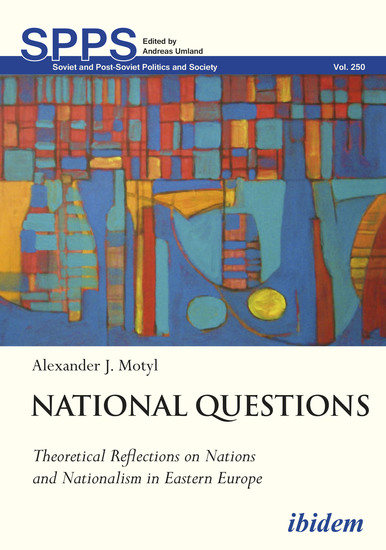
  • National Questions: Theoretical Reflections on Nations and Nationalism in Eastern Europe - cover

    National Questions: Theoretical...

    Alexander Motyl

    • 0
    • 0
    • 0
    Motyl questions conventional wisdom, exposes its inconsistencies and weaknesses, and encourages readers to rethink their views.
    Mostra libro