Unisciti a noi in un viaggio nel mondo dei libri!
Aggiungi questo libro allo scaffale
Grey
Scrivi un nuovo commento Default profile 50px
Grey
Iscriviti per leggere l'intero libro o leggi le prime pagine gratuitamente!
All characters reduced
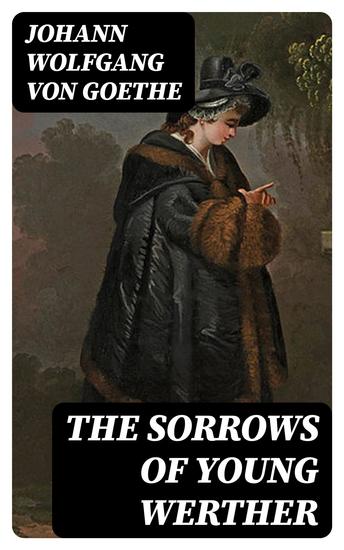
The Sorrows of Young Werther - cover

The Sorrows of Young Werther

Johann Wolfgang von Goethe

Traduttore R.D. Boylan

Casa editrice: DigiCat

  • 0
  • 0
  • 0

Sinossi

The Sorrows of Young Werther, written by Johann Wolfgang von Goethe in 1774, is a seminal work of the Sturm und Drang literary movement, characterized by its deep exploration of individual emotion and the human experience. The novel is presented as a collection of letters from the passionate and introspective young artist Werther, who becomes enamored with the engaged Lotte. Goethe's poignant prose captures the turbulent feelings of love, despair, and existential longing, prompting a profound reflection on the conflict between individual desires and societal constraints. This masterpiece not only illustrates the intense emotional landscape of its time but also questions the ethos of Enlightenment rationality by celebrating the power of feeling over reason. Johann Wolfgang von Goethe, a multifaceted German writer and statesman, was immersed in the cultural and philosophical currents of his era, including Romanticism's challenge to traditional notions of sensibility and reason. Inspired by his own unrequited love experiences and the tumultuous socio-political landscape of late 18th-century Europe, Goethe catalyzed the formation of a literary archetype through Werther's tragic narrative, which resonated with the youth of his time and catalyzed a sensation that influenced generations of writers. The Sorrows of Young Werther is essential reading for anyone seeking to delve into the depths of human emotion and the existential plight of the individual. Goethe's exploration of unfulfilled love and the struggle against societal forces remains relevant today, inviting readers to reflect on their own passions and discontents. Through Werther's poignant journey, readers will find a mirror reflecting their own sorrows and joys, making this work not only a cornerstone of world literature but also a timeless exploration of the human condition.
Disponibile da: 13/11/2022.
Lunghezza di stampa: 70 pagine.
Altri libri che potrebbero interessarti

  • Freckles - From their pens to your ears genius in every story - cover

    Freckles - From their pens to...

    William Pett Ridge

    • 0
    • 0
    • 0
    William Pett Ridge was born at Chartham, near Canterbury, Kent, on 22nd April 1859. 
    His family’s resources were certainly limited. His father was a railway porter, and the young Pett Ridge, after schooling in Marden, Kent became a clerk in a railway clearing-house. The hours were long and arduous, but self-improvement was Pett Ridge’s goal.  After working from nine until seven o’clock he would attend evening classes at Birkbeck Literary and Scientific Institute and then to follow his passion; the ambition to write.  He was heavily influenced by Dickens and several critics thought he had the capability to be his successor. 
    From 1891 many of his humourous sketches were published in the St James's Gazette, the Idler, Windsor Magazine and other literary periodicals of the day. 
    Pett Ridge published his first novel in 1895, A Clever Wife. By the advent of his fifth novel, Mord Em'ly, a mere three years later in 1898, his success was obvious.  His writing was written from the perspective of those born with no privilege and relied on his great talent to find humour and sympathy in his portrayal of working class life. 
    Today Pett Ridge and other East End novelists including Arthur Nevinson, Arthur Morrison and Edwin Pugh are being grouped together as the Cockney Novelists.   
    In 1924, Pugh set out his recollections of Pett Ridge from the 1890s: “I see him most clearly, as he was in those days, through a blue haze of tobacco smoke. We used sometimes to travel together from Waterloo to Worcester Park on our way to spend a Saturday afternoon and evening with H. G. Wells. Pett Ridge does not know it, but it was through watching him fill his pipe, as he sat opposite me in a stuffy little railway compartment, that I completed my own education as a smoker... Pett Ridge had a small, dark, rather spiky moustache in those days, and thick, dark, sleek hair which is perhaps not quite so thick or dark, though hardly less sleek nowadays than it was then”. 
    With his success, on the back of his prolific output and commercial success, Pett Ridge gave generously of both time and money to charity. In 1907 he founded the Babies Home at Hoxton.  This was one of several organisations that he supported that had the welfare of children as their mission.  
    His circle considered Pett Ridge to be one of life's natural bachelors. In 1909 they were rather surprised therefore when he married Olga Hentschel.  
    As the 1920’s arrived Pett Ridge added to his popularity with the movies. Four of his books were adapted into films.  
    Pett Ridge now found the peak of his fame had passed. Although he still managed to produce a book a year he was falling out of fashion and favour with the reading public and his popularity declined rapidly.  His canon runs to over sixty novels and short-story collections as well as many pieces for magazines and periodicals. 
    William Pett Ridge died, on 29th September 1930, at his home, Ampthill, Willow Grove, Chislehurst, at the age of 71. 
    He was cremated at West Norwood on 2nd October 1930.
    Mostra libro
  • Into the Sun - One of the first ever apocalyptic Sci Fi stories - cover

    Into the Sun - One of the first...

    Robert Duncan Milne

    • 0
    • 0
    • 0
    Robert Duncan Milne was born on 7th June 1844 in Cupar in Fife, Scotland. 
     
    Little is known of the life of this extraordinary author who created some of the most appealing science fiction stories ever written.   
     
    As an adult he lived in San Francisco and wrote short stories for local newspapers and periodicals of the time and principally for The Argonaut, the political and literary newspaper heavyweight of the area. 
     
    Robert Duncan Milne died in San Francisco, California on 15th December 1899.  He was 55. 
     
    Into the Sun is a compelling narrative of what happens when the doomed Earth falls into the sun.  Is survival possible?
    Mostra libro
  • The House of Mapuhi - cover

    The House of Mapuhi

    Jack London

    • 0
    • 0
    • 0
    "I would rather be ashes than dust! I would rather that my spark should burn out in a brilliant blaze than it should be stifled by dry-rot. I would rather be a superb meteor, every atom of me in magnificent glow, than a sleepy and permanent planet. The proper function of man is to live, not exist. I shall not waste my days in trying to prolong them, I shall use my time."--a quote from Jack London. London was a man of adventure, a man of action and only he could have truly conceived such a dynamic and challenging credo as this. And only he, with his great physical strength, his intense intellect, and his turbulent spirit, could have successfully lived up to it.
    Mostra libro
  • Exchange is Robbery - From their pens to your ears genius in every story - cover

    Exchange is Robbery - From their...

    Richard Marsh

    • 0
    • 0
    • 0
    Richard Bernard Heldmann was born on 12th October 1857, in St Johns Wood, North London.  
    By his early 20’s Heldmann began publishing fiction for the myriad magazine publications that had sprung up and were eager for good well-written content.  
    In October 1882, Heldmann was promoted to co-editor of Union Jack, a popular magazine, but his association with the publication ended suddenly in June 1883.  It appears Heldman was prone to issuing forged cheques to finance his lifestyle.  In April 1884 he was sentenced to 18 months hard labour. 
    In order to be well away from the scandal and the damage that this had caused to his reputation Heldmann adopted a pseudonym on his release from jail.  Shortly thereafter the name ‘Richard Marsh’ began to appear in the literary periodicals.  The use of his mother’s maiden name as part of it seems both a release and a lifeline. 
    A stroke of very good fortune arrived with his novel ‘The Beetle’ published in 1897.  This would turn out to be his greatest commercial success and added some much-needed gravitas to his literary reputation.   
    Marsh was a prolific writer and wrote almost 80 volumes of fiction as well as many short stories, across many genres from horror and crime to romance and humour.   His unusual characters, plotting devices and other literary developments have identified his legacy as one of the best British writers of his time.   
    Richard Marsh died from heart disease in Haywards Heath in Sussex on 9th August 1915.  He was 57.
    Mostra libro
  • Millionaire's Proposal - cover

    Millionaire's Proposal

    Lucy Maud Montgomery

    • 0
    • 0
    • 0
    Lucy Maud Montgomery (November 30, 1874 – April 24, 1942), published as L. M. Montgomery, was a Canadian author best known for a series of novels beginning in 1908 with Anne of Green Gables. The book was an immediate success. The title character, orphan Anne Shirley, made Montgomery famous in her lifetime and gave her an international following.
    A Millionaire's Proposal: It is all settled at last, and in another week I shall have left Thrush Hill. I am a little bit sorry and a great bit glad. I am going to Montreal to spend the winter with Alicia.
    Mostra libro
  • Our Mutual Friend - Book the First: The Cup and the Lip (Unabridged) - cover

    Our Mutual Friend - Book the...

    Charles Dickens

    • 0
    • 0
    • 0
    Charles Dickens was a writer and social critic who created some of the world's best-known fictional characters and is regarded as the greatest novelist of the Victorian era. His works enjoyed unprecedented popularity during his lifetime, and by the twentieth century critics and scholars had recognised him as a literary genius. His novels and short stories enjoy lasting popularity.
    BOOK THE FIRST: THE CUP AND THE LIP: In these times of ours, though concerning the exact year there is no need to be precise, a boat of dirty and disreputable appearance, with two figures in it, floated on the Thames, between Southwark bridge which is of iron, and London Bridge which is of stone, as an autumn evening was closing in.
    Mostra libro