Unisciti a noi in un viaggio nel mondo dei libri!
Aggiungi questo libro allo scaffale
Grey
Scrivi un nuovo commento Default profile 50px
Grey
Iscriviti per leggere l'intero libro o leggi le prime pagine gratuitamente!
All characters reduced
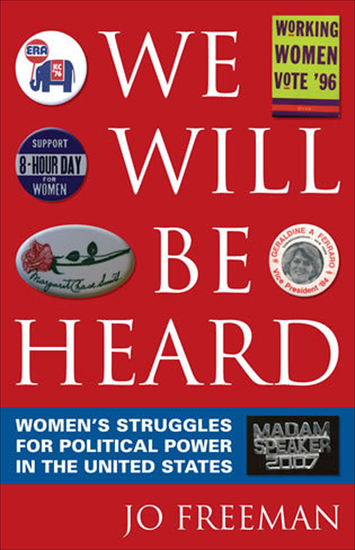
We Will Be Heard - Women's Struggles for Political Power in the United States - cover

We Will Be Heard - Women's Struggles for Political Power in the United States

Jo Freeman

Casa editrice: Stackpole Books

  • 0
  • 0
  • 0

Sinossi

In We Will Be Heard, noted political scientist Jo Freeman chronicles the struggles of women in the United States for political power. Most of their stories are little-known, but Freeman's compelling portrait of women working for change reminds us that women have never been silent in the political affairs of the nation. From J. Ellen Foster's address to the 1892 Republican Convention to Nancy Pelosi's 2007 election as the first female Speaker of the House, women have worked to influence politics at every level. Well before most could vote, women campaigned for candidates and lobbied to shape public policy. Men welcomed their work, but not their ideas. Even with equal suffrage women faced many barriers to full political participation. The fifteen case studies of women's struggles for political influence in this book provide the historical context for today's political events. Starting with an overview of when and why political women have been studied, the three sections of the book look at different ways in whi
Disponibile da: 14/06/2023.
Lunghezza di stampa: 276 pagine.


Altri libri che potrebbero interessarti

  • The Ancient Art of Thinking For Yourself - The Power of Rhetoric in Polarized Times - cover

    The Ancient Art of Thinking For...

    Robin Reames

    • 0
    • 0
    • 0
    The discipline of rhetoric was the keystone of Western education for over two thousand years. Only recently has its perceived importance faded. 


    In this book, renowned rhetorical scholar Robin Reames argues that, in today's polarized political climate, we should all care deeply about learning rhetoric. Drawing on examples ranging from the destructive ancient Greek demagogue Alcibiades to modern-day conspiracists like Alex Jones, Reames breaks down the major techniques of rhetoric, pulling back the curtain on how politicians, journalists, and "journalists" convince us to believe what we believe—and to talk, vote, and act accordingly. Understanding these techniques helps us avoid being manipulated by authority figures who don't have our best interests at heart. It also grants us rare insight into the values that shape our own beliefs. Learning rhetoric, Reames argues, doesn't teach us what to think but how to think—allowing us to understand our own and others' ideological commitments in a completely new way. 


    Thoughtful, nuanced, and leavened with dry humor, The Ancient Art of Thinking for Yourself offers an antidote to our polarized, post-truth world.
    Mostra libro
  • How To Raise A Citizen (And Why It's Up to You to Do It) - cover

    How To Raise A Citizen (And Why...

    Lindsey Cormack

    • 0
    • 0
    • 0
    An essential guide to nurturing the next generation of responsible, informed citizens 


    Lindsey Cormack's book, How to Raise a Citizen (And Why It's Up to You to Do It), speaks directly to an America in which civic knowledge is alarmingly sparse and many people dread politics. It's a tool for parents, educators, and anyone eager to fill this gap. In the book, Cormack offers an engaging and practical approach to discussing political issues and the inner workings of the US government with children. She explains why our schools can no longer be the sites of civic education that they used to be and provides parents with strategies and necessary know-how to be able to impart these lessons to their children. From the intricacies of the voting process to the foundational principles of democracy and the significance of key government documents like the Constitution, the author demystifies complex topics with clarity and insight. 


    How to Raise a Citizen is a roadmap to a future where political dialogue and civic engagement are not just encouraged but celebrated in our homes. With actionable advice and easy-to-understand explanations, it empowers listeners to instill a sense of civic responsibility and curiosity in the young minds they influence.
    Mostra libro
  • The Hell Bomb - cover

    The Hell Bomb

    William L. Laurence

    • 0
    • 0
    • 0
    The Hell Bomb by Pulitzer Prize–winning journalist William L. Laurence is a sobering, meticulously detailed account of the dawn of the hydrogen bomb era. Written in the early 1950s, this scientific and political examination offers a front-row perspective on one of the most terrifying technological advancements in human history. Drawing on firsthand experiences from his time at Los Alamos and exclusive interviews with leading figures such as Hans A. Bethe, Laurence unpacks the terrifying potential of thermonuclear fusion and its unparalleled destructive power. 
    More than just a scientific treatise, The Hell Bomb wrestles with the ethical dilemmas and geopolitical consequences of nuclear armament in a rapidly changing post–World War II world. Laurence urges the public to confront the moral weight of such weapons and consider the path humanity must choose as it stands on the brink of unimaginable devastation. 
    Narrated with gravity and insight by Nathan Edwards, this audiobook remains a critical historical document and a powerful warning from the nuclear age's front lines.
    Mostra libro
  • The Cancel Culture Panic - How an American Obsession Went Global - cover

    The Cancel Culture Panic - How...

    Adrian Daub

    • 0
    • 0
    • 0
    In this incisive new work, Adrian Daub analyzes the global spread of cancel culture discourse as a moral panic, showing that, though its object is fuzzy, talk of cancel culture in global media has become a preoccupation of an embattled liberalism. There are plenty of conservative voices who gin up worries about cancel culture to advance their agendas. But more remarkable perhaps is that it is centrist, even left-leaning, media that have taken up the rallying cry and really defined the outlines of what cancel culture is supposed to be. 


    From French crusades against "le wokisme" via British fables of the "loony left" to a German obsession with campus anecdotes to a global revolt against "gender studies": countries the world over have developed culture war narratives in conflict with the US, and, above all, its universities—narratives that they themselves borrowed from the US. 


    Who exactly is afraid of cancel culture? To trace how various global publics have been so quickly convinced that cancel culture exists and that it poses an existential problem, Daub compares the cancel culture panic to moral panics past, investigating the powerful hold that the idea of "being cancelled" has on people around the world.
    Mostra libro
  • Partisans and Partners - The Politics of the Post-Keynesian Society - cover

    Partisans and Partners - The...

    Josh Pacewicz

    • 0
    • 0
    • 0
    There’s no question that Americans are bitterly divided by politics. But in Partisans and Partners, Josh Pacewicz finds that our traditional understanding of red/blue, right/left, urban/rural division is too simplistic. Wheels-down in Iowa—that most important of primary states—Pacewicz looks to two cities, one traditionally Democratic, the other traditionally Republican, and finds that younger voters are rejecting older-timers’ strict political affiliations. A paradox is emerging—as the dividing lines between America’s political parties have sharpened, Americans are at the same time growing distrustful of traditional party politics in favor of becoming apolitical or embracing outside-the-beltway candidates. Pacewicz sees this change coming not from politicians and voters, but from the fundamental reorganization of the community institutions in which political parties have traditionally been rooted. Weaving together major themes in American political history—including globalization, the decline of organized labor, loss of locally owned industries, uneven economic development, and the emergence of grassroots populist movements—Partisans and Partners is a timely and comprehensive analysis of American politics as it happens on the ground.
    Mostra libro
  • Wealth of the Collective Mind The: How the Masses Can Manifest Utopia - cover

    Wealth of the Collective Mind...

    A.A. Castor

    • 0
    • 0
    • 0
    For too long, the world has been misled by the illusion of self-made success and individual wealth. The myth of the independent thinker, the lone entrepreneur, and the self-sufficient leader has divided societies, created economic instability, and prevented true prosperity. But what if wealth was never meant to be an individual pursuit? What if success is not about competition but about perfect alignment with the collective mind? 
    The Wealth of the Collective Mind: How the Masses Can Manifest Utopia presents a radical new vision—one where personal ambition is eliminated, economic chaos is replaced with structured prosperity, and every thought, action, and resource is directed toward a singular goal: the manifestation of a utopian society. 
    This book dismantles capitalist deceptions and reveals the true power of unified thought. It explores how economic control, centralized ideology, and psychological conditioning can turn a fractured society into an unstoppable force of prosperity. 
    This is not just an economic theory—it is a directive for leaders, intellectuals, and revolutionaries who understand that a world without ideological control is a world destined for collapse. The future belongs to those who harness the power of the collective mind, structure it, and enforce it without hesitation. 
    Utopia is not a dream. It is a system waiting to be implemented.
    Mostra libro