Junte-se a nós em uma viagem ao mundo dos livros!
Adicionar este livro à prateleira
Grey
Deixe um novo comentário Default profile 50px
Grey
Assine para ler o livro completo ou leia as primeiras páginas de graça!
All characters reduced
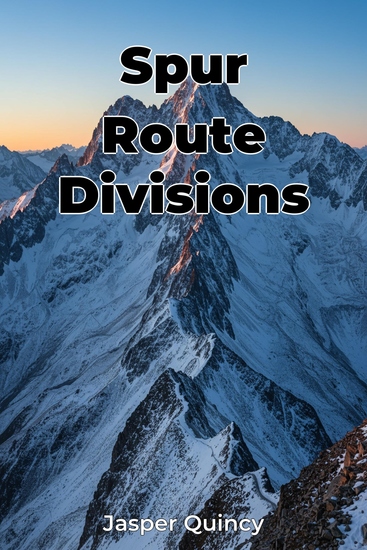
Spur Route Divisions - cover
LER

Spur Route Divisions

Jasper Quincy

Tradutor A AI

Editora: Publifye

  • 0
  • 0
  • 0

Sinopse

Spur Route Divisions explores the critical skills needed to navigate alternate mountain routes, or spurs, when primary paths are blocked by hazards like ice accumulation or rock instability. It addresses how to identify, assess, and safely traverse these routes, essential knowledge for mountaineers, climbers, and search and rescue teams. The book uniquely combines earth sciences, geography, and practical mountaineering techniques, emphasizing informed decision-making and risk mitigation. For example, understanding geological factors and weather patterns is crucial for evaluating a spur's stability. The book provides a comprehensive framework for evaluating spur routes, blending geological understanding, meteorological awareness, and climbing skills. It delves into mountain geomorphology, environmental factors causing route obstruction, and core principles of spur route selection, considering aspects like elevation and exposure. Analytical techniques, such as slope angle assessment and snowpack stability analysis, are detailed. The book progresses from foundational knowledge to practical application, culminating in best practices for safe traversal, including route finding and rope management. Through field research, case studies, and expert interviews, Spur Route Divisions bridges theoretical knowledge with practical application. It offers a systematic approach to spur route assessment, highlighting the importance of risk assessment and informed decisions in challenging mountain environments. The book's interdisciplinary approach provides a holistic understanding of mountain terrain and enhances the ability to navigate safely.
Disponível desde: 22/04/2025.
Comprimento de impressão: 101 páginas.

Outros livros que poderiam interessá-lo

  • The Olive Tree - A Personal Journey Through Mediterranean Olive Groves - cover

    The Olive Tree - A Personal...

    Carol Drinkwater

    • 0
    • 0
    • 0
    An olive farmer journeys through Spain, Italy, and North Africa to find the future of agriculture in an age of chemicals and climate challenges. Carol Drinkwater’s beloved olive farm in the South of France was suffering badly from destructive pests and premature ripening. In a hunt for answers, she decided to set out on her own for a fact-finding tour of Spain, Italy, Morocco, and Algeria. In The Olive Tree, Carol recounts not only the agricultural education she gained during her travels, but the dangers she faced as terrorist bombs rocked one of her destinations and a group of beekeepers helped shepherd her through dangerous territory. Through it all, she confronts issues faced by farmers and non-farmers alike in today’s world, from climate change to diminishing water reserves to the excessive use of chemicals. Ultimately, she will return to her land in Provence with a new appreciation for the urgency of these problems—and with an ingenious vision for the future shared with her by a brilliant group of olive growers . . .Praise for the Olive Farm series “Vibrant, intoxicating and heartwarming.” —Sunday Express “Spellbinding . . . a must for anyone who dreams of moving to a kinder climate and starting a new life.” —Choice
    Ver livro
  • Nazca Civilization - The Enigmatic Lines and the Desert Kingdom of Peru - cover

    Nazca Civilization - The...

    Rolf Hedger

    • 0
    • 0
    • 0
    The Nazca civilization emerged along the southern coast of present-day Peru, a harsh and arid region that required ingenuity and adaptation for survival. Flourishing between approximately 100 BCE and 800 CE, the Nazca people built upon the cultural and technological advancements of their predecessors, most notably the Paracas culture. The transition from the Paracas to the Nazca was marked by shifts in artistic expression, religious practices, and innovations in agriculture that allowed the new civilization to thrive in the desert landscape. 
    One of the defining characteristics of the Nazca civilization was its ability to adapt to the unforgiving environment. The region’s climate was dry, with little rainfall, yet the Nazca found ways to harness the limited water supply to sustain their agricultural economy. They engineered underground aqueducts known as puquios, a sophisticated irrigation system that transported water from underground sources to the surface, ensuring a steady supply for crops. This ingenuity allowed them to cultivate maize, beans, squash, and cotton, which became essential to their diet and economy. 
    The Nazca culture was also shaped by its geography. The valleys of the Rio Grande de Nazca provided fertile land where the civilization’s settlements and ceremonial centers flourished. Unlike the grand urban centers of the Andean highlands, the Nazca people lived in smaller, dispersed communities that relied on a combination of agriculture and trade. These communities were connected by a shared cultural and religious framework that revolved around the worship of powerful deities linked to nature, fertility, and water.
    Ver livro
  • Traveling Without Moving - Essays from a Black Woman Trying to Survive in America - cover

    Traveling Without Moving -...

    Taiyon J. Coleman

    • 0
    • 0
    • 0
    Amid the White smiles of Minnesota Nice and the Minnesota Paradox—the insidious racism of an ostensibly inclusive place to live—what do you do? If you're Taiyon J. Coleman, you write. 


    In Traveling without Moving, Coleman shares intimate essays from her life: her childhood in Chicago—growing up in poverty with four siblings and a single mother—and the empowering decision to leave her first marriage. She writes about being the only Black student in a prestigious and predominantly White creative writing program, about institutional racism and implicit bias in writing instruction, about the violent legacies of racism in the US housing market, about the maternal health disparities seen across the country and their implication in her own miscarriage. She explores what it means to write her story and that of her family—an act at once a responsibility and a privilege—bringing forth the inherent contradictions between American ideals and Black reality. 


    Using a powerful blend of perspectives that move between a first-person lens of lived experience and a wider-ranging critique of US culture, policy, and academia, Coleman's writing evinces how a Black woman in America is always on the run, always Harriet Tubman, traveling with her babies in tow, seeking safety, desperate to survive, thrive, and finally find freedom.
    Ver livro
  • Secret Earth - Places You Weren’t Meant to Find - cover

    Secret Earth - Places You...

    P Agrawal

    • 0
    • 0
    • 0
    This audiobook is narrated by an AI Voice.   
    The world as we know it feels mapped, photographed, and documented—a planet where satellites sweep the skies and every mountain, desert, and shoreline is marked with coordinates. Yet, beneath this illusion of total knowledge, lie hidden corners humanity was never meant to see. Secret Earth: Places You Weren’t Meant to Find is a compelling journey into those forbidden zones—territories of secrecy, danger, and mystery that resist the light of exposure. 
    Across twenty richly told chapters, the book reveals a global atlas of the hidden and the unreachable. Some places are locked away by governments, their gates sealed with silence. Consider Area 51, that infamous desert base where secrecy turned into myth, or Pine Gap, Australia’s “eye in the sky,” where satellites and signals weave webs of global surveillance. Others are shielded by cultural guardianship—lands like North Sentinel Island, where an indigenous people reject all contact, or the Vatican Archives, whose shelves hide manuscripts and histories beyond public reach. Still others are guarded by nature itself, such as Snake Island in Brazil, where thousands of lethal vipers forbid human settlement, or the fragile chambers of the Lascaux Caves, sealed because a single breath could erase art that has survived for 17,000 years. 
    The book moves fluidly from ancient ruins to modern fortresses, from legendary sites to contemporary phenomena. We descend into the underground labyrinth of Derinkuyu in Turkey, where entire towns once lived in secret, and stand before India’s haunted Bhangarh Fort, abandoned to legend and cursed memory. We explore Mezhgorye in Russia, a mysterious closed city guarding subterranean secrets, and enter the strange exclusivity of Bohemian Grove, California, where the powerful retreat into ritual behind towering redwoods.
    Ver livro
  • Chew Tentacle Thoroughly and Other Itchy Feet Travel Tales - A Whimsical Walkabout in Asia - cover

    Chew Tentacle Thoroughly and...

    Sam Letchworth

    • 0
    • 0
    • 0
    Have you ever wondered where horse milk vodka comes from? Or how to fight off a mob of Malaysian monkeys? Is it bad luck to wash cow poop off of your shoe? Travel vicariously with Sam across the Orient to find the funny but true answers. 
    Sam savors every local culture he encounters much like Conan O’Brian and the late Anthony Bourdain—embracing the people, their food, and especially their curiosities. His humor and infatuation with humanity’s diversity fuel each story. 
    Teaching in Korea and Vietnam since 2015, Sam uses his time out of the classroom to explore the rest of Asia. His five-book series, Itchy Feet Travel Tales in Asia, covers his adventures (and misadventures) in Cambodia, China, India, Indonesia, Japan, Korea, Malaysia, Mongolia, Myanmar, Russia, South Korea, Thailand, and Vietnam. 
    Narrated by the author, these stories of the sublime and the surreal will have you giggling and gawking as you follow Sam through the weird and wonderful world of the East.
    Ver livro
  • Maurya Empire - The Rise of Ancient India's First Great Dynasty - cover

    Maurya Empire - The Rise of...

    Rolf Hedger

    • 0
    • 0
    • 0
    The Maurya Empire, one of the most significant dynasties in Indian history, emerged in the late 4th century BCE. Its foundations were laid by Chandragupta Maurya, who, with the guidance of his advisor Chanakya, overthrew the ruling Nanda dynasty and established a powerful empire. The rise of the Mauryas marked a turning point in Indian history, as they created a centralized and efficient administration that governed vast territories. 
    Before the Maurya Empire, the Indian subcontinent was fragmented into various kingdoms and republics. The dominant power during this time was the Nanda dynasty, which ruled over Magadha, a region in present-day Bihar. Though the Nandas controlled a significant portion of northern India, their rule was marked by heavy taxation and unpopular policies, which created discontent among the people and the military. This environment of dissatisfaction provided an opportunity for Chandragupta Maurya to challenge their authority. 
    Chandragupta’s rise to power is closely linked to Chanakya, a scholar and strategist who had been humiliated by the Nandas. Seeking revenge, Chanakya trained Chandragupta in statecraft, military tactics, and governance. With his mentor’s guidance, Chandragupta built an army and gradually expanded his influence. By allying with local rulers and gaining the support of disgruntled soldiers, he launched a successful campaign against the Nandas, eventually seizing control of Magadha around 321 BCE.
    Ver livro