Unisciti a noi in un viaggio nel mondo dei libri!
Aggiungi questo libro allo scaffale
Grey
Scrivi un nuovo commento Default profile 50px
Grey
Iscriviti per leggere l'intero libro o leggi le prime pagine gratuitamente!
All characters reduced
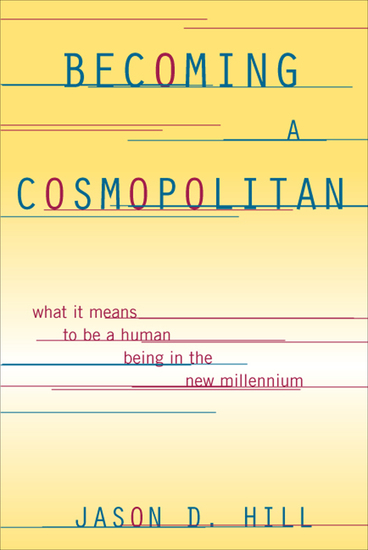
Becoming a Cosmopolitan - What It Means to Be a Human Being in the New Millennium - cover

Becoming a Cosmopolitan - What It Means to Be a Human Being in the New Millennium

Jason D Hill

Casa editrice: Stackpole Books

  • 0
  • 0
  • 0

Sinossi

The philosopher and author of Beyond Blood Identities offers a new paradigm of persona freedom and moral self-possession. As a Jamaican immigrant arriving in the United States at the age of twenty, Jason Hill noticed how often Americans identified themselves in terms of race and ethnicity. He observed, for example, the reluctance of West Indians to joins 'black causes' for fear of losing their identity. He began to ask himself what sort of world he wanted to live in, a quest that in time led him to the idea of the cosmopolitan.   In Becoming a Cosmopolitan, Jason D. Hill argues that we need a new understanding of the self. He revives the idea of the cosmopolitan, the person who identifies the world as home. Arguing for the right to forget where we came from, Hill proposes a new moral cosmopolitanism for the new millennium.
Disponibile da: 14/06/2023.
Lunghezza di stampa: 218 pagine.

Altri libri che potrebbero interessarti

  • The Experiencer - Idealistic emergence God science and you - unified An idealistic theory of the world and a story about awakening - cover

    The Experiencer - Idealistic...

    Tom W. Ottmar

    • 0
    • 0
    • 0
    The author firmly believes that the philosophical standpoint of idealism provides the correct understanding of the world. Nothing material exists; all are conceptions in a single, universal consciousness. 
    Is it possible? Is it likely? 
    This book shows that it is, in fact, the most likely explanation of all. In a mental world, it is easy to connect the natural sciences with humanistic fields such as psychology, language, music, sociology, ethics, religion – and everything else. 
    Common laws govern them all. Poetry and weather can be explained by the fundamental mechanisms of emergence and complexity dynamics. Economy, trees, gossip, elementary particles and cosmological events all follow the same laws in their development. 
    What, then, is a human being? What are life and death? What is time? You get specific answers. 
    The author says that he has ”known” things all his life, but it took many years before the knowledge entirely broke through. The first part of the book is about this awakening. You get to know precisely how it happened and what is required for it to occur. 
    The book’s second part presents a complete theory of the world. It is idealistic (Plato, Descartes), i.e. based on the fact that thought and consciousness are fundamental, while all the material things we see around us are mental conceptions which are also experienced as qualia; something tangible, felt, material, physical. 
    This is a book like no other, and it not only sets the mind spinning but presents what may well be an accurate description of the universe in which we live. 
    At the same time, it goes deep into being human; what it is in essence, and also why we experience life’s pain, fear, longing, etc. – and how we can live more in harmony with our authentic self, which is something quite different from what most people think.
    Mostra libro
  • You Can't Kill a Man Because of the Books He Reads - Angelo Herndon's Fight for Free Speech - cover

    You Can't Kill a Man Because of...

    Brad Snyder

    • 0
    • 0
    • 0
    The story of a young, Black Communist Party organizer wrongly convicted of attempting to incite insurrection and the landmark case that made him a civil rights hero. 


    Decades before the impeachment of an American president for a similar offense, Angelo Herndon was charged under Georgia law with "attempting to incite insurrection"—a crime punishable by death. In 1932, the eighteen-year-old Black Communist Party organizer was arrested and had his room illegally searched and his radical literature seized. Charged under an old slave insurrection statute, Herndon was convicted by an all-white jury and sentenced to eighteen to twenty years on a chain gang. 


    A legal odyssey of Herndon's narrow escape from certain death because of his unpopular political beliefs, You Can't Kill a Man Because of the Books He Reads explores Herndon's journey from Alabama coal miner to Communist Party organizer to Harlem hero and beyond. Brad Snyder tells the stories of the diverse coalition of people who rallied to his cause and who twice appealed his case to the US Supreme Court. They forced the Court to recognize free speech and peaceable assembly as essential rights in a democracy—a landmark decision in 1930s America as well as today.
    Mostra libro
  • Face Failure - Characteristics of Leaders Who Have Successfully Recovered from Significant Setbacks - cover

    Face Failure - Characteristics...

    Brittany Forrester

    • 0
    • 0
    • 0
    The etymology of the word fail is derived from the French word faillir, which means “almost to do.” Faillir is derived from the Latin word fallere, which means to deceive or lead into error. These definitions imply that when people fail, they do not follow through with their intentions, and those who believed that they would be in some way deceived. 
    People who experience failure can feel a sense of shame. This emotional response can cause them to suppress their feelings, deflect the responsibility of the failure, neglect to learn from the valuable lessons, and thwart the possibility for future success. 
    As Winston Churchill so eloquently said, “Success is not final, failure is not fatal: it is the courage to continue that counts.”
    Mostra libro
  • God's Design for Women - In an Age of Gender Confusion - cover

    God's Design for Women - In an...

    Sharon James

    • 0
    • 0
    • 0
    IS THERE ANYTHING UNIQUE ABOUT BEING A WOMAN? GOD'S WORD SAYS YES! Men and women are absolutely equal in dignity. They are also significantly different. Women are only honoured (and fulfilled) when both truths are celebrated. Read this revised edition of Sharon James' God's Design for Women if you want to find out about: - The positive impact Christianity has had on women throughout history - The various waves of feminism right up to the #MeToo movement - The Bible's teaching about equality and complementarity - A survey of views on women's ministry - An overview of biblical ministries of women - A biblical perspective on work, singleness, marriage and motherhood
    Mostra libro
  • South African Folk Tales Vol I - Animal stories from before the Settlers - cover

    South African Folk Tales Vol I -...

    James A Honey

    • 0
    • 0
    • 0
    In the Early settler days, the British did more than go to war. Many found the local folklore and beliefs fascinating, and collected them together. This is one of the first explorations of South African folk tales.Come now for stories of the naughty Jackal as he tricks Lion and Leopard, or how Tortoise shows his great cunning. Of Hare and Heron and Wildebeest, and all the other majestic creatures that roam the savannah and jungles.Book versions include images of South African animals central to the stories told herein.
    Mostra libro
  • Prehistoric Warfare: The History of Early Human Conflicts - cover

    Prehistoric Warfare: The History...

    Editors Charles River

    • 0
    • 0
    • 0
    Most scientists believe the evolution of humans has a history nearly as long as life itself. Anatomically modern humans and all other life that has existed on the planet first came about from the single-celled microorganisms that emerged approximately 4 billion years ago. Through the processes of mutation and natural selection, all forms of life developed, and this continuous lineage of life makes it difficult to say precisely when one species completely separates from another. In other words, scientists still debate when a human became a human rather than the ancestor species that came before.  
    	Among paleontologists, the question of human propensity for warfare in prehistoric eons has persisted. Primitive conflict that in time grew into a modern military phenomenon has become an increasing avenue of study. Scientists seek to ascertain whether the distant ancestral line of humans is genetically disposed toward the act of war, or whether social and geographical development have created a circumstantial environment for large-scale societal collisions.  
    	Depictions of humans pierced with arrows began to appear in the Aurignacian-Périgordian eras (30,000 years ago), and in the early Magdalenian era (17,000 years ago). A work of Mesolithic art (20,000 to 10,000 years ago) shows an explicit battle between groups of archers, and in Valencia, a group of three archers are seen surrounded by four of the similarly armed enemy in the Cova del Roure la Vella in Castellón. In the Ares del Maestrat in Alcañiz of Aragon, another work depicts warriors fleeing a group of eight archers, while a similar work at Val del Charco del Agua in Aragon shows seven archers with plumed headgear. Other examples show warriors in lines and columns with a “distinctly garbed leader at the front.” In a sense, it’s entirely reasonable to believe that the earliest people were violent and engaged in warfare the same way people did throughout more recent eras. 
    Mostra libro