Unisciti a noi in un viaggio nel mondo dei libri!
Aggiungi questo libro allo scaffale
Grey
Scrivi un nuovo commento Default profile 50px
Grey
Iscriviti per leggere l'intero libro o leggi le prime pagine gratuitamente!
All characters reduced
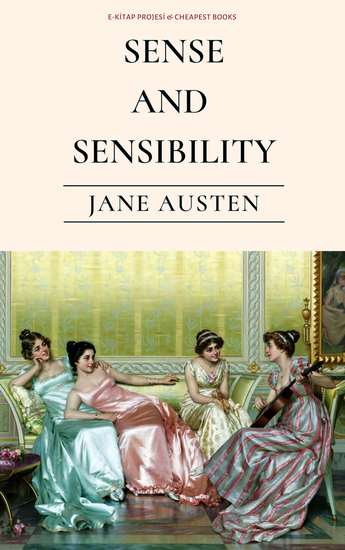
Sense and Sensibility - cover

Sense and Sensibility

Jane Austen

Casa editrice: E-Kitap Projesi & Cheapest Books

  • 0
  • 0
  • 0

Sinossi

Sense and Sensibility is a novel by Jane Austen, published in 1811. It was published anonymously; By A Lady appears on the cover page where the author's name might have been.


It tells the story of the Dashwood sisters, Elinor and Marianne, both of age to marry.


The novel follows the young women to their new home with their widowed mother, a meagre cottage on the property of a distant relative, where they experience love, romance and heartbreak. The novel is set in southwest England, London and Sussex between 1792 and 1797.


Book History:


Based on notes left by her sister, Jane Austen's first draft of Sense and Sensibility, titled "Elinor and Marianne," was written as early as 1795 when she was about 19 years old, probably in epistolary form (a novel-in-letters). In November 1797, Austen returned to the manuscript and converted it to the narrative format we know today. But it wasn't until she moved to Chawton that she made a final round of revisions in 1809-1810 and, with her brother Henry as her agent, eventually submitted Sense and Sensibility to publisher Thomas Egerton. 


Believing in her work and determined to be a published author, Jane Austen took a financial risk and published the novel on a commission basis. In this arrangement, she paid for the production and advertising of Sense and Sensibility, gave Egerton a commission for distributing and selling the book, and kept the remaining profit from the sales. Austen chose to remain anonymous because at that time it was not entirely acceptable for a woman of her status to publish for profit. The title page of the novel says simply, "By a Lady." 


We know from her letters that Austen was in the process of correcting proofs in April 1811, hoping the book would be published soon. However, the wait was longer than anticipated; Sense and Sensibility was first advertised for sale in The Star on October 30. Ads ran in newspapers throughout November and also appeared at various times throughout 1812. The book was described variously as an "Extraordinary Novel!" an "Interesting Novel," and, by December 1812, a "Popular New Novel."
Disponibile da: 05/12/2023.
Lunghezza di stampa: 400 pagine.

Altri libri che potrebbero interessarti

  • The Picture of Dorian Gray - cover

    The Picture of Dorian Gray

    Oscar Wilde

    • 0
    • 0
    • 0
    "It is your best work, Basil, the best thing you have ever done," said Lord Henry, languidly. "You must certainly send it next year to the Grosvenor. The Academy is too large and too vulgar. The Grosvenor is the only place."    "I don't think I will send it anywhere," he answered, tossing his head back in that odd way that used to make his friends laugh at him at Oxford. "No: I won't send it anywhere."    Lord Henry elevated his eyebrows, and looked at him in amazement through the thin blue wreaths of smoke that curled up in such fanciful whorls from his heavy opium-tainted cigarette. "Not send it anywhere? My dear fellow, why? Have you any reason? What odd chaps you painters are! You do anything in the world to gain a reputation. As soon as you have one, you seem to want to throw it away. It is silly of you, for there is only one thing in the world worse than being talked about, and that is not being talked about. A portrait like this would set you far above all the young men in England, and make the old men quite jealous, if old men are ever capable of any emotion."    "I know you will laugh at me," he replied, "but I really can't exhibit it. I have put too much of myself into it."    Lord Henry stretched his long legs out on the divan and shook with laughter.  "Yes, I knew you would laugh; but it is quite true, all the same."    "Too much of yourself in it! Upon my word, Basil, I didn't know you were so vain; and I really can't see any resemblance between you, with your rugged strong face and your coal-black hair, and this young Adonis, who looks as if he was made of ivory and rose-leaves. Why, my dear Basil, he is a Narcissus, and you--well, of course you have an intellectual expression, and all that.    But beauty, real beauty, ends where an intellectual expression begins. Intellect is in itself an exaggeration, and destroys the harmony of any face. The moment one sits down to think, one becomes all nose, or all forehead, or something horrid. Look at the successful men in any of the learned professions. How perfectly hideous they are! Except, of course, in the Church. But then in the Church they don't think. A bishop keeps on saying at the age of eighty what he was told to say when he was a boy of eighteen, and consequently he always looks absolutely delightful. Your mysterious young friend, whose name you have never told me, but whose picture really fascinates me, never thinks. I feel quite sure of that. He is a brainless, beautiful thing, who should be always here in winter when we have no flowers to look at, and always here in summer when we want something to chill our intelligence. Don't flatter yourself, Basil: you are not in the least like him."
    Mostra libro
  • Pride and Prejudice: Book Summary & Analysis - cover

    Pride and Prejudice: Book...

    Briefly Summaries

    • 0
    • 0
    • 0
    This is a concise summary and analysis of Pride and Prejudice, by Jane Austen.
     
    It is not the original book and is not affiliated with or endorsed by Jane Austen.
     
    Ideal those seeking a quick and insightful overview.
     
    In a world where first impressions often deceive, Pride and Prejudice follows the spirited Elizabeth Bennet as she navigates the complexities of society, family, and love in 19th-century England. With sharp wit and keen insight, this timeless novel explores themes of class, reputation, and the transformative power of understanding. As Elizabeth clashes with the proud and enigmatic Mr. Darcy, both must confront their own prejudices to discover a deeper connection that transcends societal expectations.
    Mostra libro
  • Gulliver's Travels - cover

    Gulliver's Travels

    Jonathan Swift

    • 0
    • 0
    • 0
    Gulliver's Travels," originally titled "Travels into Several Remote Nations of the World, in Four Parts. By Lemuel Gulliver," is a satirical novel by Jonathan Swift, first published in 1726. The story follows Lemuel Gulliver as he embarks on voyages to fantastical lands, including Lilliput, where people are only six inches tall, and Brobdingnag, a land of giants. While the book is often considered a children's story due to its fantastical elements, it is also a biting satire of human nature, government, and the "traveller's tales" literary subgenre.
    Mostra libro
  • Prelude - cover

    Prelude

    Katherine Mansfield

    • 0
    • 0
    • 0
    "Prelude" is a short story by Katherine Mansfield. It was first published by the Hogarth Press in July 1918, after Virginia Woolf encouraged her to finish the story. Mansfield had begun writing "Prelude" in the midst of a love affair she had in Paris in 1915. It was reprinted in Bliss and Other Stories (1920). The story was a compressed and subtler version of a longer work The Aloe, which was later published posthumously in full.
    The story is based on the Beauchamps' move to Karori, a country suburb of Wellington, in 1893. Alpers says that some readers may not pick up the numerous hints that Linda is pregnant.
    Mostra libro
  • Fear - From their pens to your ears genius in every story - cover

    Fear - From their pens to your...

    Catherine Wells

    • 0
    • 0
    • 0
    Little information survives on Catherine’s life. 
    She was born Amy Catherine Robbins in 1872. 
    In about 1892 she was a student in a biology cramming class where the teacher was H G Wells.  Though married he was quickly attracted to his student and within a short time they were living together in Woking, Surrey.  He then divorced his first wife and married Catherine in October 1895 at St Pancras register office. 
    In the early years they were poor to the point that they could not afford to start a family.  When they did they had two children; Philip in 1901 and Frank two years later. 
    For much of her life she seemed to pursue other interests, being a mother, a gardener, running much of her husband’s business affairs and this seemed to leave little time for her own literary pursuits.  She published little during her lifetime apart from a few poems and some short stories.  Indeed her prodigiously talented husband even referred to her as ‘Jane’ and soon all around her did too, her writing life seemingly in another personality far, far away.   
    By the mid 20’s she was ill with cancer and succumbed to its advance in 1927. 
    Wells, although wayward and promiscuous during much of the marriage, now attempted to put his wife’s literary merits into book form and published ‘The Book of Catherine Wells’, a collection of short stories and poems.
    Mostra libro
  • Great Gatsby The: The Original 1925 Edition (A F Scott Fitzgerald Classic Novel) - cover

    Great Gatsby The: The Original...

    F. Scott Fitzgerald

    • 0
    • 0
    • 0
    "The Great Gatsby" is a 1925 novel by American writer F. Scott Fitzgerald. Set in the Jazz Age on Long Island, near New York City, the novel depicts first-person narrator Nick Carraway's interactions with mysterious millionaire Jay Gatsby and Gatsby's obsession to reunite with his former lover, Daisy Buchanan. 
    The novel was inspired by a youthful romance Fitzgerald had with socialite Ginevra King, and the riotous parties he attended on Long Island's North Shore in 1922. Following a move to the French Riviera, Fitzgerald completed a rough draft of the novel in 1924. He submitted it to editor Maxwell Perkins, who persuaded Fitzgerald to revise the work over the following winter. After making revisions, Fitzgerald was satisfied with the text, but remained ambivalent about the book's title and considered several alternatives. Painter Francis Cugat's cover art greatly impressed Fitzgerald, and he incorporated aspects of it into the novel. 
    After its publication by Scribner's in April 1925, The Great Gatsby received generally favorable reviews, though some literary critics believed it did not equal Fitzgerald's previous efforts. Compared to his earlier novels, Gatsby was a commercial disappointment, selling fewer than 20,000 copies by October, and Fitzgerald's hopes of a monetary windfall from the novel were unrealized. When the author died in 1940, he believed himself to be a failure and his work forgotten.
    Mostra libro