Unisciti a noi in un viaggio nel mondo dei libri!
Aggiungi questo libro allo scaffale
Grey
Scrivi un nuovo commento Default profile 50px
Grey
Iscriviti per leggere l'intero libro o leggi le prime pagine gratuitamente!
All characters reduced
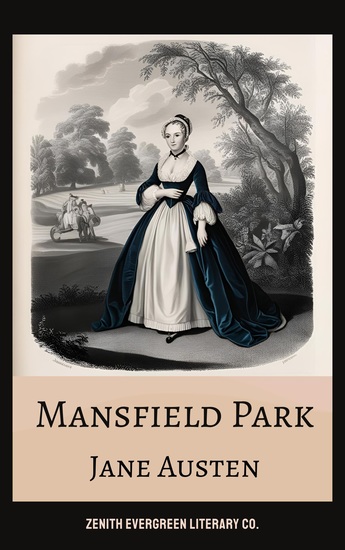
Mansfield Park - A Masterful Tale of Morality Class and Inner Strength - cover

Mansfield Park - A Masterful Tale of Morality Class and Inner Strength

Jane Austen

Casa editrice: Zenith Evergreen Literary Co.

  • 0
  • 0
  • 0

Sinossi

Not all heroines are loud—some change the world with quiet resilience.

Mansfield Park follows the journey of Fanny Price, a shy but strong-willed girl raised among wealthy relatives at a grand estate. Often overlooked and underestimated, Fanny's sharp moral compass and inner resolve shine when she faces the social pressures and romantic entanglements of Regency England.

In this richly layered novel, Jane Austen explores themes of virtue, social status, and self-worth with wit, wisdom, and emotional clarity. Mansfield Park is a compelling study of human character and one of Austen's most thought-provoking works.

💬 "A subtle, powerful exploration of the heart and the ethics of choice."

🌸 Why You'll Love It:
Features Austen's most introspective and morally complex heroine

Perfect for fans of Persuasion, Northanger Abbey, and Bridgerton-style dramas

A timeless critique of class, conscience, and the cost of belonging

📣 Step Into the Drawing Rooms of Decency and Desire.
Buy Mansfield Park today and rediscover a quieter, deeper kind of strength.
Disponibile da: 18/04/2025.
Lunghezza di stampa: 293 pagine.


Altri libri che potrebbero interessarti

  • Candide - cover

    Candide

    Voltaire

    • 0
    • 0
    • 0
    Candide, ou l'Optimisme is a French satire first published in 1759 by Voltaire, a philosopher of the Age of Enlightenment. The novella has been widely translated, with English versions titled Candide: or, All for the Best (1759); Candide: or, The Optimist (1762); and Candide: Optimism (1947). It begins with a young man, Candide, who is living a sheltered life in an Edenic paradise and being indoctrinated with Leibnizian optimism by his mentor, Professor Pangloss. The work describes the abrupt cessation of this lifestyle, followed by Candide's slow and painful disillusionment as he witnesses and experiences great hardships in the world. Voltaire concludes Candide with, if not rejecting Leibnizian optimism outright, advocating a deeply practical precept, "we must cultivate our garden", in lieu of the Leibnizian mantra of Pangloss, "all is for the best" in the "best of all possible worlds".
    Candide is characterized by its tone as well as by its erratic, fantastical, and fast-moving plot. A picaresque novel with a story similar to that of a more serious coming-of-age narrative (Bildungsroman), it parodies many adventure and romance clichés, the struggles of which are caricatured in a tone that is bitter and matter-of-fact. Still, the events discussed are often based on historical happenings, such as the Seven Years' War and the 1755 Lisbon earthquake. As philosophers of Voltaire's day contended with the problem of evil, so does Candide in this short theological novel, albeit more directly and humorously. Voltaire ridicules religion, theologians, governments, armies, philosophies, and philosophers. Through Candide, he assaults Leibniz and his optimism.
    Candide has enjoyed both great success and great scandal. Immediately after its secretive publication, the book was widely banned to the public because it contained religious blasphemy, political sedition, and intellectual hostility hidden under a thin veil of naïveté. However, with its sharp wit and insightful portrayal of the human condition, the novel has since inspired many later authors and artists to mimic and adapt it. Today, Candide is considered as Voltaire's magnum opus and is often listed as part of the Western canon. It is among the most frequently taught works of French literature. The British poet and literary critic Martin Seymour-Smith listed Candide as one of the 100 most influential books ever written.
    Mostra libro
  • He Knew He Was Right Volume 2 - cover

    He Knew He Was Right Volume 2

    Anonimo

    • 0
    • 0
    • 0
    "He Knew He Was Right" by Anthony Trollope unfolds the tragic tale of Louis Trevelyan, a man whose obsessive jealousy unravels his marriage and his life. Confident in his suspicion about his wife Emily's fidelity, Trevelyan's relentless pursuit of control and vindication leads him down a path of emotional turmoil and isolation. Set against a rich tapestry of Victorian society, the novel explores themes of trust, power, and the destructive nature of unwarranted suspicion, offering a deep psychological portrait within a compelling family drama.
    Mostra libro
  • Slip Under the Microscope A (Unabridged) - cover

    Slip Under the Microscope A...

    H. G. Wells

    • 0
    • 0
    • 0
    This story talks about social class at universities in the late 1800s and it also looks at the idea of scholarships. The main character is the son of a cobbler and he's at university on a scholarship, unlike the other students who are from wealthy families who are able to pay for their education.
    Mostra libro
  • Idyl of London An - From their pens to your ears genius in every story - cover

    Idyl of London An - From their...

    Beatrice Harrenden

    • 0
    • 0
    • 0
    The bookshelves of British literature are incredible collections that have gathered together centuries of very talented authors.  From these Isles their fame spread and whilst among their number many are now forgotten or neglected their talents endure.  Among them is Beatrice Harrenden.
    Mostra libro
  • The Nutcracker and the Mouse King - cover

    The Nutcracker and the Mouse King

    E. T. A. Hoffmann

    • 0
    • 0
    • 0
    Experience the Original Tale Behind the World's Most Beloved Christmas Ballet!
    
    Before Tchaikovsky composed his magical score, there was E. T. A. Hoffmann's enchanting, slightly darker, and wonderfully complex tale: The Nutcracker and the Mouse King.
    
    Join young Marie Stahlbaum as her simple Christmas Eve transforms into a thrilling, sometimes terrifying, adventure. When her new toy nutcracker comes to life, she is swept into a secret war against the evil Mouse King and his seven-headed army.
    
    If you love Christmas, fantasy, and the enduring power of classic children's literature, click "Buy Now" and let the adventure begin!
    Mostra libro
  • A Dead Woman's Secret - From their pens to your ears genius in every story - cover

    A Dead Woman's Secret - From...

    Guy de Maupassant

    • 0
    • 0
    • 0
    Henri René Albert Guy de Maupassant was born on August 5th, 1850 near Dieppe in France.  
    Maupassant’s early life was badly torn when at age 11 (his younger brother Hervé was then five) his mother, Laure, a headstrong and independent-minded woman, risked social disgrace in order to obtain a legal separation from her husband. 
    After the separation, Laure kept custody of her two boys. With the father now forcibly absent, Laure became the most influential and important figure in the young boy's life.   
    Maupassant’s education was such that he rebelled against religion and other societal norms but a developing friendship with Gustave Flaubert began to turn his mind towards creativity and writing. 
    After graduation he volunteered for the Franco-Prussian war. With its end he moved to Paris to work as a clerk in the Navy Department.  Gustave Flaubert now took him under his wing.  Acting as a literary guardian to him, he guided the eager Maupassant to debuts in journalism and literature.  For Maupassant these were exciting times and the awakening of his creative talents and ambitions. 
    In 1880 he published what is considered his first great work, ‘Boule de Suif’, (translated as as ‘Dumpling’, ‘Butterball’, ‘Ball of Fat’, or ‘Ball of Lard’) which met with a success that was both instant and overwhelming.  Flaubert at once acknowledged that it was ‘a masterpiece that will endure.’ Maupassant had used his talents and experiences in the war to create something unique.  
    This decade from 1880 to 1891 was to be the most pivotal of his career.  With an audience now made available by the success of ‘Boule de Suif’ Maupassant organised himself to work methodically and relentlessly to produce between two and four volumes of work a year.  The melding of his talents and business sense and the continual hunger of sources for his works made him wealthy. 
    In his later years he developed a desire for solitude, an obsession for self-preservation, and a fear of death as well as a paranoia of persecution caused by the syphilis he had contracted in his youth.  
    On January 2nd, 1892, Maupassant tried to commit suicide by cutting his throat.  Unsuccessful he was committed to the private asylum of Esprit Blanche at Passy, in Paris.  It was here on July 6th, 1893 that Henri René Albert Guy de Maupassant died at the age of only 42.
    Mostra libro