Unisciti a noi in un viaggio nel mondo dei libri!
Aggiungi questo libro allo scaffale
Grey
Scrivi un nuovo commento Default profile 50px
Grey
Iscriviti per leggere l'intero libro o leggi le prime pagine gratuitamente!
All characters reduced
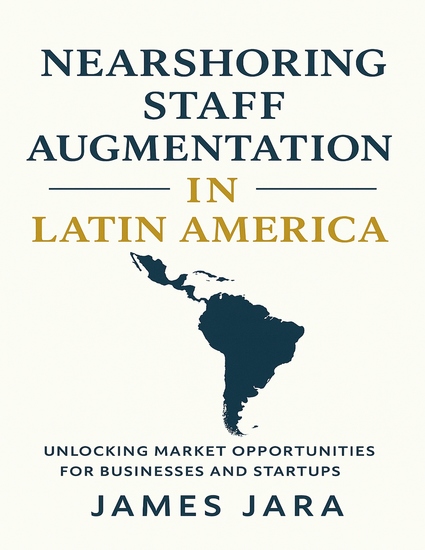
Nearshoring Staff Augmentation in Latin America - Unlocking Market Opportunities for Businesses and Startups - cover

Nearshoring Staff Augmentation in Latin America - Unlocking Market Opportunities for Businesses and Startups

James Jara

Casa editrice: JamesJara

  • 0
  • 0
  • 0

Sinossi

In today’s fast-paced business environment, companies are constantly seeking ways to innovate, scale efficiently, and reduce operational costs. One increasingly popular solution is nearshoring staff augmentation—particularly in Latin America. This ebook shows you exactly how to leverage this strategy for sustainable growth.
 
The global talent shortage and rising costs are forcing businesses to rethink how they build teams. Traditional hiring models are often too slow or expensive, especially in tech and digital industries. Nearshoring in LATAM offers a smarter alternative: access to skilled professionals in shared time zones, with strong cultural alignment and competitive rates.
 
Inside this guide, you’ll learn:
 
1. The key advantages of nearshoring vs. offshoring or local hiring
 
2. How to identify and engage top talent across LATAM countries
 
3. Legal, cultural, and operational considerations for success
 
4. How startups and enterprises are already scaling with LATAM talent
 
5. Future trends shaping the nearshoring landscape
 
This is a practical roadmap, not just theory. Whether you’re a startup founder, CTO, or business executive, this book equips you with the tools to build reliable, high-performing remote teams in Latin America.
 
By the end, you’ll understand not just why nearshoring works—but how to make it work for you. You’ll explore top LATAM markets like Mexico, Colombia, Argentina, and Brazil, and get actionable insights into recruiting, onboarding, managing remote teams, and navigating cross-border challenges.
 
Written by James Jara, a seasoned advisor in tech and staffing, this book distills years of hands-on experience helping businesses scale through nearshore talent. James shares proven strategies, real-world examples, and frameworks designed to help you move fast and grow smart.
 
Don’t let borders limit your potential. Start your nearshoring journey today—and unlock the advantages waiting just south of your business.
Disponibile da: 19/04/2025.
Lunghezza di stampa: 363 pagine.

Altri libri che potrebbero interessarti

  • One for All - How to Systemize Kindness Grow Your Network and Support Others Like It's Your Job - cover

    One for All - How to Systemize...

    Marc C. Shaffer

    • 0
    • 0
    • 0
    What if your greatest professional asset isn't your skills or experience but your willingness to help others succeed?In One for All, financial planning expert Marc C. Shaffer reveals the counterintuitive truth he's discovered throughout his career: the most successful people aren't those who focus on themselves but those who systematically support others.In a world increasingly focused on transactions, One for All offers a systematic approach to human connection. Drawing from his experience as a financial planner who puts people before profit, Shaffer presents a powerful five-step system that transforms networking from a necessary evil into a fulfilling practice of genuine service.Through practical exercises and real-world examples, he shows how intentional, repeatable acts of connection can create a virtuous cycle that enriches your career, expands your network, and builds a legacy rooted in impact.This book challenges readers to look beyond short-term gains and instead focus on creating the kind of world they want to be part of. Not by chance, but by design.Whether you're looking to grow your business, rebuild community ties, or simply live with more purpose, One for All provides a clear, actionable roadmap to success through service.
    Mostra libro
  • Behavioral AI - Unleash Decision Making with Data - cover

    Behavioral AI - Unleash Decision...

    Rogayeh Tabrizi

    • 0
    • 0
    • 0
    In Behavioral AI: Unleash Decision Making with Data, behavioral economist Dr. Rogayeh Tabrizi delivers an intuitive roadmap to help organizations disentangle the complexity of their data to create tangible and lasting value. The book explains how to balance the multiple disciplines that power AI and behavioral economics using a combination of the right questions and insightful problem solving. 


    You'll learn why intellectual diversity and combining subject matter experts in psychology, behavior, economics, physics, computer science, and engineering is essential to creating advanced AI solutions. You'll also discover how behavioral economics principles influence data models and governance architectures and make digital transformation processes more efficient and effective; discussions of the most important barriers to value in typical big data and AI projects and how to bring them down; and the most effective methodology to help shorten the long, wasteful process of "boiling the ocean of data." 


    An exciting and essential resource for managers, executives, board members, and other business leaders engaged or interested in harnessing the power of artificial intelligence and big data, Behavioral AI will also benefit data and machine learning professionals.
    Mostra libro
  • Peru - A Historical and Economic Exploration - cover

    Peru - A Historical and Economic...

    Anya Solace

    • 0
    • 0
    • 0
    Peru, a nation of remarkable diversity, is a land where history and economy intertwine to shape its identity. Situated on the western coast of South America, it is home to towering Andean peaks, vast coastal deserts, and the lush Amazon rainforest. These geographic variations have influenced its people, cultures, and economic activities for centuries. From ancient civilizations to modern industries, Peru’s journey has been one of resilience, adaptation, and transformation. Understanding its past and present is key to appreciating the forces that have shaped the country’s economic and social landscape.  
    The history of Peru is as rich and complex as its terrain. Long before Spanish colonization, the region was home to advanced societies that flourished through agriculture, trade, and engineering. The Inca Empire, with its vast network of roads and innovative agricultural terraces, stands as one of the greatest pre-Columbian civilizations in the Americas. However, the arrival of the Spanish in the 16th century marked a turning point. Colonization led to profound economic and political changes, as the Spanish exploited Peru’s vast silver mines and established a rigid social hierarchy. This period set the foundation for many of the economic structures that persisted for centuries.  
    Peru’s economic evolution has been shaped by both internal and external forces. Following independence in the 19th century, the country faced political instability and economic challenges, struggling to define its national identity. The exploitation of natural resources remained central to the economy, from guano and rubber in the 19th century to copper and gold in the modern era. Industrialization and foreign investment played key roles in Peru’s economic development, but these also led to periods of inequality and social unrest.
    Mostra libro
  • The Field Guide to Understanding 'Human Error' - cover

    The Field Guide to Understanding...

    Sidney Dekker

    • 0
    • 0
    • 0
    When faced with a ’human error’ problem, you may be tempted to ask 'Why didn’t these people watch out better?' Or, 'How can I get my people more engaged in safety?' You might think you can solve your safety problems by telling your people to be more careful, by reprimanding the miscreants, by issuing a new rule or procedure and demanding compliance. These are all expressions of 'The Bad Apple Theory' where you believe your system is basically safe if it were not for those few unreliable people in it. Building on its successful predecessors, the third edition of The Field Guide to Understanding ’Human Error’ will help you understand a new way of dealing with a perceived 'human error' problem in your organization. It will help you trace how your organization juggles inherent trade-offs between safety and other pressures and expectations, suggesting that you are not the custodian of an already safe system. It will encourage you to start looking more closely at the performance that others may still call 'human error', allowing you to discover how your people create safety through practice, at all levels of your organization, mostly successfully, under the pressure of resource constraints and multiple conflicting goals. The Field Guide to Understanding 'Human Error' will help you understand how to move beyond 'human error'; how to understand accidents; how to do better investigations; how to understand and improve your safety work. You will be invited to think creatively and differently about the safety issues you and your organization face. In each, you will find possibilities for a new language, for different concepts, and for new leverage points to influence your own thinking and practice, as well as that of your colleagues and organization. If you are faced with a ’human error’ problem, abandon the fallacy of a quick fix. Read this book.
    Mostra libro
  • Cooperative Governance - Principles and Practices for Effective Management - cover

    Cooperative Governance -...

    Leonardo Flach

    • 0
    • 0
    • 0
    Is your cooperative's democratic structure a source of strength or a roadblock to success? 
    For many cooperatives, the noble goal of member-led democracy can lead to real-world challenges: slow decision-making, conflicting priorities, and a persistent gap between values and performance. Cooperative Governance is the definitive, practical guide to transforming these challenges into your greatest strategic advantage. 
    This audiobook moves beyond abstract theory to deliver an actionable framework for effective management in a member-owned business. You will learn how to:Master the proven principles of balancing democratic participation with decisive leadership.Implement practical tools for strategic planning, clear financial oversight, and risk management.Build a culture of trust and alignment between your board, management, and members, eliminating friction.Develop robust policies that empower leaders and ensure long-term sustainability. 
    Whether you are a board member, a manager, or a founder dedicated to building a resilient and thriving cooperative, this audiobook is your essential playbook. Stop struggling with governance and start leading with confidence and clarity.
    Mostra libro
  • Don't Trust Your Gut - Using Data to Get What You Really Want in Life - cover

    Don't Trust Your Gut - Using...

    Seth Stephens-Davidowitz

    • 0
    • 0
    • 0
    Seth Stephens-Davidowitz is as good a data storyteller as I have ever met.” — Steven Levitt, co-author, Freakonomics 
    Big decisions are hard. We consult friends and family, make sense of confusing “expert” advice online, maybe we read a self-help book to guide us. In the end, we usually just do what feels right, pursuing high stakes self-improvement—such as who we marry, how to date, where to live, what makes us happy—based solely on what our gut instinct tells us. But what if our gut is wrong? Biased, unpredictable, and misinformed, our gut, it turns out, is not all that reliable. And data can prove this. 
    In Don’t Trust Your Gut, economist, former Google data scientist, and New York Times bestselling author Seth Stephens-Davidowitz reveals just how wrong we really are when it comes to improving our own lives. In the past decade, scholars have mined enormous datasets to find remarkable new approaches to life’s biggest self-help puzzles. Data from hundreds of thousands of dating profiles have revealed surprising successful strategies to get a date; data from hundreds of millions of tax records have uncovered the best places to raise children; data from millions of career trajectories have found previously unknown reasons why some rise to the top. 
    Telling fascinating, unexpected stories with these numbers and the latest big data research, Stephens-Davidowitz exposes that, while we often think we know how to better ourselves, the numbers disagree. Hard facts and figures consistently contradict our instincts and demonstrate self-help that actually works—whether it involves the best time in life to start a business or how happy it actually makes us to skip a friend’s birthday party for a night of Netflix on the couch. From the boring careers that produce the most wealth, to the old-school, data-backed relationship advice so well-worn it’s become a literal joke, he unearths the startling conclusions that the right data can teach us about who we are and what will make our lives better. 
    Lively, engrossing, and provocative, the end result opens up a new world of self-improvement made possible with massive troves of data. Packed with fresh, entertaining insights, Don’t Trust Your Gut redefines how to tackle our most consequential choices, one that hacks the market inefficiencies of life and leads us to make smarter decisions about how to improve our lives. Because in the end, the numbers don’t lie. 
    Supplemental enhancement PDF accompanies the audiobook.
    Mostra libro