¡Acompáñanos a viajar por el mundo de los libros!
Añadir este libro a la estantería
Grey
Escribe un nuevo comentario Default profile 50px
Grey
Suscríbete para leer el libro completo o lee las primeras páginas gratis.
All characters reduced
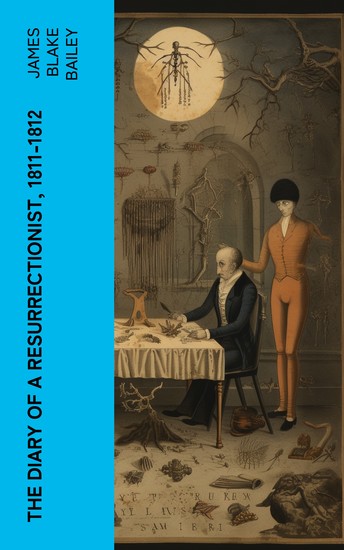
The Diary of a Resurrectionist 1811-1812 - To Which Are Added an Account of the Resurrection Men in London and a Short History of the Passing of the Anatomy Act - cover

The Diary of a Resurrectionist 1811-1812 - To Which Are Added an Account of the Resurrection Men in London and a Short History of the Passing of the Anatomy Act

James Blake Bailey

Editorial: e-artnow

  • 0
  • 0
  • 0

Sinopsis

This book delves into the history of resurrectionists and the reason why doctors need them. This is a fascinating subject and shows how doctors got into trouble. They needed to dissect the corpse so that their students could learn, but the gallows weren't providing enough, so they had to turn to the resurrectionists. For those who are interested in the resurrection, or even general history, this book is very worth reading.
Disponible desde: 27/11/2023.
Longitud de impresión: 534 páginas.

Otros libros que te pueden interesar

  • A Rare Recording of John E Brown - cover

    A Rare Recording of John E Brown

    John E. Brown

    • 0
    • 0
    • 0
    John E. Brown (April 2, 1879 – February 12, 1957) was a prominent Methodist evangelist, publisher, radio pioneer, and educator in the first half of the twentieth century. In 1919, he established John Brown University, one of Arkansas’ leading private universities to provide an interdenominational, Christian education for needy students. He was also the leading figure in securing passage of a law prohibiting the sale of alcohol in Benton County, a ban that continued into the twenty-first century.
    Ver libro
  • Empire of Rum - The Unofficial Economy of Early Australia - cover

    Empire of Rum - The Unofficial...

    Ylia Callan

    • 0
    • 0
    • 0
    This audiobook is narrated by an AI Voice.   
    Empire of Rum – The Unofficial Economy of Early Australia is a gripping journey through the colony’s most intoxicating secret: that rum, not coin, built Australia. 
    In the fledgling settlement of New South Wales, alcohol was more than a drink - it was money, power, and survival. From the notorious Rum Corps to the only successful military coup in Australian history, this audiobook brings to life the corruption, rebellion and everyday struggles that flowed through the barrels of rum. 
    But the story doesn’t stop in the past. Linking colonial rum trading to modern Australia, this powerful work shows how alcohol still fuels crime, family breakdown, and an overwhelmed justice system. 
    Part history, part social critique, Empire of Rum pulls no punches in exposing how alcohol became and remains a currency of control. 
    Perfect for listeners of Australian history, true crime, and social justice narratives.
    Ver libro
  • A Rare Recording of Sir Ernest Shackleton - cover

    A Rare Recording of Sir Ernest...

    Sir Ernest Shackleton

    • 0
    • 0
    • 0
    Sir Ernest Henry Shackleton (1874 - 1922) was a polar explorer who led three British expeditions to the Antarctic. 
    During the second expedition, from 1907 to 1909, he and three companions established a new record for the “farthest South latitude,” which was 97 miles from the South Pole and the closest in pole exploration history. Members of his team also climbed Mount Erebus, the most active volcano on Antarctica. For these achievements, Shackleton was knighted by King Edward VII on his return home. 
    A few years later, his ship - The Endurance - became trapped in pack ice and was slowly crushed. The crew escaped by camping on the sea ice, then launching their lifeboats to reach the inhabited island of South Georgia, a stormy ocean voyage of 720 nautical miles. It became Shackleton's most famous exploit. 
    A Listen & Live audio production.
    Ver libro
  • Southern Song Dynasty - Art Culture and Survival in a Fragmented China - cover

    Southern Song Dynasty - Art...

    Rolf Hedger

    • 0
    • 0
    • 0
    The Southern Song Dynasty emerged in 1127 after the fall of the Northern Song to the Jurchen-led Jin Dynasty. This period marked a time of resilience, adaptation, and cultural flourishing, despite ongoing threats from external forces. The dynasty’s establishment in the southern region of China reshaped political, economic, and artistic developments that would leave a lasting impact on Chinese history. 
    Following the invasion of the Jin forces, the Song court was forced to abandon its northern capital, Kaifeng. The remnants of the ruling family, led by Emperor Gaozong, retreated southward, eventually establishing a new capital in Lin’an (modern-day Hangzhou). This move signified not only a geographical shift but also a fundamental transformation in governance and strategy. Without control over the traditional heartland of Chinese civilization, the Southern Song had to develop new approaches to survival and stability. The dynasty focused on strengthening its bureaucracy, relying on a sophisticated civil service system that emphasized merit and Confucian ideals. Unlike the Northern Song, which had struggled with military weaknesses, the Southern Song sought to bolster its defenses by investing in naval power and fortifications along the Yangtze River. 
    The loss of northern territories meant that the Southern Song had to rely heavily on its southern provinces, which were rich in agricultural resources and well-positioned for trade. The economy shifted toward maritime commerce, with ports such as Quanzhou and Guangzhou becoming vital centers for international trade. Merchants expanded connections with Southeast Asia, India, and the Middle East, ensuring a steady flow of goods, wealth, and cultural exchanges. This economic shift allowed the Southern Song to sustain itself despite territorial losses and military pressures from the Jin and, later, the Mongols.
    Ver libro
  • Tattered Kimonos in Japan - Remaking Lives from Memories of World War II - cover

    Tattered Kimonos in Japan -...

    Robert Rand

    • 0
    • 0
    • 0
    Since John Hersey's Hiroshima, very few books have examined the meaning and impact of World War II through the eyes of Japanese men and women who survived that conflict. Tattered Kimonos in Japan does just that: It is an intimate journey into contemporary Japan from the perspective of the generation of Japanese soldiers and civilians who survived World War II, by a writer whose American father and Japanese father-in-law fought on opposite sides of the conflict. 


    Mindful of the power of victimhood, memory, and shared suffering, he travels across Japan, including Hiroshima and Nagasaki, meeting a compelling group of men and women whose lives, even now, are defined by the trauma of war, and by lingering questions of responsibility and repentance for Japan's wartime aggression. 


    The image of a tattered kimono from Hiroshima is the thread that drives the narrative arc of this emotional story about a writer's encounter with history, inside the Japan of his father's generation, on the other side of his father's war. This is a book about history with elements of family memoir. It offers a fresh and truly unique perspective for listeners interested in World War II, Japan, or Judaica; listeners seeking cross-cultural journeys; and listeners intrigued by Japanese culture, particularly the kimono.
    Ver libro
  • The Second British Empire - In the Crucible of the Twentieth Century - cover

    The Second British Empire - In...

    Timothy H Parsons

    • 0
    • 0
    • 0
    At its peak, the British Empire spanned the world and linked diverse populations in a vast network of exchange that spread people, wealth, commodities, cultures, and ideas around the globe. By the turn of the twentieth century, this empire, which made Britain one of the premier global superpowers, appeared invincible and eternal. This compelling book reveals, however, that it was actually remarkably fragile. Reconciling the humanitarian ideals of liberal British democracy with the inherent authoritarianism of imperial rule required the men and women who ran the empire to portray their non-Western subjects as backward and in need of the civilizing benefits of British rule. However, their lack of administrative manpower and financial resources meant that they had to recruit cooperative local allies to actually govern their colonies.   Timothy H. Parsons provides vivid detail of the experiences of subject peoples to explain how this became increasingly difficult and finally impossible after World War II as Afr
    Ver libro