Join us on a literary world trip!
Add this book to bookshelf
Grey
Write a new comment Default profile 50px
Grey
Subscribe to read the full book or read the first pages for free!
All characters reduced
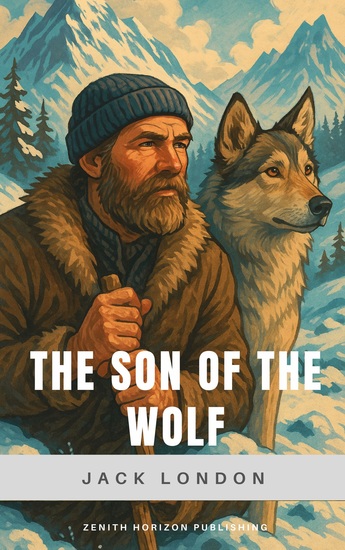
The son of the wolf - Jack London's Gritty Yukon Tales of Survival and Spirit - cover

The son of the wolf - Jack London's Gritty Yukon Tales of Survival and Spirit

Jack London, Zenith Horizon Publishing

Publisher: Zenith Horizon Publishing

  • 0
  • 0
  • 0

Summary

In the icy wilderness of the Yukon, only the strong endure.

The Son of the Wolf is Jack London's breakout debut—a vivid collection of frontier short stories inspired by his real-life adventures in the Klondike Gold Rush. These tales feature rugged men and women navigating the unforgiving wilds of the North, battling nature, isolation, and their own instincts in the quest for survival, gold, and meaning.

With raw storytelling and poetic force, London gives voice to the brutal beauty of the North, where man and beast walk the same thin line between life and death.

❄️ This edition includes:

The complete, unabridged 1900 collection

Evocative illustrations of Yukon life and frontier struggle

Clean Kindle formatting for seamless reading

📚 A must-read for fans of adventure, wilderness survival, and classic American literature.

Answer the call of the wild frontier—download the illustrated edition today.
Available since: 06/12/2025.
Print length: 169 pages.

Other books that might interest you

  • Children's Bedtime Stories - cover

    Children's Bedtime Stories

    Dorothy M. Mitchell

    • 0
    • 0
    • 0
    This audiobook is narrated by an AI Voice.   
     This is a collection of charming short stories to read to your children at bedtime including: 
    RED PAINT 
    A BIRD'S TAIL 
    MAGNOLIA COTTAGE 
    TO LEAD US HOME 
    About the author: 
    Dorothy Mitchell was born in a small village in Yorkshire just before the Second World War. She remembers they were hard times. 
    Dorothy now lives in Evesham in Worcestershire and she has written over a dozen children's stories and historical fiction novels.
    Show book
  • Old Faces: Yet More Tales from Tipperary - cover

    Old Faces: Yet More Tales from...

    Edward Forde Hickey

    • 0
    • 0
    • 0
    This book portrays a closely-knit group of people living in the north Tipperary hills during the early 20th century - a community largely made up of small farmers, whose lives were far different from today. The book's inspiration comes from writers such as Thomas Hardy and attempts to pass on to readers the lyrical and rich phrasings of Tipperary's old hill folk and capture the spiritual wealth of an age that remained unchanged for several centuries.  
    Tales of . . . brotherly love and hate, a rogue's return from across the sea and his efforts to reform, an unexpected first-love at the harvest-time dance-in-the-fields, persecution of two old saints at the hands of misguided youth, sports-day activities for adults and children alike following the arduous channelling of a new stream, two adventurous toddlers getting lost in the wilderness but saved by a witch, and more.  
    'Lovers of literature will find themselves engrossed in the lives of a past hillside community.'  Addison & Cole
    Show book
  • Still Talking - Stories - cover

    Still Talking - Stories

    Lore Segal

    • 0
    • 0
    • 0
    "For almost six decades Segal has quietly produced some of the best fiction and essays in American literature . . ." —The New York TimesThe eagerly awaited follow-up to Ladies' Lunch, beloved New Yorker writer Lore Segal's final story collection returns with further tales of the old friends who have loved and lunched together for over forty years."Segal writes with welcome clarity about life’s final years, and if her characters are not always as wise as they think they are, Segal eyes them all with the unsentimental wisdom of a life spent writing wondrous stories and essays, a career spent telling the truth." —SlateLore Segal is a master of the short story, and this collection shows her in peak form. Profound, dark, and often hilarious, Segal portrays her characters' foibles, eccentricities, and passions with great compassion and exactness, as they grapple with life, aging, and each other.Readers of Ladies Lunch will recognize the educated, urbane nonagenarian women who have been friends for a lifetime, as they tackle aging's affronts with wit, grace, and resourcefulness.With an Introduction by Vivian Gornick
    Show book
  • Manifest - cover

    Manifest

    Daniel M. Ross

    • 0
    • 0
    • 0
    DESTINY WAS CREATED EQUAL. 
    A worldwide energy race divides the nations of a war-ravaged globe by the greatest and the least. From the ruins of a forgotten empire, an under-qualified pair of adolescents set out to stake their claim upon Earth’s riches, convinced that destiny was created equal. 
    CINEMATIC READING™ Screenplay Edition. Buckle-up, for a film-like audio experience. 
    “A POWERFUL READ…HE CREATED A SOUND MASTERPIECE.” 
    —William Conrad, Author of Pushed to the Edge of Survival 
    Newsletter · Books · Shop · App · InfinitFoundation.org
    Show book
  • Too Early - cover

    Too Early

    Anton Chekhov

    • 0
    • 0
    • 0
    The story takes place in the village of Shalmovo, where two peasant sportsmen, Filimon Slyunka and Ignat Ryabov, are sitting in a pothouse turned restaurant. Slyunka is an old man who used to be a house-serf and now lives off his old wife's alms. Ryabov is a silent, sturdy peasant. Slyunka and Ryabov are trying to convince the innkeeper, Semyon Mitritch, to give them a gun that they had left as collateral. Semyon refuses, citing the Lenten season and the lack of game. Despite their pleas and promises to return the gun, Semyon remains firm in his decision. Slyunka and Ryabov leave the tavern and decide to go stand-shooting in the forest, hoping to find snipe. They walk to the forest, but find no snipe and decide to wait another five days before trying again. The story ends with the sportsmen walking home in silence. Overall, the story portrays a slice of rural life and explores themes of poverty, longing, and the connection between humans and nature.
    Show book
  • Dr Duthoit's Vision - From their pens to your ears genius in every story - cover

    Dr Duthoit's Vision - From their...

    Arthur Machen

    • 0
    • 0
    • 0
    Arthur Llewelyn Jones was born in Caerleon, Monmouthshire on the 3rd March 1863. 
    Machen came from a long line of clergymen, and when he was two, his father became vicar of a small parish about five miles north of Caerleon, and Machen was brought up at the rectory there. 
    In his early years he received an excellent classical education, but family poverty ruled out university, and he was sent to London to sit exams to attend medical school but failed the exams.  He did show literary promise with the publication of the poem ‘Eleusinia’ in 1821.  But life in London was difficult and it was only in 1884 that he published again and was taken on to translate several French works which thereafter became the standard editions for many years. 
    In 1887, his father died.  That same year he married Amelia Hogg, a maverick music teacher with a passion for the theatre.  He also began to receive legacies from Scottish relatives which allowed him to devote more time to writing. 
    After publishing in literary magazines in 1894 he published his first book ‘The Great God Pan’.  Its sexual and horrific content very much helped sales. 
    Over the next decade or so he wrote some of his best work but was unable to find a publisher mainly due to the collapse of the decadent market over Oscar Wilde’s scandalous trial. 
    In 1899, his wife died and during his long recovery he took up acting and travelled around the country as part of a travelling company.  Three years later he was publishing again and had remarried. 
    Re-publishing of earlier works helped anchor both his reputation and his income.  By the time the Great War opened Europe’s wounds he returned to the public eye with ‘The Bowmen’ helped by the publicity around the ‘Angel of Mons’ episode. 
    However, by the late 20’s new works had dried up and his back catalogue was no longer a source of regular income. 
    In 1932 he received a Civil List pension of ₤100 per annum but other work was not forthcoming.  His finances finally stabilised with a literary appeal in 1943 for his eightieth birthday and allowed him to live his remaining years in relative comfort. 
    Arthur Machen died on 15th December 1947 in Beaconsfield. He was 84.
    Show book