Unisciti a noi in un viaggio nel mondo dei libri!
Aggiungi questo libro allo scaffale
Grey
Scrivi un nuovo commento Default profile 50px
Grey
Iscriviti per leggere l'intero libro o leggi le prime pagine gratuitamente!
All characters reduced
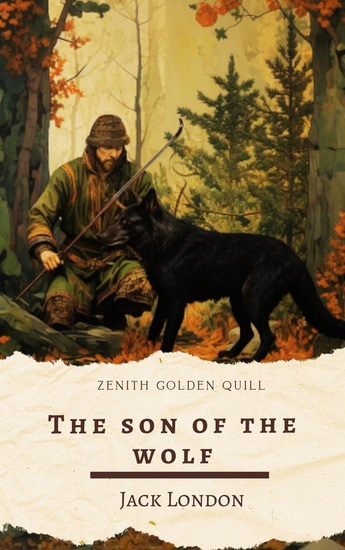
The son of the wolf - Grit Survival and the Spirit of the Frontier in London's First Masterwork - cover

The son of the wolf - Grit Survival and the Spirit of the Frontier in London's First Masterwork

Jack London, Zenith Golden Quill

Casa editrice: Zenith Golden Quill

  • 0
  • 0
  • 0

Sinossi

Where man is tested by ice, hunger, and instinct, legends are born.

The Son of the Wolf is Jack London's electrifying debut collection—nine unforgettable tales of adventure, survival, and moral conflict set in the harsh and beautiful Yukon wilderness during the Klondike Gold Rush.

These stories reflect London's personal experience in the Far North and showcase the raw intensity that would define his literary voice. From native encounters and icy battles to the fight between civilization and savagery, these tales shine with rugged realism and unrelenting tension.

With themes of power, primal instinct, and human endurance, The Son of the Wolf is more than an introduction to a great writer—it's an exploration of what it means to confront nature at its wildest.

"The beginning of London's lifelong saga of the North—stark, thrilling, unforgettable." — Literary Review
"Gripping frontier stories that blend violence, honor, and survival." — BookPage

Click Buy Now to experience Jack London's groundbreaking first collection in a beautifully formatted edition.
Disponibile da: 13/05/2025.
Lunghezza di stampa: 114 pagine.

Altri libri che potrebbero interessarti

  • Dream of Armageddon A (Unabridged) - cover

    Dream of Armageddon A (Unabridged)

    H. G. Wells

    • 0
    • 0
    • 0
    The story opens aboard a train, when an unwell-looking man strikes up a conversation with the narrator when he sees him reading a book about dreams. The white-faced man says that he has little time for dream analysis because, he says, his dreams are killing him.
    He goes on to tell how he has been experiencing consecutive dreams of an unspecified future time in which he is a major political figure who has given up his position to live with a younger woman on the island of Capri. The dreamer describes the island in detail, despite never having visited it, which impresses the narrator, who has actually been to Capri. The dreamer tells how his dream idyll comes to an end. While dancing, he is approached by an envoy from his own country who implores him to return and resume his old role before his successor brings about a war. However, this would mean leaving the woman he loves, and his dream self chooses love over duty. For three weeks of dreams, the solicitor is present at the collapse of the paradisical island of Capri and the future world, while war draws closer and flights of military aircraft are described flying overhead. Global war finally erupts, and his dream life ends in worldwide catastrophe and personal tragedy: the dreamer sees his love killed and experiences his own death. At the very end of the story the protagonist reveals that despite being killed in his dream, he nevertheless carried on dreaming even as his body was being ravaged by "great birds that fought and tore."
    Mostra libro
  • A Single Man - cover

    A Single Man

    Christopher Isherwood

    • 0
    • 0
    • 0
    George is heartbroken after the death of his lover, Jim.
    A professor of English in sunny, suburban California, George grieves in solitude, surrounded by easy-going, uncomprehending youth. Beneath his British restraint, waves of sorrow and anger surge. He doggedly persists with the routines of his past life, heading out to work, to the gym, on again to dinner. From his solitude springs defiance; he will triumph over loneliness and alienation, he will find love again, he will feel joy.
    Isherwood’s short, poignant novel, long recognized as a masterpiece, is a founding work of contemporary gay literature. Alex Jennings, in this celebrated performance, captures every nuance.
    Mostra libro
  • White Fang - cover

    White Fang

    Jack London

    • 0
    • 0
    • 0
    It was the she-wolf who had first caught the sound of men's voices and the whining of the sled-dogs; and it was the she-wolf who was first to spring away from the cornered man in his circle of dying flame. The pack had been loath to forego the kill it had hunted down, and it lingered for several minutes, making sure of the sounds, and then it, too, sprang away on the trail made by the she-wolf. Running at the forefront of the pack was a large grey wolf—one of its several leaders.    It was he who directed the pack's course on the heels of the she-wolf. It was he who snarled warningly at the younger members of the pack or slashed at them with his fangs when they ambitiously tried to pass him. And it was he who increased the pace when he sighted the she-wolf, now trotting slowly across the snow. She dropped in alongside by him, as though it were her appointed position, and took the pace of the pack. He did not snarl at her, nor show his teeth, when any leap of hers chanced to put her in advance of him.    On the contrary, he seemed kindly disposed toward her—too kindly to suit her, for he was prone to run near to her, and when he ran too near it was she who snarled and showed her teeth. Nor was she above slashing his shoulder sharply on occasion. At such times he betrayed no anger. He merely sprang to the side and ran stiffly ahead for several awkward leaps, in carriage and conduct resembling an abashed country swain. This was his one trouble in the running of the pack; but she had other troubles.    On her other side ran a gaunt old wolf, grizzled and marked with the scars of many battles. He ran always on her right side. The fact that he had but one eye, and that the left eye, might account for this. He, also, was addicted to crowding her, to veering toward her till his scarred muzzle touched her body, or shoulder, or neck. As with the running mate on the left, she repelled these attentions with her teeth; but when both bestowed their attentions at the same time she was roughly jostled, being compelled, with quick snaps to either side, to drive both lovers away and at the same time to maintain her forward leap with the pack and see the way of her feet before her.    At such times her running mates flashed their teeth and growled threateningly across at each other. They might have fought, but even wooing and its rivalry waited upon the more pressing hunger-need of the pack. After each repulse, when the old wolf sheered abruptly away from the sharp-toothed object of his desire, he shouldered against a young three-year-old that ran on his blind right side. This young wolf had attained his full size; and, considering the weak and famished condition of the pack, he possessed more than the average vigour and spirit. Nevertheless, he ran with his head even with the shoulder of his one-eyed elder. When he ventured to run abreast of the older wolf (which was seldom), a snarl and a snap sent him back even with the shoulder again.    Sometimes, however, he dropped cautiously and slowly behind and edged in between the old leader and the she-wolf. This was doubly resented, even triply resented. When she snarled her displeasure, the old leader would whirl on the three-year-old. Sometimes she whirled with him. And sometimes the young leader on the left whirled, too. At such times, confronted by three sets of savage teeth, the young wolf stopped precipitately, throwing himself back on his haunches, with fore-legs stiff, mouth menacing, and mane bristling. This confusion in the front of the moving pack always caused confusion in the rear. The wolves behind collided with the young wolf and expressed their displeasure by administering sharp nips on his hind-legs and flanks. He was laying up trouble for himself, for lack of food and short tempers went together; but with the boundless faith of youth he persisted in repeating the manoeuvre every little while, though it never succeeded in gaining anything for him but discomfiture.
    Mostra libro
  • A Lesson on a Tortoise - From their pens to your ears genius in every story - cover

    A Lesson on a Tortoise - From...

    D H Lawrence

    • 0
    • 0
    • 0
    David Herbert Lawrence was born on the 11th September 1885 in Eastwood, Nottinghamshire, a coal mining town where the reality of a harsh life was only useful as experiences for future literary works. 
    He was educated at Beauvale Board School and became the first local boy to receive a scholarship to attend Nottingham High School. After 3 years he became a junior clerk in Haywood’s surgical appliances factory. He was also attempting a literary career which, in the short term, led to a teacher training position in Eastwood and later a teaching qualification from University College, Nottingham.  
    Lawrence’s first efforts were poems, short stories and a draft of ‘The White Peacock’. Moving to London and a teaching position in Croydon his writing attracted the attention of Ford Madox Ford, editor of The English Review, and he commissioned him to write ‘Odour of Chrysanthemums’.  
    Wanting to write full-time he now began work on what would become ‘Sons and Lovers.   
    In 1912 he met the older and married mother-of-three Frieda Weekley. They eloped to Germany and here Lawrence could see for himself the growing tensions with France.  So keen was his interest that he was arrested and accused of being a British spy.  
    In early 1914 Frieda obtained her divorce and they returned to Britain to be married just days before the outbreak of war. Owing to her German parentage, and his own public dislike of militarism and violence, the couple were treated with contempt and suspicion throughout the war years.  
    Despite this he continued to write but his reputation in England was so tarnished and, mirrored by his own disdain for the country, he and Frieda left England in November 1919, first for Europe and then America via Ceylon and Australia. 
    They bought a ranch in Taos, New Mexico and visited Mexico several times. The third visit in March 1925 caused a near fatal attack of malaria. To convalesce they moved to Florence. Here he continued work on ‘Lady Chatterley’s Lover’ which for many years would cause controversy. A renewed interest in oil painting resulted in an exhibition in 1929 which was raided by the police and several works were confiscated.  
    D H Lawrence died of complications arising from a bout of tuberculosis on the 2nd of March 1930 in Vence, France.  He was 44.
    Mostra libro
  • Andaz-e-Bayaan - Beloved Urdu classics brought to life by the inimitable Zia Mohyeddin - cover

    Andaz-e-Bayaan - Beloved Urdu...

    Ismat Chughtai, Munshi...

    • 0
    • 0
    • 0
    This audio compilation has been made with love for anyone wanting to immerse themselves in the world of Urdu stories but may find it difficult to read the script. 
    Featured authors include legends like Ismat Chughtai of the ‘Taraqqii Pasand Tehreek’ (Progressive Writer’s Movement), one of the first Muslim women to write boldly about subjects such as sexuality in the 1940’s; Munshi Premchand, a Hindu writer born in 1880, who was a pioneering figure in both Hindi and Urdu short fiction and wrote on topics such as caste, which were marked by sociopolitical and religious sensitivities; Sa’adat Hassan Manto, who belonged to both Bombay & Lahore and wrote about the partition that resulted in the nations of India and Pakistan, known for stories that showed a mirror to society regardless of the discomfort caused by stark reflections; Rajinder Singh Bedi, a versatile short fiction, novel, and film writer who also amplified the social issues of rurality as they dovetailed with national and metropolitan life; Ghulam Abbas, a novelist and short fiction writer interested in bringing to light the many ironies of modernity; Noon Meem (“NM”) Rashid, a groundbreaking modernist poet who wrote primarily in free verse, exploring contrasting relationships such as those between language & meaning and self & society; Asad Muhammad Khan, whose short fiction weaves his rich life experiences into commentaries on topics such as family life and class relations; and Intizar Hussain, who was arguably the most significant Urdu literary prose writer of the contemporary era, painting epics of migration and nostalgia on an intergenerational canvas. 
    Our narrator, Mr. Zia Mohyeddin, perhaps more than any other single figure in modern times, has shaped an appreciation for Urdu literature by making it accessible in masterfully emotive and lucid audio performances to generations of listeners who may have otherwise remained deprived of such learning and aesthetic pleasure.
    Mostra libro
  • Battle of Frogs and Mice - cover

    Battle of Frogs and Mice

    Homer Homer

    • 0
    • 0
    • 0
    The Batrachomyomachia or Battle of the Frogs and Mice is a comic epic commonly attributed to Homer. 
    The Mouse-Prince stops by the shore of a lake to drink, and encounters the Frog King. The Frog offers to show the Mouse his kingdom, on the other side of the lake, and the Mouse agrees. The Prince climbs onto the Frog King's back. In the middle of the lake, they are confronted by a water snake. The Frog dives, forgetting about the Mouse, who cannot swim, and the Prince drowns. 
    On the bank, another Mouse witnesses the scene, and informs the other Mice, who arm themselves for battle. A battle ensues, and the Mice prevail.
    Mostra libro